
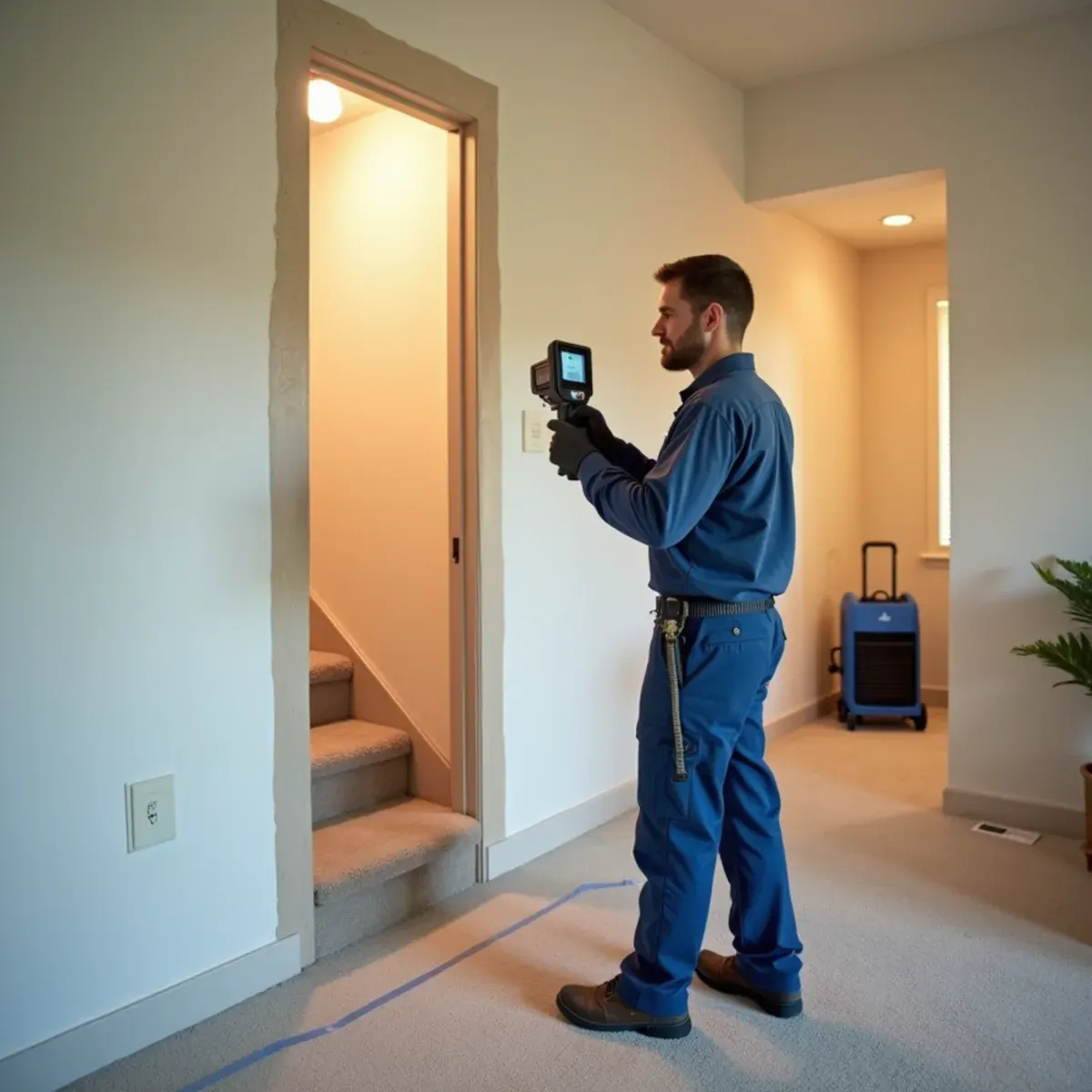
Some of the better news we deliver in Fountain Valley is that there is no leak. This city is dead flat and sits on what the old maps called Gospel Swamp, with the shallowest water table in Orange County underneath it. Slabs release vapor here as a routine background condition, and that vapor collects at the base of walls, behind baseboards, under vinyl plank. To a homeowner and to a meter it looks exactly like a plumbing failure. Before we mark a cut line we separate a real loss from ordinary slab emission, because one of those needs a saw and the other does not.
When it is a real loss, that same ground condition shapes the rebuild. New board set tight against a damp slab wicks moisture straight back up, so we hold the bottom edge up off the concrete behind the baseboard and let the cavity breathe. In the flat sixties and seventies tracts around Mile Square Park, where nearly every house is the same slab-on-grade layout, the flooring failures we get called to are usually the symptom of a slab nobody ever tested rather than the leak everyone assumed. We test the slab and put the number in the report.
What Fountain Valley Changes About Drywall Repair
1Slab vapor mimics a plumbing leak
The water table under this city is the shallowest in the county, so slabs emit vapor continuously. It shows up as damp baseboards, cupped plank edges and a musty smell at floor level with no drip anywhere. We run a calcium chloride or relative humidity test on the slab and compare wall readings against an unaffected room before recommending demolition to anyone.
2New board held off the concrete
Paper-faced gypsum sitting directly on a damp Fountain Valley slab will wick, and the repair fails from the bottom edge up within a season. When we hang new board after a flood cut we leave a small gap at the slab, hidden behind the baseboard, so the wall can breathe. It is a detail that costs nothing and it is why our repairs here stay dry.
3Test the slab before flooring goes back
Most of the flooring failures we see in the tracts around Mile Square Park trace to material installed over a slab that was never tested. If we are repairing the wall base after a loss, that is the right moment to get a number on the slab. It either clears the way for the flooring you want or tells you which underlayment the situation actually requires.
How the Work Runs
The method is the same one we use on every drywall repair job, documented to the IICRC S500:2025 standard. Here it is in short — the full drywall water damage repair process explains each stage in detail.
- Meter the wall first
- Decide dry-in-place or remove
- Open the cavity, not the wall
- Cut to a stud and a seam line
- Clear the cavity and dry the framing
- Tape, texture, prime, paint
The Fountain Valley Background Worth Knowing
Groundwater beneath Fountain Valley sits close enough to the surface that moisture vapor migration up through concrete slabs is a routine background condition rather than an anomaly. Homeowners here regularly describe a slab that feels cool and damp, or a closet on an exterior wall that never quite feels dry, without any leak at all.
There is more on the housing stock, drainage and plumbing history of this city on our water damage restoration in Fountain Valley page.
Fountain Valley at a glance
- Dominant construction era
- 1960–1980
- Foundation type
- slab on grade
- Supply piping found here
- under-slab copper
- Drain line materials
- cast iron
- Terrain and water table
- flat, shallow water table
- Most common local failure
- slab vapor emission mistaken for a leak, and flooring failures caused by installing over an untested slab
- Highest-value local prevention
- clearing the yard and area drains before the season, because a blocked drain on dead-flat ground ponds water against the house
What It Costs in Fountain Valley
We do not quote a number over the phone before seeing the property — anyone who does is guessing. The variables that actually move the price on a drywall repair job are how much board comes out, cut height and seam count, texture type and match difficulty, and they are broken down in full on the drywall water damage repair page. The assessment and the written estimate are free anywhere in Fountain Valley, day or night, with no obligation.
Drywall Repair Questions from Fountain Valley Homeowners
That pattern is common on this ground. Fountain Valley sits on former wetland with a very shallow water table, so the slab releases moisture vapor all year and more of it in the wet months. It collects at the wall base where the board meets the concrete. Testing the slab settles it in a day. If it is vapor, the fix is a proper base detail, ventilation and the right floor covering, not opening walls and replacing gypsum that will only get damp again.
No, and that assumption is why a lot of walls come out that did not need to. Gypsum board that got clean water, still reads firm under thumb pressure, and is coming down in moisture content day over day can usually be dried in place through the cavity. What forces removal is contaminated water, a core that has softened or swelled, visible growth on the paper, or insulation behind it that holds moisture against the board. We take readings before we answer that question.
Usually two feet or four feet above the floor, measured level across the whole run rather than following the stain. Board comes in four-foot widths, so a cut at either height lands the new seam where a factory edge would sit, which is far easier to hide than a seam floating mid-wall. The cut also has to end at the center of a stud on each side, so the patch has something to fasten to. Cutting to the shape of the damage looks thrifty and finishes badly.
The city sits on former wetland with one of the shallowest water tables in Orange County, so moisture vapor migrating up through slabs is a normal background condition here rather than a defect. It matters most when installing flooring over the slab, which is why we test with in-situ RH probes before anything goes back down.