
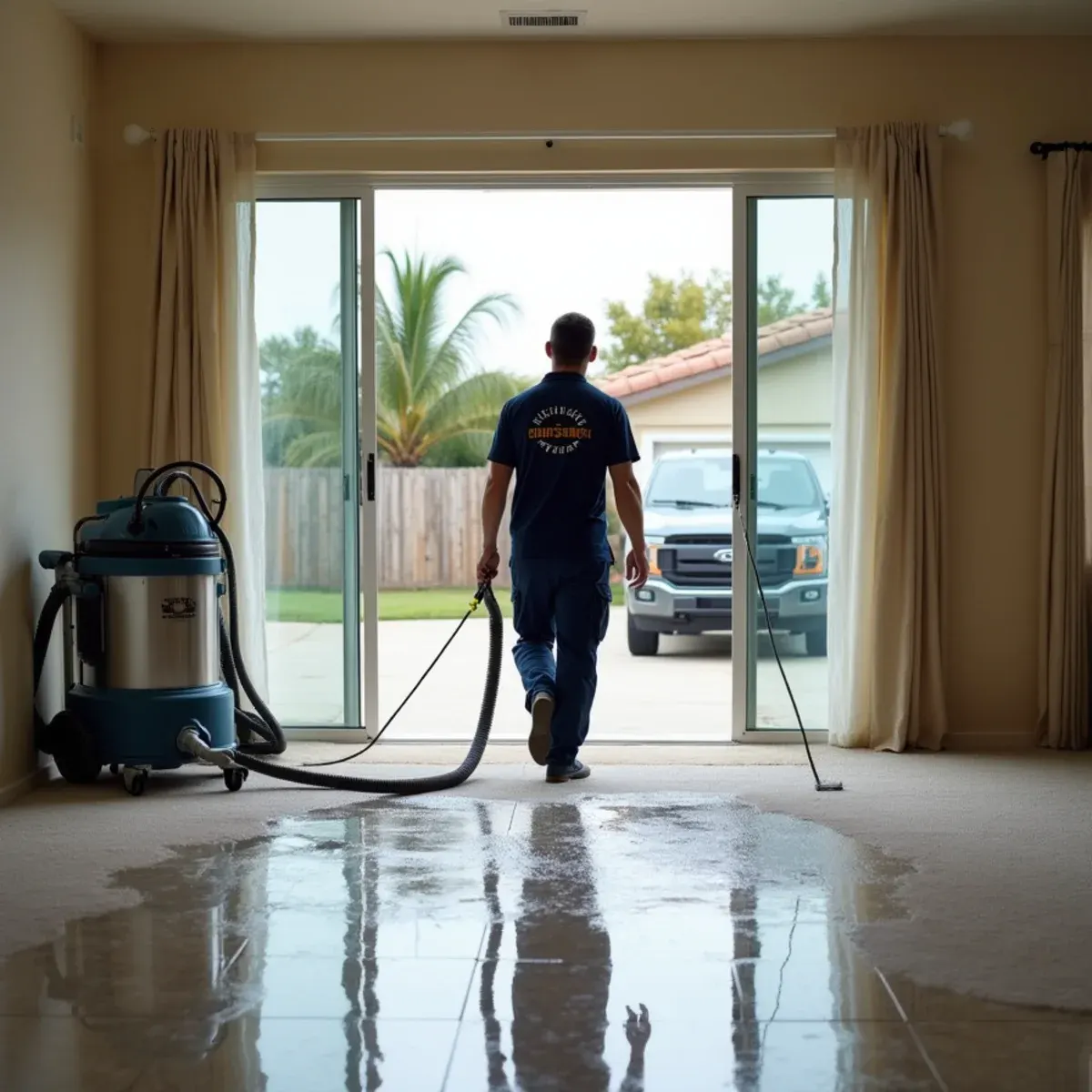
Before we extract anything in Fountain Valley, we want to know whether there's actually a leak. This city was built on drained wetland — Gospel Swamp on the old maps — and it sits over one of the shallowest water tables in Orange County. Slab vapor emission is a normal background condition here, not an anomaly. We've been to plenty of Fountain Valley homes where a damp patch under vinyl plank was the slab breathing rather than a supply line, and pulling out the floor would have fixed nothing at all.
When it is a genuine loss, the dead-flat ground works against you twice. Water on a slab in a 1970s tract off Brookhurst spreads wide and shallow across a large footprint instead of collecting somewhere convenient, so weighted extraction has to cover the entire affected area rather than a puddle. And outside there's no fall to carry discharge away — we have to pump it somewhere deliberate. Blocked yard and area drains near Mile Square Park are a routine reason water ends up standing against a foundation in the first place.
What Fountain Valley Changes About Water Extraction
1Test the slab before tearing out
A wet spot with no plumbing above it deserves a moisture map and, where it matters, in-situ relative humidity testing in the slab before anyone opens a floor. In this city the answer is often vapor emission, which is a flooring-system problem rather than an extraction problem. We'd rather spend an hour proving that than bill you for removing a floor that was never leaking.
2Flat ground spreads water thin and wide
With no grade anywhere in the plan, water from a slab leak travels under flooring in every direction at once and can involve four rooms while never being more than a film deep. Thin water is easy to miss and just as damaging to a pad. We meter well past the visible edge and run weighted extraction across the whole mapped area, not only where the floor looks dark.
3Discharge has nowhere to run downhill
On dead-flat lots there's no natural fall to send extracted water toward, and dumping it beside the house just puts it back against your foundation or your neighbor's. We plan discharge to an approved point and keep it moving away from the structure. The same physics is why clearing your yard and area drains before the rainy season matters more here than in cities with real slope.
How the Work Runs
The method is the same one we use on every water extraction job, documented to the IICRC S500:2025 standard. Here it is in short — the full water extraction & removal process explains each stage in detail.
- Bulk removal with submersible pumps
- Truck-mounted extraction on carpet and pad
- Hard-surface and specialty extraction
- Cavity and void extraction
- Removing what cannot be saved
- Post-extraction moisture reading
The Fountain Valley Background Worth Knowing
Groundwater beneath Fountain Valley sits close enough to the surface that moisture vapor migration up through concrete slabs is a routine background condition rather than an anomaly. Homeowners here regularly describe a slab that feels cool and damp, or a closet on an exterior wall that never quite feels dry, without any leak at all.
There is more on the housing stock, drainage and plumbing history of this city on our water damage restoration in Fountain Valley page.
Fountain Valley at a glance
- Dominant construction era
- 1960–1980
- Foundation type
- slab on grade
- Supply piping found here
- under-slab copper
- Drain line materials
- cast iron
- Terrain and water table
- flat, shallow water table
- Most common local failure
- slab vapor emission mistaken for a leak, and flooring failures caused by installing over an untested slab
- Highest-value local prevention
- clearing the yard and area drains before the season, because a blocked drain on dead-flat ground ponds water against the house
What It Costs in Fountain Valley
We do not quote a number over the phone before seeing the property — anyone who does is guessing. The variables that actually move the price on a water extraction job are volume and depth of water, flooring type, contamination level, and they are broken down in full on the water extraction & removal page. The assessment and the written estimate are free anywhere in Fountain Valley, day or night, with no obligation.
Water Extraction Questions from Fountain Valley Homeowners
Start with the test. In Fountain Valley, moisture appearing with no plumbing nearby is frequently slab vapor emission rather than a leak, and extraction won't change it. We map the moisture, check for a pressurized-line signature, and where the pattern suggests vapor we recommend in-situ RH testing in the concrete. If it turns out to be a leak, we extract the same day. If it's vapor, the fix is a flooring and vapor-barrier decision, not a restoration job.
For a typical single-room residential loss, extraction runs one to three hours. Multi-room losses or Category 3 water can take most of a day because of containment setup and material removal. We will give you a realistic timeframe after the walkthrough, before we start.
Often we can save the carpet and only replace the pad, which is the cheaper and less disruptive path. The deciding factors are water category, how long it sat, and whether the pad is a moisture barrier type. Clean water caught quickly usually means the carpet stays.
The city sits on former wetland with one of the shallowest water tables in Orange County, so moisture vapor migrating up through slabs is a normal background condition here rather than a defect. It matters most when installing flooring over the slab, which is why we test with in-situ RH probes before anything goes back down.