
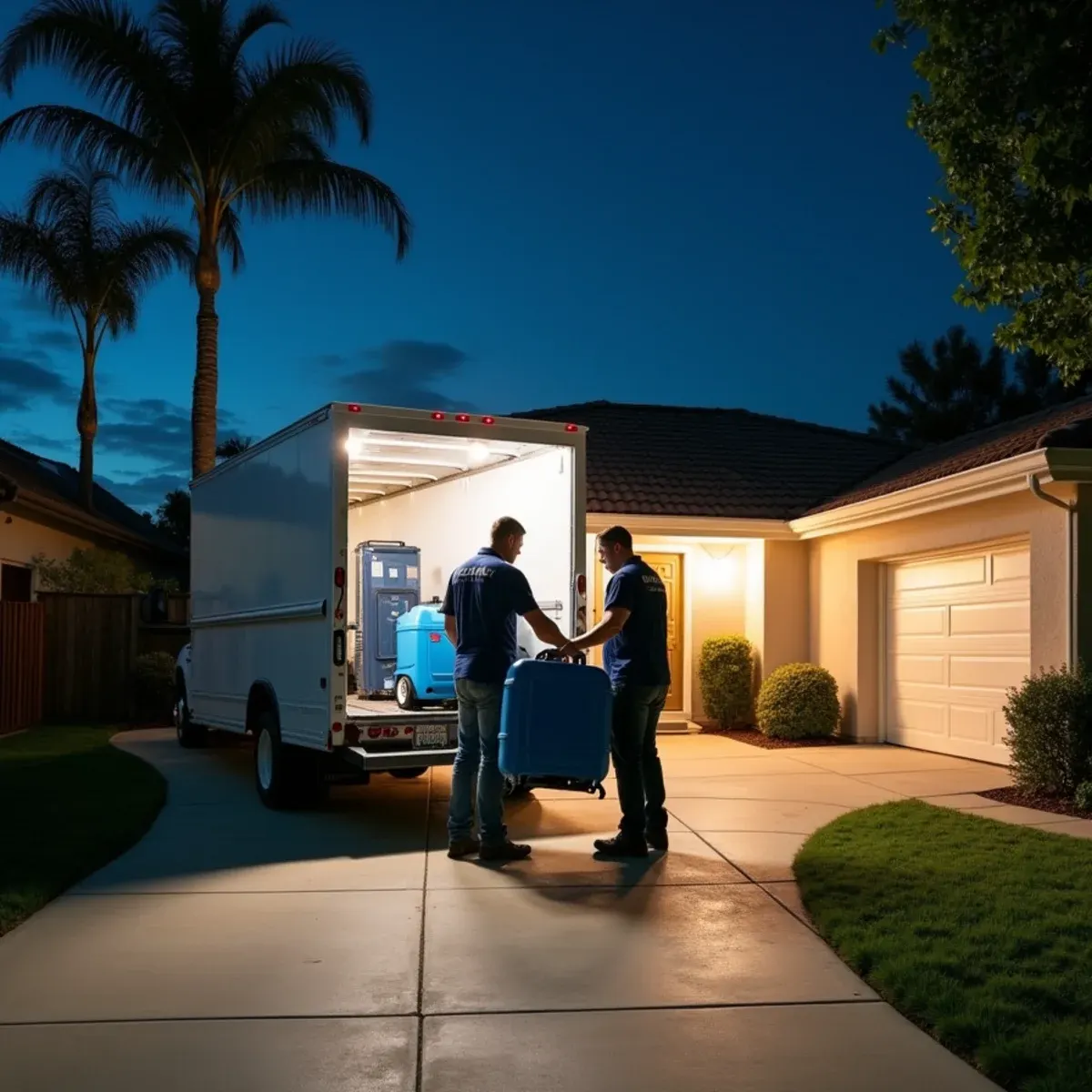
Before the tracts went in, most of this city was Gospel Swamp: wetland drained and filled so houses could be built on it through the 1960s and 70s. The water table underneath is among the shallowest in Orange County, which is where the name Fountain Valley comes from and why slabs here behave differently from slabs in La Palma or Cerritos. Concrete over ground like that moves vapor upward continuously. A meter reading on a Fountain Valley floor needs context before it means very much.
The other consequence is grade. This is the flattest ground we work on, so storm water doesn't run off, it sits. A yard drain packed with three seasons of leaves under a mature ficus turns into a shallow pond against the stucco within an hour of steady rain, and stucco standing in water will wick. Every fall, the highest-value thing a homeowner here can do costs nothing at all: pull the grates, clear the drains, and confirm the line still flows before the first storm.
What Fountain Valley Changes About Emergency Restoration
1Vapor is the baseline, not the emergency
A slab over a high water table reads damp year-round. We establish what normal looks like on your floor by metering unaffected areas of the same slab, then judge the wet area against that instead of a textbook number. IICRC S500 asks for a dry standard drawn from the building itself, and in Fountain Valley that distinction is most of the diagnosis.
2Blocked drains pond on flat ground
With no slope to help, a single clogged area drain holds water against the foundation instead of shedding it. We've traced more than one interior wet baseline here to a drain nobody had opened since they bought the house. Clear them before the first storm, run a hose to confirm flow, and watch where water actually stands during the first real rain.
3Flooring failures from an untested slab
New floors go down over Fountain Valley slabs every week with no in-situ moisture test, and a share of them cup, bubble or delaminate within two years. After a loss we hold the slab to the flooring manufacturer's moisture limit before anything is installed, and we put that in writing. It's a slower finish and a floor that stays down.
How the Work Runs
The method is the same one we use on every emergency restoration job, documented to the IICRC S500:2025 standard. Here it is in short — the full emergency water damage restoration process explains each stage in detail.
- Call answered and crew dispatched
- Arrival, safety check, and moisture mapping
- Documentation before anything is touched
- Extraction
- Controlled structural drying
- Cleaning, sanitizing, and final verification
The Fountain Valley Background Worth Knowing
Groundwater beneath Fountain Valley sits close enough to the surface that moisture vapor migration up through concrete slabs is a routine background condition rather than an anomaly. Homeowners here regularly describe a slab that feels cool and damp, or a closet on an exterior wall that never quite feels dry, without any leak at all.
There is more on the housing stock, drainage and plumbing history of this city on our water damage restoration in Fountain Valley page.
Fountain Valley at a glance
- Dominant construction era
- 1960–1980
- Foundation type
- slab on grade
- Supply piping found here
- under-slab copper
- Drain line materials
- cast iron
- Terrain and water table
- flat, shallow water table
- Most common local failure
- slab vapor emission mistaken for a leak, and flooring failures caused by installing over an untested slab
- Highest-value local prevention
- clearing the yard and area drains before the season, because a blocked drain on dead-flat ground ponds water against the house
What It Costs in Fountain Valley
We do not quote a number over the phone before seeing the property — anyone who does is guessing. The variables that actually move the price on a emergency restoration job are water category, affected square footage and number of rooms, how many days of equipment, and they are broken down in full on the emergency water damage restoration page. The assessment and the written estimate are free anywhere in Fountain Valley, day or night, with no obligation.
Emergency Restoration Questions from Fountain Valley Homeowners
There are two likely explanations and they need telling apart. Either something is still leaking, or you're seeing vapor emission through a slab sitting over very shallow groundwater, which worsens in winter and after heavy rain. We check with a moisture map across the whole floor rather than the one spot, plus in-situ probes if needed. Repeated wetting in the same footprint means a leak. Diffuse damp that shifts with the weather is the slab doing what slabs here do.
We commit to being on-site within 60 minutes of a confirmed emergency call anywhere in Cypress, and we credit $100 off your invoice if we miss it. Most of the time we are there in 30 to 45 minutes because our trucks stage on Katella Avenue, right here in the city.
No. The emergency assessment and written estimate are free, 24 hours a day. You are not obligated to hire us after we walk the property, and we will tell you plainly if we think the damage is small enough to handle yourself.
The city sits on former wetland with one of the shallowest water tables in Orange County, so moisture vapor migrating up through slabs is a normal background condition here rather than a defect. It matters most when installing flooring over the slab, which is why we test with in-situ RH probes before anything goes back down.