
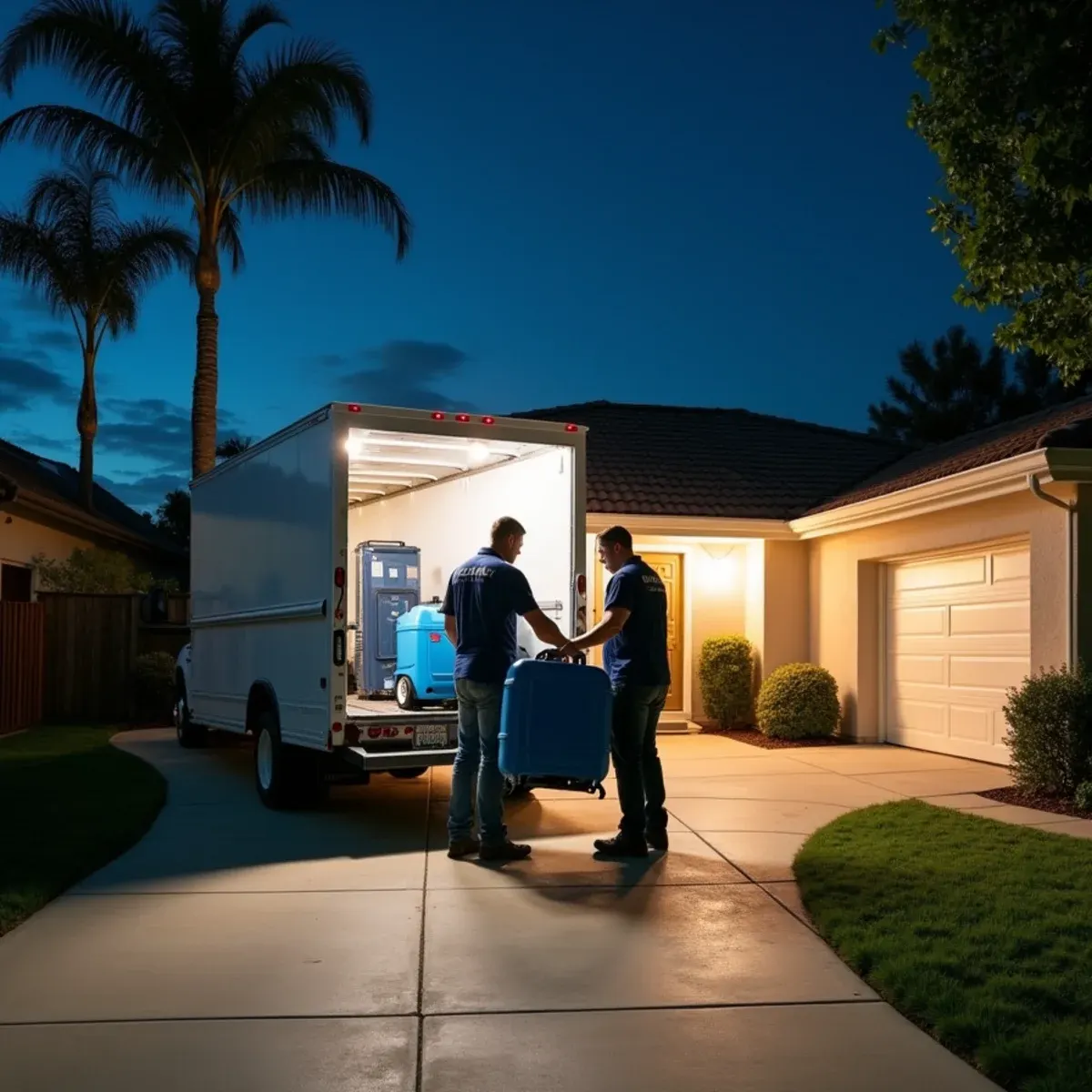
Storms come off the water here with wind behind them, and wind-driven rain finds every sealant the salt air has already been working on. That's the difference between a Huntington Beach storm call and an inland one: the failure usually isn't the roof, it's a window flashing, a door threshold or a stucco joint whose caulking gave up two seasons early because it lives in salt spray. Water enters high, runs down inside the wall, and appears on the floor across the room from where it got in.
Then there's the Harbour. Canal-front homes sit over groundwater that moves with the tide, so a damp garage slab out there can be a genuine condition of the site rather than a plumbing failure, and it needs to be identified as one before anyone writes a scope. Downtown near Main Street and Pacific City the constraint is physical: narrow lots, no driveway, street parking only. We plan hose runs and staging before we arrive, because a truck-mount two hundred feet from your living room is an ordinary day here.
What Huntington Beach Changes About Emergency Restoration
1Salt shortens every sealant's life
Caulk, flashing, fasteners and threshold seals near the coast fail years before the manufacturer's schedule says they should. After a storm intrusion we look at the exterior envelope, not just the wet drywall, because drying a wall that will take on water again in the next system wastes your claim. Renewing exterior sealant here runs on a much shorter cycle than inland guidance suggests.
2Tidal groundwater under Harbour slabs
Canal-front and waterfront properties sit close to a water table that rises and falls with the tide. Persistent damp at a garage slab edge or the base of a lower wall can track that cycle rather than any pipe. We check readings against tide timing and against unaffected areas before calling it a leak, since the fix for one looks nothing like the fix for the other.
3Narrow downtown lots, long hose runs
Between Main Street and the pier, lots are deep and thin, driveways are rare, and the truck can end up a block away. That's manageable when it's planned: extra hose, staged equipment, power sorted in advance. It's a two-hour delay when it isn't. Tell us the parking situation when you call and we'll bring the right setup the first time.
How the Work Runs
The method is the same one we use on every emergency restoration job, documented to the IICRC S500:2025 standard. Here it is in short — the full emergency water damage restoration process explains each stage in detail.
- Call answered and crew dispatched
- Arrival, safety check, and moisture mapping
- Documentation before anything is touched
- Extraction
- Controlled structural drying
- Cleaning, sanitizing, and final verification
The Huntington Beach Background Worth Knowing
Salt does not damage buildings directly. It damages the details that keep water out, and then water does the rest.
There is more on the housing stock, drainage and plumbing history of this city on our water damage restoration in Huntington Beach page.
Huntington Beach at a glance
- Dominant construction era
- 1960–1990
- Foundation type
- slab on grade
- Supply piping found here
- under-slab copper
- Drain line materials
- cast iron, ABS
- Terrain and water table
- coastal-flat, shallow water table
- Most common local failure
- wind-driven rain entering through salt-corroded window flashing and failed exterior sealant
- Highest-value local prevention
- renewing exterior caulking and flashing on a far shorter cycle than inland guidance suggests
What It Costs in Huntington Beach
We do not quote a number over the phone before seeing the property — anyone who does is guessing. The variables that actually move the price on a emergency restoration job are water category, affected square footage and number of rooms, how many days of equipment, and they are broken down in full on the emergency water damage restoration page. The assessment and the written estimate are free anywhere in Huntington Beach, day or night, with no obligation.
Emergency Restoration Questions from Huntington Beach Homeowners
That pattern usually tracks groundwater rather than plumbing. Harbour lots sit over a water table that moves with the tide, and a slab edge close to it can take on moisture through capillary action, especially in winter. We confirm it by taking readings at different tide stages and comparing them against the interior slab. If it follows the tide, the answer is a vapor and drainage strategy, not drying equipment and not a claim.
We commit to being on-site within 60 minutes of a confirmed emergency call anywhere in Cypress, and we credit $100 off your invoice if we miss it. Most of the time we are there in 30 to 45 minutes because our trucks stage on Katella Avenue, right here in the city.
No. The emergency assessment and written estimate are free, 24 hours a day. You are not obligated to hire us after we walk the property, and we will tell you plainly if we think the damage is small enough to handle yourself.
Ambient humidity near the coast stays high enough for long enough that materials dry slowly on their own, which widens the window in which growth can establish after any moisture event. Combined with salt-accelerated failures of exterior sealants and flashings, coastal homes simply get more moisture intrusion and dry from it more slowly.