
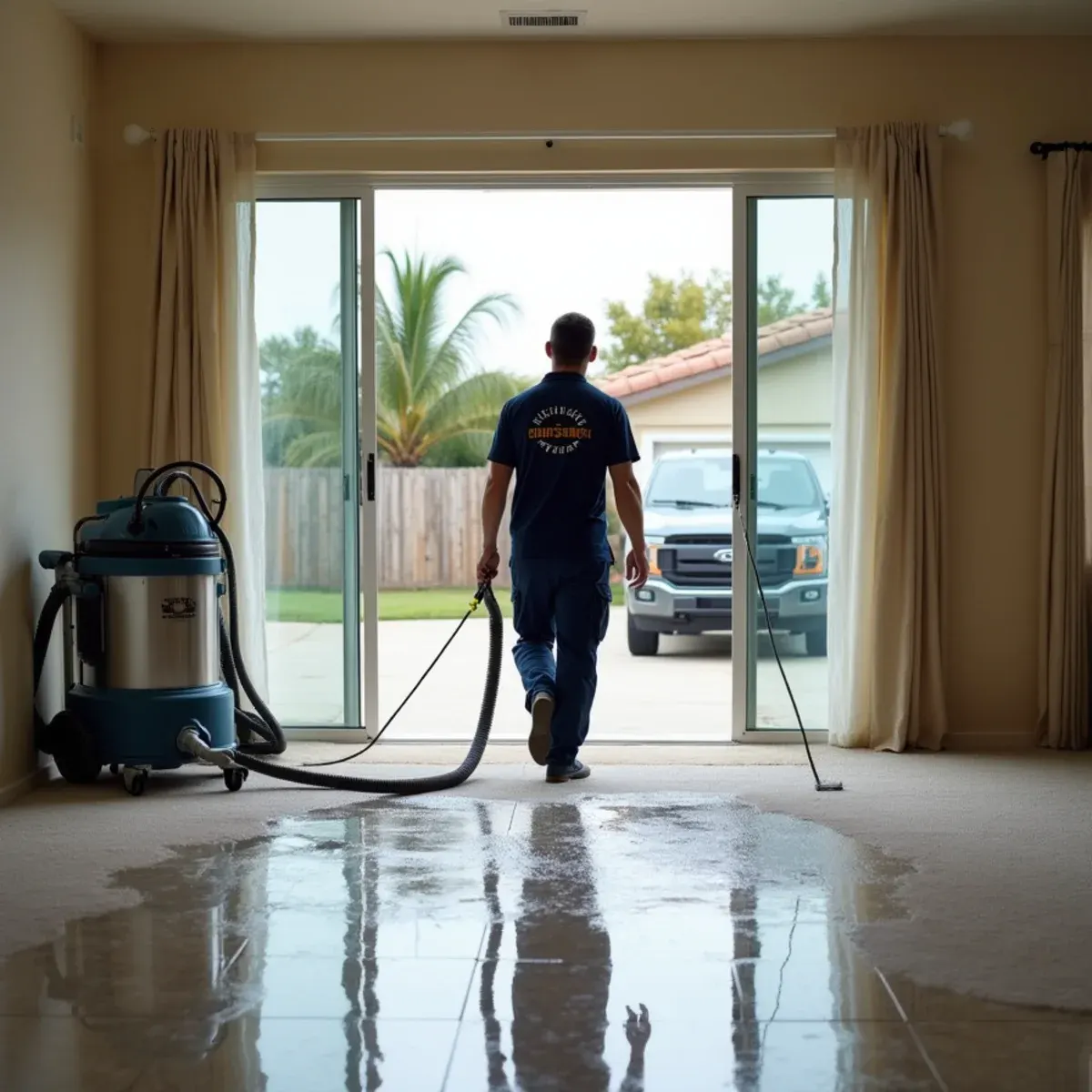
Park on Main Street on a Saturday and you'll understand one of the real constraints of extraction work down here. Downtown Huntington Beach lots are narrow, most have no driveway, and the truck can end up half a block from your front door. That's solvable — we carry long hose lays and plan the route before we roll — but it costs time, and time is the entire game when there's standing water on a floor. Tell us the address and the parking situation when you call and we'll load for it.
The coastal exposure shapes the rest. Salt chews through exterior sealant, window flashing and fasteners far faster here than inland, so a real share of our calls are wind-driven rain coming in through failed flashing rather than a plumbing break. Out in Huntington Harbour the groundwater is tidal, which means a wet lower level doesn't drain the way you'd expect it to. And sustained marine humidity means water we leave behind simply stays — extraction has to be thorough, because evaporation isn't going to quietly finish the job.
What Huntington Beach Changes About Water Extraction
1Narrow downtown lots, long hose lays
Between Main Street and the pier, equipment access is the limiting factor, not equipment capacity. We plan the hose route, protect the path, and keep the sidewalk usable. In the tightest lots we switch to portable extractors carried in and staged inside. That's slower per gallon than a truck-mount, and it's the honest tradeoff for working in a neighborhood platted long before anyone imagined a restoration truck.
2Rain intrusion, not just plumbing
Salt-corroded window flashing and failed exterior sealant let wind-driven rain into wall cavities during a storm, which produces a very different extraction from a burst supply line. The water enters high and travels down inside the wall, so the wet zone is the cavity and the base of the wall rather than an open floor. We extract from the cavity and remove wet base insulation, then talk about the flashing, because otherwise it repeats next storm.
3Tidal groundwater in Huntington Harbour
Along the canals and seawalls, the water table moves with the tide. A lower level or below-grade space that seems to be draining can refill, and pumping out on an outgoing tide gives a misleadingly good result. We keep monitoring rather than declaring it done after one pass, and we're candid when a situation needs a drainage or seawall specialist rather than more extraction capacity.
How the Work Runs
The method is the same one we use on every water extraction job, documented to the IICRC S500:2025 standard. Here it is in short — the full water extraction & removal process explains each stage in detail.
- Bulk removal with submersible pumps
- Truck-mounted extraction on carpet and pad
- Hard-surface and specialty extraction
- Cavity and void extraction
- Removing what cannot be saved
- Post-extraction moisture reading
The Huntington Beach Background Worth Knowing
Salt does not damage buildings directly. It damages the details that keep water out, and then water does the rest.
There is more on the housing stock, drainage and plumbing history of this city on our water damage restoration in Huntington Beach page.
Huntington Beach at a glance
- Dominant construction era
- 1960–1990
- Foundation type
- slab on grade
- Supply piping found here
- under-slab copper
- Drain line materials
- cast iron, ABS
- Terrain and water table
- coastal-flat, shallow water table
- Most common local failure
- wind-driven rain entering through salt-corroded window flashing and failed exterior sealant
- Highest-value local prevention
- renewing exterior caulking and flashing on a far shorter cycle than inland guidance suggests
What It Costs in Huntington Beach
We do not quote a number over the phone before seeing the property — anyone who does is guessing. The variables that actually move the price on a water extraction job are volume and depth of water, flooring type, contamination level, and they are broken down in full on the water extraction & removal page. The assessment and the written estimate are free anywhere in Huntington Beach, day or night, with no obligation.
Water Extraction Questions from Huntington Beach Homeowners
Both, usually. Rain that enters through corroded flashing runs down inside the wall cavity and collects at the bottom plate and in the insulation, so there's real water to remove even when the floor looks only damp. We extract from the cavity, pull saturated batt insulation, and dry the framing. Then the flashing and exterior sealant need renewing on a much shorter cycle than inland guidance suggests, or the same wall gets wet again next winter.
For a typical single-room residential loss, extraction runs one to three hours. Multi-room losses or Category 3 water can take most of a day because of containment setup and material removal. We will give you a realistic timeframe after the walkthrough, before we start.
Often we can save the carpet and only replace the pad, which is the cheaper and less disruptive path. The deciding factors are water category, how long it sat, and whether the pad is a moisture barrier type. Clean water caught quickly usually means the carpet stays.
Ambient humidity near the coast stays high enough for long enough that materials dry slowly on their own, which widens the window in which growth can establish after any moisture event. Combined with salt-accelerated failures of exterior sealants and flashings, coastal homes simply get more moisture intrusion and dry from it more slowly.