
A damp patch on a Fountain Valley slab is not automatically a leak. This city was built on drained wetland, Gospel Swamp on the old maps, and it carries one of the shallowest water tables in Orange County. Slabs poured through the sixties and seventies here often went down over little or no vapor barrier, so ground moisture rises through the concrete as vapor and condenses beneath whatever flooring is on top. It looks exactly like a leak. It feels like one underfoot. Jackhammering to find it is an expensive way to learn otherwise.
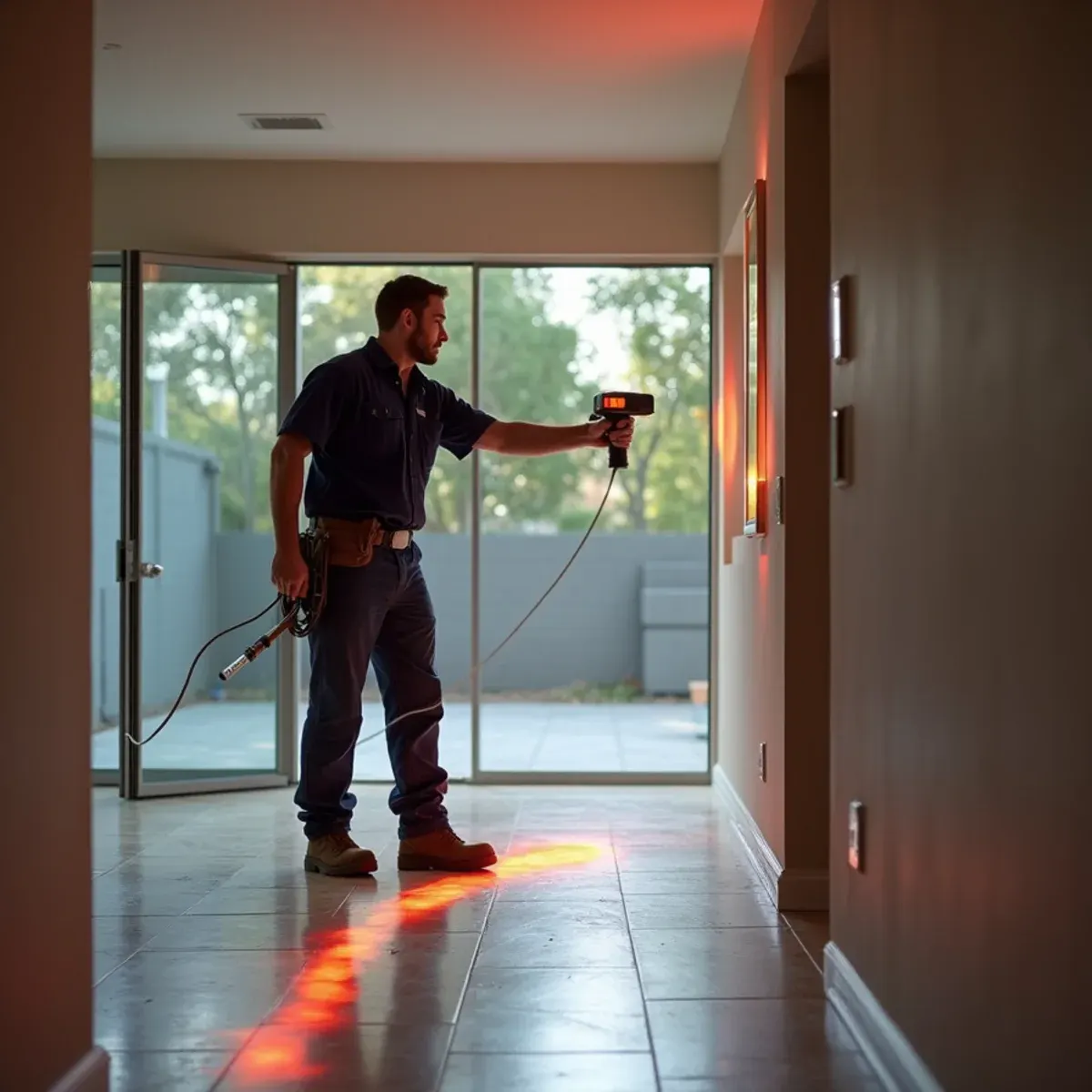
So we start at the meter, not at the concrete. If the dial sits still with every fixture closed, water isn't coming out of a pipe, and the conversation moves to vapor emission and flooring choices rather than trenching. If the dial creeps, we go to thermal imaging and acoustic location to find where. The tract stock around Mile Square Regional Park and along the Brookhurst corridor repeats consistently enough that we usually know the likely supply run before we start, which shortens the search and keeps the opening in your floor small.
What Fountain Valley Changes About Slab Leak Damage
1Vapor emission is the local baseline
Slabs poured over this drained wetland in the sixties and seventies frequently went down with little or no vapor barrier, so ground moisture rises through the concrete continuously. It darkens flooring, lifts adhesive and reads wet on a surface meter. It is not a plumbing failure, and treating it as one leads to a hole in your floor with no leak at the bottom of it.
2Dead-flat ground ponds against the house
There's essentially no fall anywhere in this city, so a blocked yard or area drain doesn't send water somewhere else. It holds it against your foundation until it finds a way in. Clear those drains before the first real storm. A good share of our January calls here turn out to be exterior water that looked, from inside, exactly like a slab leak.
3Reroutes beat trenching in saturated ground
Backfill in a trench cut through a slab sitting on high groundwater stays wet, and the patch takes longer to reach a moisture level any flooring can go over. Where the layout allows it, abandoning the failed line and running new pipe overhead avoids that completely. It isn't always cheaper on the invoice. It's frequently faster to a finished floor.
How the Work Runs
The method is the same one we use on every slab leak damage job, documented to the IICRC S500:2025 standard. Here it is in short — the full slab leak water damage repair process explains each stage in detail.
- Confirm it is actually a slab leak
- Electronic leak location
- Choose the repair approach with you
- Dry the slab and the affected assemblies
- Address the flooring and wall base
- Restore the floor and finish
The Fountain Valley Background Worth Knowing
Groundwater beneath Fountain Valley sits close enough to the surface that moisture vapor migration up through concrete slabs is a routine background condition rather than an anomaly. Homeowners here regularly describe a slab that feels cool and damp, or a closet on an exterior wall that never quite feels dry, without any leak at all.
There is more on the housing stock, drainage and plumbing history of this city on our water damage restoration in Fountain Valley page.
Fountain Valley at a glance
- Dominant construction era
- 1960–1980
- Foundation type
- slab on grade
- Supply piping found here
- under-slab copper
- Drain line materials
- cast iron
- Terrain and water table
- flat, shallow water table
- Most common local failure
- slab vapor emission mistaken for a leak, and flooring failures caused by installing over an untested slab
- Highest-value local prevention
- clearing the yard and area drains before the season, because a blocked drain on dead-flat ground ponds water against the house
What It Costs in Fountain Valley
We do not quote a number over the phone before seeing the property — anyone who does is guessing. The variables that actually move the price on a slab leak damage job are how long the leak ran undetected, flooring type over the leak, repair method chosen, and they are broken down in full on the slab leak water damage repair page. The assessment and the written estimate are free anywhere in Fountain Valley, day or night, with no obligation.
Slab Leak Damage Questions from Fountain Valley Homeowners
Probably not. What usually happened is that the floor went down before the slab was cleared with an in-situ relative humidity test. In Fountain Valley the concrete keeps releasing ground moisture long after the plumbing is sound, and laminate and vinyl plank trap it underneath. Any new floor here should go over a slab that has been probe-tested and documented, and most installers will only honor a warranty on that basis.
The meter test is the first step: shut off every fixture and watch the low-flow indicator. If it moves and nothing is wet above the floor, suspect the slab. Warm spots on the floor, running-water sounds from below, and flooring that lifts or cups without an obvious cause all point the same direction. We confirm it with thermal imaging and moisture mapping at no charge.
Not always. Depending on where the leak is and the condition of the system, rerouting the line overhead through the attic and walls avoids opening the concrete entirely. When a spot repair is the better option, precise electronic location keeps the opening small — typically a couple of feet, not a trench across the room.
The city sits on former wetland with one of the shallowest water tables in Orange County, so moisture vapor migrating up through slabs is a normal background condition here rather than a defect. It matters most when installing flooring over the slab, which is why we test with in-situ RH probes before anything goes back down.