
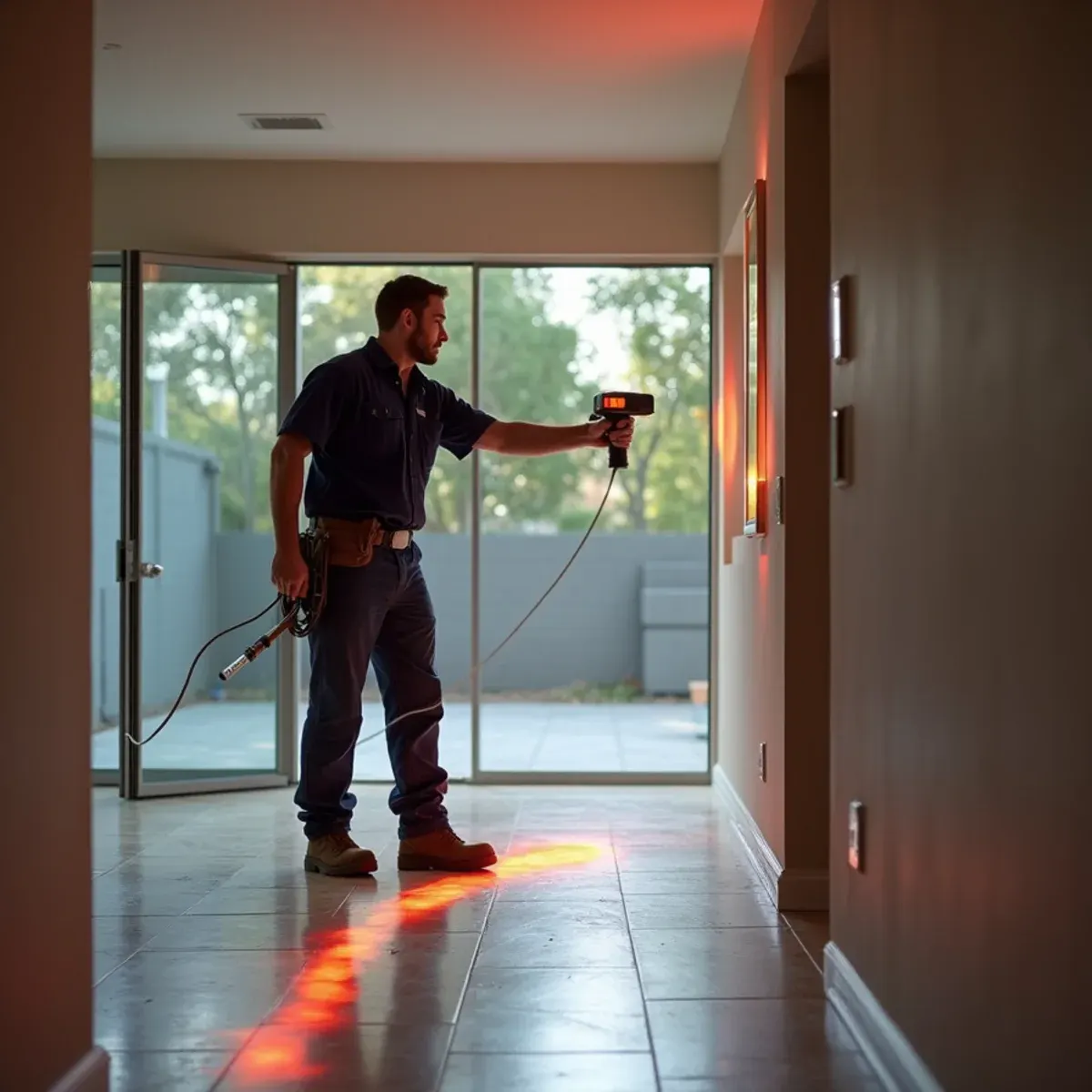
A good share of the calls we take from Floral Park, French Park and Washington Square come in as slab leaks and turn out to be something else. Those homes date from the 1900s through the 1930s and sit on raised foundations with crawl spaces underneath. A failed supply line there drips into dirt rather than pooling on concrete, so it runs longer before anyone notices. But when we do find it, we can reach the pipe without cutting a floor, and that is a materially better outcome than the same failure two miles south.
The postwar and 1960s parts of the city are conventional slab-on-grade, and so are additions poured onto much older houses. That seam, where an original raised foundation meets a newer slab addition, is somewhere we check early, because the pipe crossing it has been flexing at a joint for decades. When water does reach original lath-and-plaster the clock changes entirely. Plaster holds several times the water drywall does, gives it back slowly, and softens at the keys until it starts pulling away from the wood lath behind it.
What Santa Ana Changes About Slab Leak Damage
1Crawl spaces change the whole repair
Under a raised foundation, a failed supply line is reachable without cutting any floor, which turns a two-day concrete job into an afternoon. The catch is detection. Water drips into soil rather than pooling where you'd see it, so these leaks run for weeks. A musty smell in one room with dry floors underfoot is often the only signal you get.
2Plaster needs desiccant drying, started fast
Lath-and-plaster holds several times the water drywall does and releases it slowly. The longer it stays wet, the more the keys pushed through the lath soften and let the plaster leave the wall. IICRC S500:2025 treats an assembly like that as its own drying problem, and it needs desiccant capacity within hours rather than air movers the next morning.
3Historic review shapes what gets replaced
In Floral Park, French Park and Washington Square, exterior work and some interior work goes through preservation review. Original wood windows and old-growth flooring have no modern equivalent, so the default here is to dry and save rather than tear out. We plan for that from the first visit, because a demolition decision made on day one is very hard to argue with later.
How the Work Runs
The method is the same one we use on every slab leak damage job, documented to the IICRC S500:2025 standard. Here it is in short — the full slab leak water damage repair process explains each stage in detail.
- Confirm it is actually a slab leak
- Electronic leak location
- Choose the repair approach with you
- Dry the slab and the affected assemblies
- Address the flooring and wall base
- Restore the floor and finish
The Santa Ana Background Worth Knowing
Lath and plaster is wood strips nailed across the studs with several coats of plaster troweled over them. The plaster that squeezes through the gaps between lath forms keys that hook over the wood and hold the whole wall in place. That construction is why plaster walls last a century — and why they behave so differently from drywall when wet.
There is more on the housing stock, drainage and plumbing history of this city on our water damage restoration in Santa Ana page.
Santa Ana at a glance
- Dominant construction era
- 1900–1970
- Foundation type
- mixed on grade
- Supply piping found here
- original early-century piping, galvanized steel, copper
- Drain line materials
- cast iron, clay
- Terrain and water table
- flat, moderate water table
- Most common local failure
- plaster key failure, where wet plaster softens and releases from the wood lath holding it to the wall
- Highest-value local prevention
- starting aggressive drying within hours on any plaster loss — waiting is the one thing that costs you the wall
What It Costs in Santa Ana
We do not quote a number over the phone before seeing the property — anyone who does is guessing. The variables that actually move the price on a slab leak damage job are how long the leak ran undetected, flooring type over the leak, repair method chosen, and they are broken down in full on the slab leak water damage repair page. The assessment and the written estimate are free anywhere in Santa Ana, day or night, with no obligation.
Slab Leak Damage Questions from Santa Ana Homeowners
Almost certainly not, because a house of that age here sits on a raised foundation. What you likely have is a supply line leaking into the crawl space, with moisture wicking up through the subfloor at the low point. That's better news than a slab leak, since we can reach the pipe without cutting your floor. The urgent part is the plaster, which suffers long before the wood does.
The meter test is the first step: shut off every fixture and watch the low-flow indicator. If it moves and nothing is wet above the floor, suspect the slab. Warm spots on the floor, running-water sounds from below, and flooring that lifts or cups without an obvious cause all point the same direction. We confirm it with thermal imaging and moisture mapping at no charge.
Not always. Depending on where the leak is and the condition of the system, rerouting the line overhead through the attic and walls avoids opening the concrete entirely. When a spot repair is the better option, precise electronic location keeps the opening small — typically a couple of feet, not a trench across the room.
Usually, if drying starts quickly. Plaster holds much more water than drywall and dries far more slowly, so it needs more equipment and often desiccant dehumidification. The risk is the plaster keys softening and releasing from the lath, which is why waiting is the one thing that genuinely costs you the wall.