
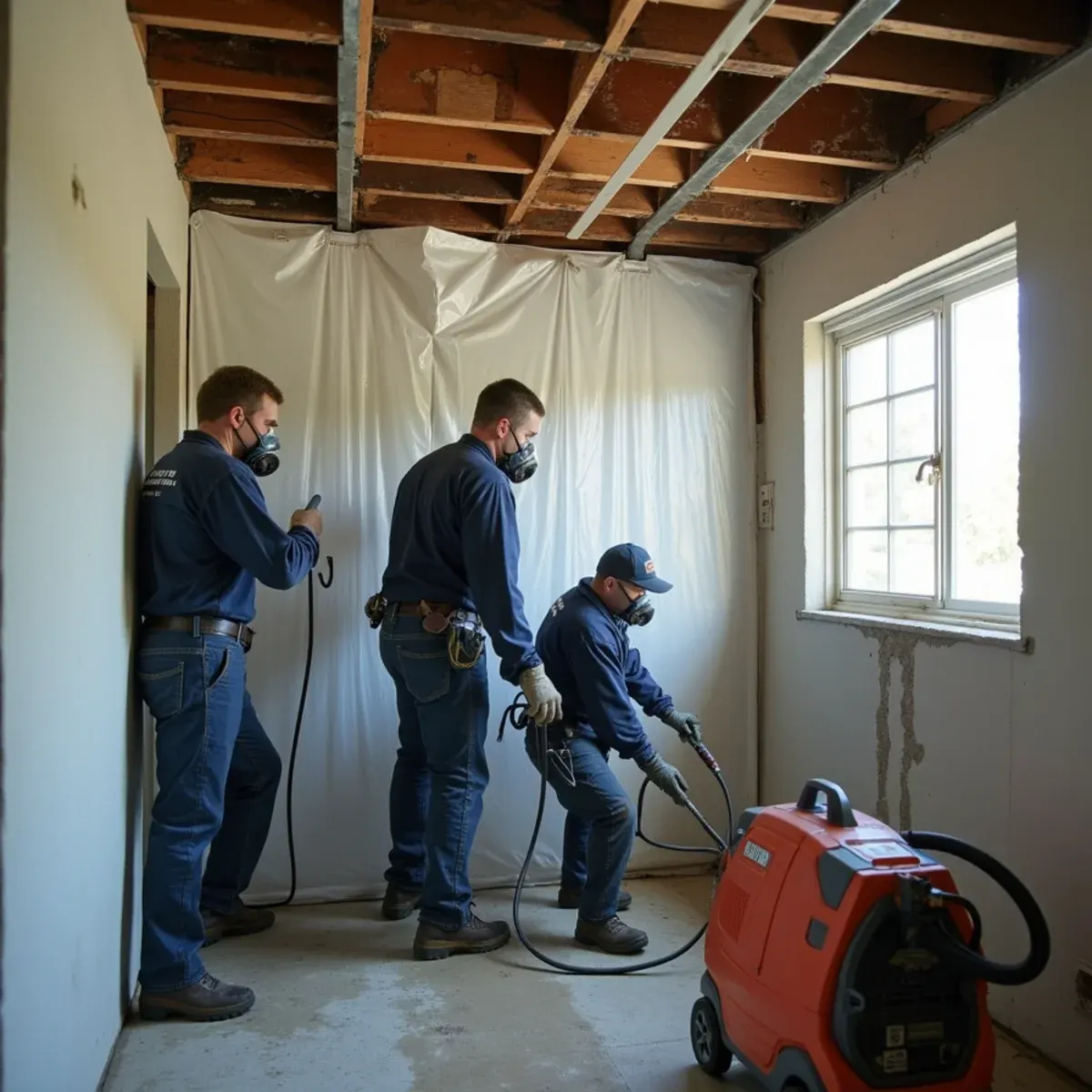
Plaster lies to you about how wet it is. In Floral Park, French Park and Washington Square the walls are plaster over wood lath, and after a flood the water climbs well above the line you can see — we routinely find elevated readings two feet or more up a wall whose stain stopped at eight inches. Plaster also holds several times what drywall holds and gives it back slowly, so the surface feels barely damp while the lath and the cavity behind it stay saturated and the odor builds.
That is the central problem of flood work in the county's oldest city. Santa Ana carries 1900s through 1930s housing in designated historic districts, original wood windows and old-growth hardwood floors with no modern equivalent, alongside dense postwar apartments near the civic core and the river. Preservation review applies to exterior and some interior work, so what comes out and how it goes back is not entirely our decision. The response still has to be immediate: wet plaster keys soften and release from the lath, and a wall that could have been saved fails within days.
What Santa Ana Changes About Flood Cleanup
1Setting the cut line by meter
On a Category 3 loss the contaminated portion has to come out, and in a plaster house that portion extends past the visible mark. We meter a grid up the wall, set the line from the readings, and cut at a sensible architectural break above it. Cutting at the stain leaves wet lath sealed in the wall. Cutting high on principle destroys material that cannot be matched.
2Desiccant capacity for slow-release materials
Plaster, old-growth fir and thick original flooring release moisture far more slowly than modern materials, and conventional refrigerant dehumidifiers can stall out on them. Desiccant equipment holds a lower vapor pressure and keeps pulling once the fast drying is over. Santa Ana jobs generally run longer than a comparable postwar house, and the honest version of the schedule says so at the beginning.
3Historic district review shapes the rebuild
In the designated districts, replacement of windows, exterior finishes and some interior features goes through review. That does not slow emergency work — extraction, removal and drying proceed immediately — but it does change what the rebuild scope can specify and how long approvals take. We document original materials in place before removal, so there is a record to build the replacement case on later.
How the Work Runs
The method is the same one we use on every flood cleanup job, documented to the IICRC S500:2025 standard. Here it is in short — the full flood damage cleanup process explains each stage in detail.
- Safety assessment and utility check
- Containment and negative air
- Documentation and contents triage
- Extraction and controlled demolition
- Cleaning and disinfection
- Structural drying and clearance
The Santa Ana Background Worth Knowing
Lath and plaster is wood strips nailed across the studs with several coats of plaster troweled over them. The plaster that squeezes through the gaps between lath forms keys that hook over the wood and hold the whole wall in place. That construction is why plaster walls last a century — and why they behave so differently from drywall when wet.
There is more on the housing stock, drainage and plumbing history of this city on our water damage restoration in Santa Ana page.
Santa Ana at a glance
- Dominant construction era
- 1900–1970
- Foundation type
- mixed on grade
- Supply piping found here
- original early-century piping, galvanized steel, copper
- Drain line materials
- cast iron, clay
- Terrain and water table
- flat, moderate water table
- Most common local failure
- plaster key failure, where wet plaster softens and releases from the wood lath holding it to the wall
- Highest-value local prevention
- starting aggressive drying within hours on any plaster loss — waiting is the one thing that costs you the wall
What It Costs in Santa Ana
We do not quote a number over the phone before seeing the property — anyone who does is guessing. The variables that actually move the price on a flood cleanup job are how high the water reached, how long it sat before extraction, contents volume in the flooded area, and they are broken down in full on the flood damage cleanup page. The assessment and the written estimate are free anywhere in Santa Ana, day or night, with no obligation.
Flood Cleanup Questions from Santa Ana Homeowners
Partly both. The section that stood in contaminated water comes out, along with the lath and anything porous in the cavity, because Category 3 water does not get dried in place. Above that line, plaster can very often be saved with aggressive drying started early, and it is worth saving. The deciding factor is time — wet keys lose their grip on the lath within days, and once they do the wall is gone regardless.
Yes. Water that crossed soil, pavement, or a storm drain is Category 3 by IICRC classification regardless of appearance — it carries bacteria, fuel and oil residue, lawn chemicals, and whatever else was on the ground. Do not walk through it in open shoes, and keep children and pets out of the area entirely.
If the water came from outside across the ground, almost certainly not — that requires separate flood insurance. If it came from a failed water heater, a burst pipe, or a supply line inside the garage, it is usually covered. We document the source carefully because that distinction determines everything.
Usually, if drying starts quickly. Plaster holds much more water than drywall and dries far more slowly, so it needs more equipment and often desiccant dehumidification. The risk is the plaster keys softening and releasing from the lath, which is why waiting is the one thing that genuinely costs you the wall.