
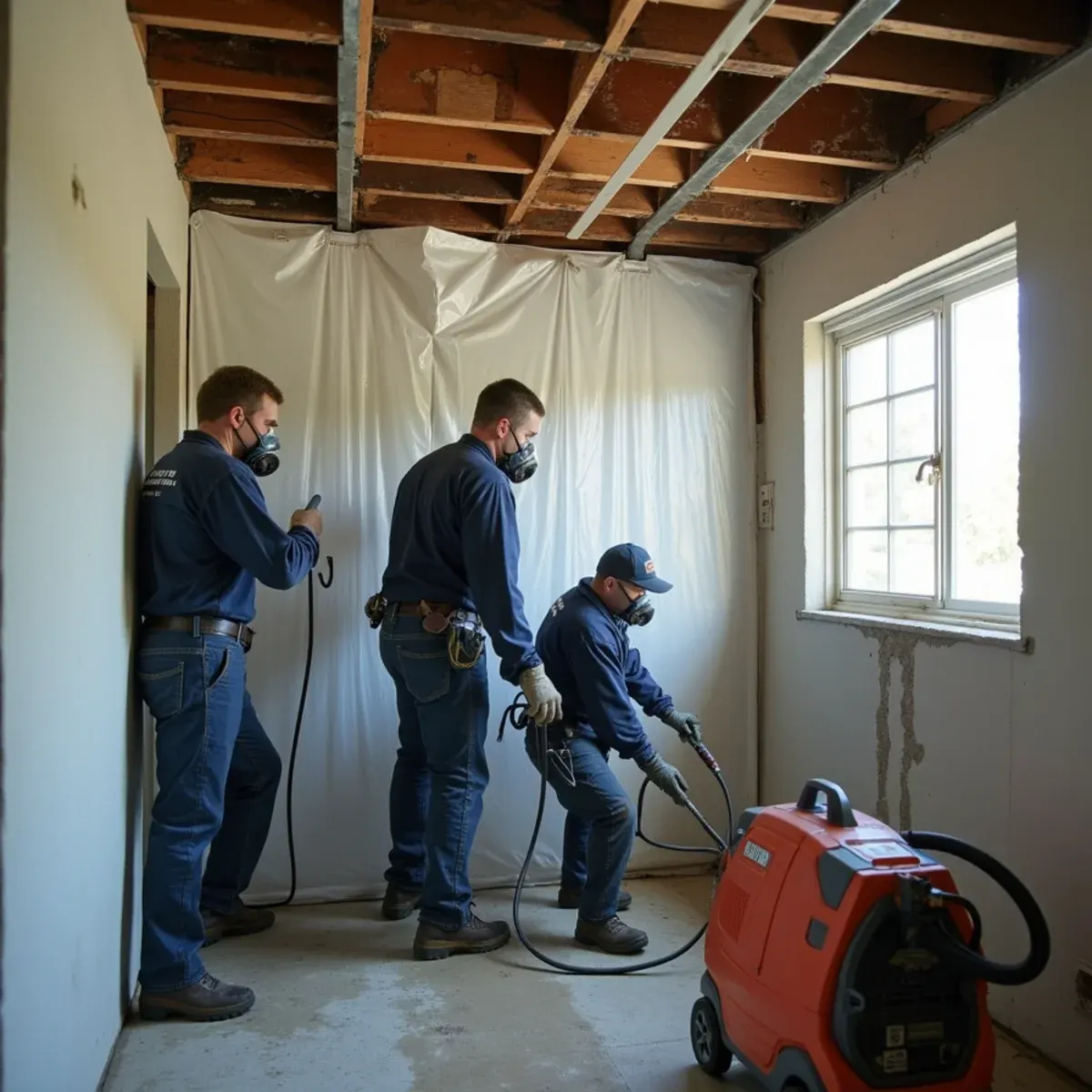
One flooded ground floor in Garden Grove can displace eight or nine people. Homes here were built for a 1955 household and now routinely shelter two or three generations, sometimes two families, and the rooms that flood first are the ones added later — the converted garage, the back room, the enclosed patio sitting at grade. So the first question we ask is not about the water. It is how many people sleep in the affected space tonight, and which part of the house we can contain and keep livable while the rest gets opened up.
The building stock is mostly 1950s and 1960s slab tract through the neighborhoods around Garden Grove Park and Historic Main Street, with clay and cast iron under the older lots. That combination matters during a storm. A surcharged clay lateral pushing back into the house and street water coming under the door look identical on a wet floor and answer to completely different coverage. We work with Vietnamese and Korean-speaking households constantly, and we put source determination in writing so whoever handles the claim in your family can read it.
What Garden Grove Changes About Flood Cleanup
1Converted garages flood first and worst
Garage conversions sit on the lowest slab in the house, usually without the vapor barrier or drainage detail the rest of the home has, and the finished walls are often drywall on furring strips with insulation behind. Once floodwater is in, that cavity holds it. We open the base of those walls, remove porous material, and dry the slab itself, which is frequently still releasing moisture after the visible water is gone.
2Keeping part of a full house livable
With this many people under one roof, sending everyone to a hotel is rarely realistic. We build containment so the unaffected half of the home stays sealed off, route negative air exhaust away from bedrooms, and sequence demolition so the kitchen and at least one bathroom keep working wherever the layout allows. It is slower than gutting the whole floor at once, and usually worth it.
3Storm surcharge in old clay laterals
Many of these lots still drain through original clay, and clay joints take on ground water in heavy rain and back up. If your floor drain or the lowest tub gurgled before water appeared, that points to a lateral event rather than a pure surface flood. Both are Category 3 and both get the same cleanup, but only one may have a coverage path. We scope it rather than guess.
How the Work Runs
The method is the same one we use on every flood cleanup job, documented to the IICRC S500:2025 standard. Here it is in short — the full flood damage cleanup process explains each stage in detail.
- Safety assessment and utility check
- Containment and negative air
- Documentation and contents triage
- Extraction and controlled demolition
- Cleaning and disinfection
- Structural drying and clearance
The Garden Grove Background Worth Knowing
A 1958 tract home was plumbed for a family of four with one bathroom in regular use, one washing machine, and a single water heater sized to match. Many Garden Grove homes today support considerably more than that, and the plumbing feels it.
There is more on the housing stock, drainage and plumbing history of this city on our water damage restoration in Garden Grove page.
Garden Grove at a glance
- Dominant construction era
- 1950–1970
- Foundation type
- slab on grade
- Supply piping found here
- galvanized steel, under-slab copper
- Drain line materials
- cast iron, clay
- Terrain and water table
- flat, moderate water table
- Most common local failure
- accelerated wear on angle stops, supply risers and washing machine hoses from far higher fixture cycle counts
- Highest-value local prevention
- shorter replacement intervals on every wear item — hoses at five years without exception
What It Costs in Garden Grove
We do not quote a number over the phone before seeing the property — anyone who does is guessing. The variables that actually move the price on a flood cleanup job are how high the water reached, how long it sat before extraction, contents volume in the flooded area, and they are broken down in full on the flood damage cleanup page. The assessment and the written estimate are free anywhere in Garden Grove, day or night, with no obligation.
Flood Cleanup Questions from Garden Grove Homeowners
It can, and it is better to be straightforward with your adjuster early. Unpermitted conversions sometimes complicate what an insurer will pay toward rebuilding, though the cleanup itself does not change: contaminated water in a sleeping space gets full Category 3 handling regardless. We document the room as we find it, note the construction we uncover behind the finishes, and provide slab readings so the drying record stands on its own merits.
Yes. Water that crossed soil, pavement, or a storm drain is Category 3 by IICRC classification regardless of appearance — it carries bacteria, fuel and oil residue, lawn chemicals, and whatever else was on the ground. Do not walk through it in open shoes, and keep children and pets out of the area entirely.
If the water came from outside across the ground, almost certainly not — that requires separate flood insurance. If it came from a failed water heater, a burst pipe, or a supply line inside the garage, it is usually covered. We document the source carefully because that distinction determines everything.
Yes, all five ZIP codes — 92840, 92841, 92843, 92844, and 92845 — for both residential and commercial properties. Response time runs about twenty-five to thirty-five minutes depending on where in the city.