
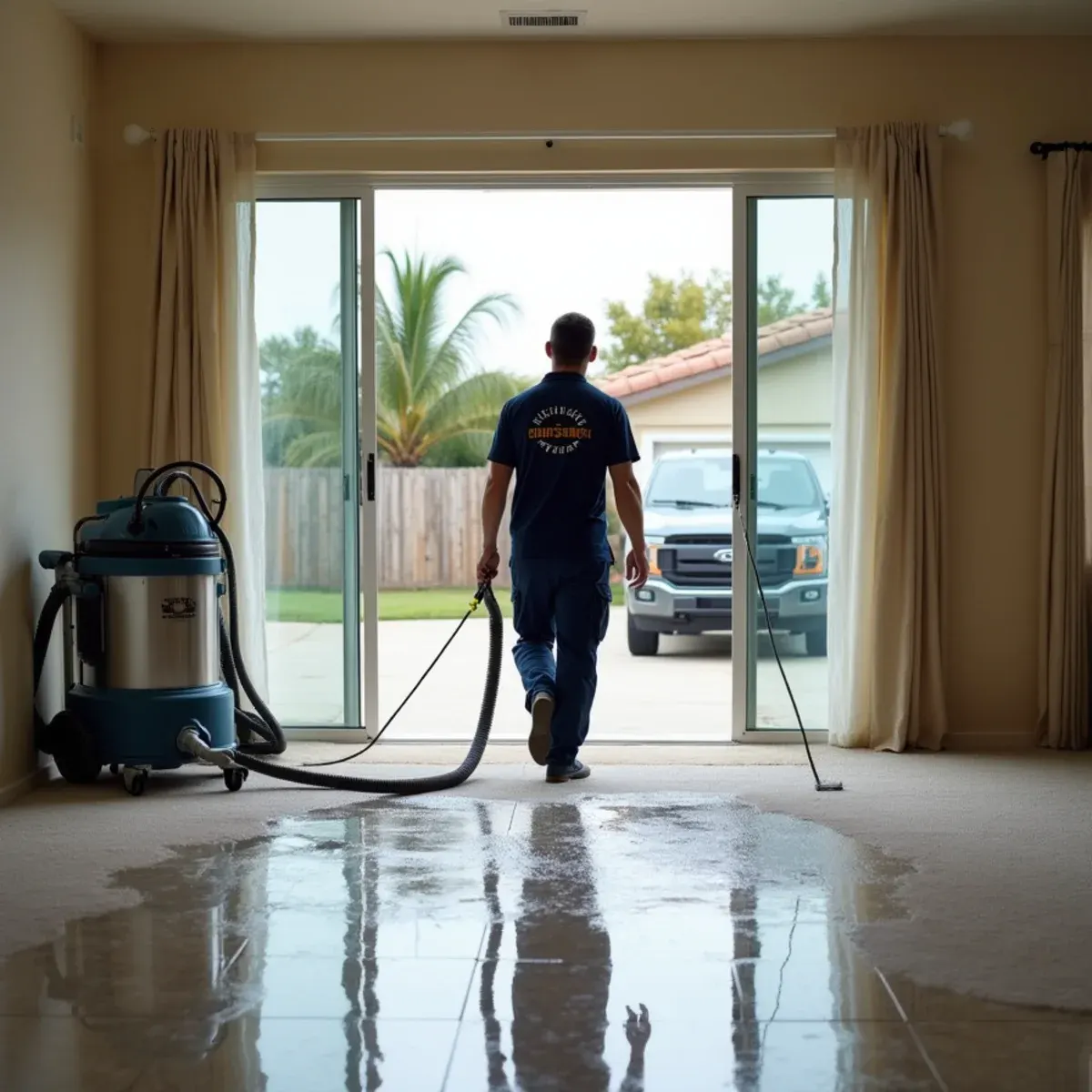
In a lot of Garden Grove houses there are more people living under the roof than the builder ever planned for, and that shows up the moment we walk in with equipment. Rooms are in use. Storage is stacked along the walls where the water went. Nobody has anywhere to go for two days. So extraction here begins with contents — lifting furniture, blocking legs, getting boxes off wet flooring — before the first pump comes off the truck. Skip that and you pull water out of the carpet and straight back into cardboard.
These neighborhoods went from farmland to finished suburb in about fifteen years, mostly 1950s and 1960s slab construction with galvanized supply and cast iron waste. Plumbing sized for one 1955 household is now carrying several times the fixture cycles it was built for, and angle stops, supply risers and washing machine hoses wear out to match. Near Historic Main Street and through the Korean Business District we do a good deal of commercial extraction as well, in buildings where the ground floor is retail and the water always finds the storage room first.
What Garden Grove Changes About Water Extraction
1Contents come first, water comes second
Wet boxes, mattresses on the floor, and furniture legs standing in a puddle all act as reservoirs. Extract around them and they release moisture back into the pad for days afterward. So the first crew hour goes to lifting, blocking and staging belongings out of the wet footprint. In a fully occupied house that takes coordination, and it's the difference between one drying cycle and three.
2Wear items fail faster in busy homes
Angle stops, toilet supply risers and washing machine hoses are rated by cycles, not years. A Garden Grove house running two or three households' worth of laundry and dishes reaches those cycle counts far sooner than the same house with two occupants. Most of the sudden, high-volume losses we extract here start at one of those three components. Replace washing machine hoses at five years, no exceptions.
3Scope explained in the family's language
Decisions about what gets removed — carpet pad, a section of drywall, a cabinet toe kick — usually involve more than one adult here, and often more than one generation. We slow down and walk through the scope with whoever is making the call, in plain terms, and we work regularly with Vietnamese- and Korean-speaking families. Nobody should be signing for work that wasn't explained to them.
How the Work Runs
The method is the same one we use on every water extraction job, documented to the IICRC S500:2025 standard. Here it is in short — the full water extraction & removal process explains each stage in detail.
- Bulk removal with submersible pumps
- Truck-mounted extraction on carpet and pad
- Hard-surface and specialty extraction
- Cavity and void extraction
- Removing what cannot be saved
- Post-extraction moisture reading
The Garden Grove Background Worth Knowing
A 1958 tract home was plumbed for a family of four with one bathroom in regular use, one washing machine, and a single water heater sized to match. Many Garden Grove homes today support considerably more than that, and the plumbing feels it.
There is more on the housing stock, drainage and plumbing history of this city on our water damage restoration in Garden Grove page.
Garden Grove at a glance
- Dominant construction era
- 1950–1970
- Foundation type
- slab on grade
- Supply piping found here
- galvanized steel, under-slab copper
- Drain line materials
- cast iron, clay
- Terrain and water table
- flat, moderate water table
- Most common local failure
- accelerated wear on angle stops, supply risers and washing machine hoses from far higher fixture cycle counts
- Highest-value local prevention
- shorter replacement intervals on every wear item — hoses at five years without exception
What It Costs in Garden Grove
We do not quote a number over the phone before seeing the property — anyone who does is guessing. The variables that actually move the price on a water extraction job are volume and depth of water, flooring type, contamination level, and they are broken down in full on the water extraction & removal page. The assessment and the written estimate are free anywhere in Garden Grove, day or night, with no obligation.
Water Extraction Questions from Garden Grove Homeowners
Usually yes, and we plan for it. Extraction is the loud, disruptive part but it's also the shortest — the drying equipment that follows is what lives with you for a few days. We work room by room, keep a clear path to a bathroom and the kitchen, and stage belongings into dry rooms rather than out to a curb. If a bedroom has to be off limits overnight, we'll tell you which one and why before we start.
For a typical single-room residential loss, extraction runs one to three hours. Multi-room losses or Category 3 water can take most of a day because of containment setup and material removal. We will give you a realistic timeframe after the walkthrough, before we start.
Often we can save the carpet and only replace the pad, which is the cheaper and less disruptive path. The deciding factors are water category, how long it sat, and whether the pad is a moisture barrier type. Clean water caught quickly usually means the carpet stays.
Yes, all five ZIP codes — 92840, 92841, 92843, 92844, and 92845 — for both residential and commercial properties. Response time runs about twenty-five to thirty-five minutes depending on where in the city.