
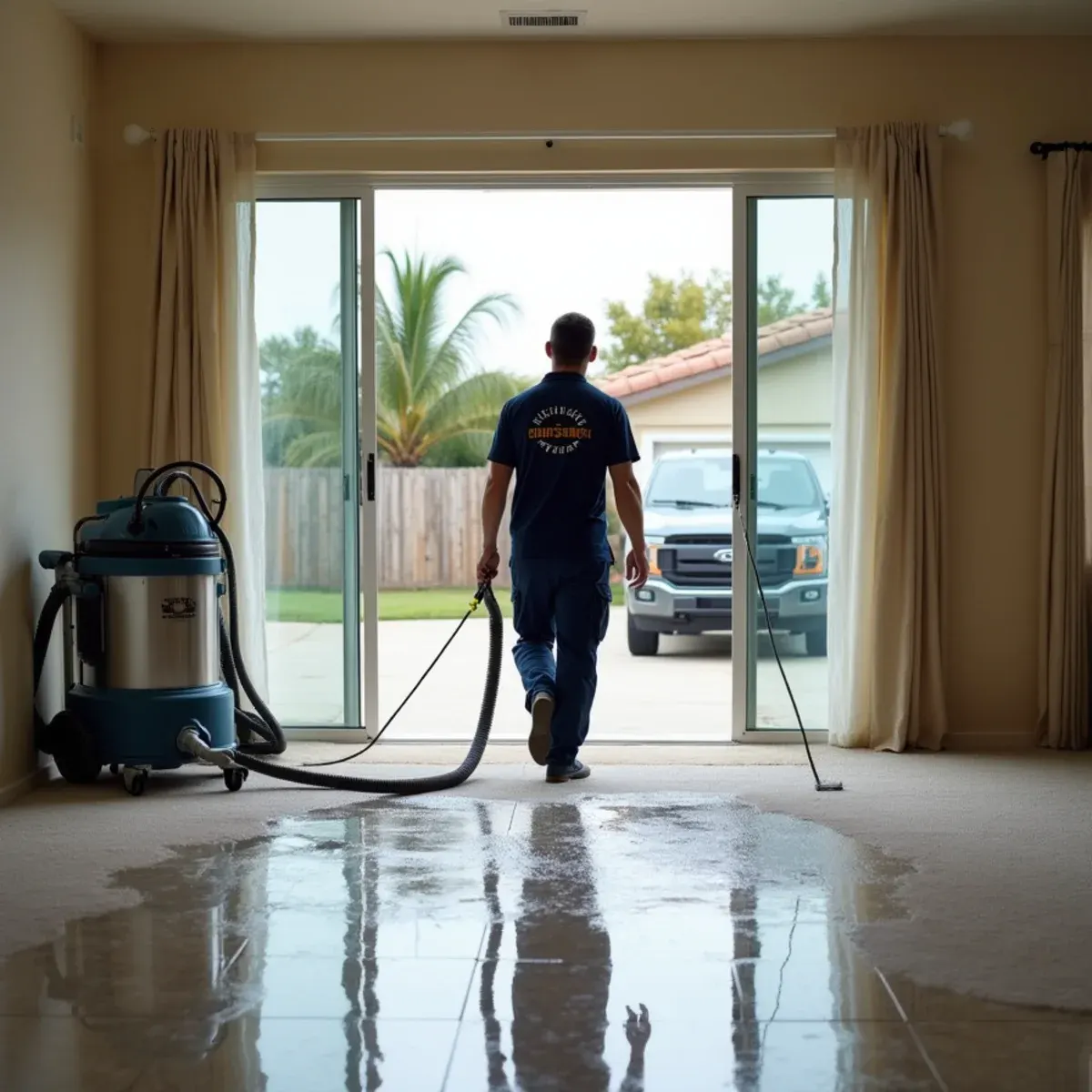
Most restoration companies in this county quietly decline manufactured-home work. We don't, and Stanton is a big part of why we had to get good at it. A manufactured home has particleboard floor decking sitting over a belly wrap — a sealed membrane slung under the frame. When a supply line beneath that floor fails, the water doesn't run out onto the ground. It pools inside the wrap, against the underside of the decking, and stays. You can run a shop vac over the vinyl all afternoon and remove none of it.
The rest of Stanton is dense: older apartment buildings, small single-family homes on tight lots, and a mix of galvanized, copper, and the PEX and poly that came with the manufactured units. Near Stanton Central Park and along the Beach Boulevard corridor, the only warning most people get is a floor that starts feeling soft underfoot. Real extraction on the manufactured side means opening the belly wrap from below, draining it, pulling saturated underfloor insulation, and removing decking that is never coming back.
What Stanton Changes About Water Extraction
1Opening the belly wrap to drain it
There's no shortcut. We access the underside, cut the belly board where the water has collected, and let it drain before anything else happens. Then the wet fiberglass comes out, because saturated insulation trapped under a floor holds moisture against the decking for months. We repair the wrap afterward. It's messier and slower than working a stick-built floor, and it's the only method that actually removes the water.
2Particleboard decking doesn't dry, it fails
Manufactured-home floor decking is particleboard, and once it swells it has lost its structure permanently. Drying it in place restores neither thickness nor strength. So part of extraction here is an honest call about what's salvageable — sections gone spongy get cut out and replaced, sections that metered high but still feel solid get dried and rechecked. We'd rather show you the meter than argue about it.
3Tight lots limit truck-mount access
Stanton is one of the densest cities in this part of the county. In a mobile home park or an older apartment court, the truck often can't get within reasonable hose distance of the unit. We plan long lays or bring portables, and we keep equipment out of shared drives so neighbors and emergency access aren't blocked. Telling us the park layout on the phone saves real time on arrival.
How the Work Runs
The method is the same one we use on every water extraction job, documented to the IICRC S500:2025 standard. Here it is in short — the full water extraction & removal process explains each stage in detail.
- Bulk removal with submersible pumps
- Truck-mounted extraction on carpet and pad
- Hard-surface and specialty extraction
- Cavity and void extraction
- Removing what cannot be saved
- Post-extraction moisture reading
The Stanton Background Worth Knowing
Mobile and manufactured homes need a genuinely different restoration approach, and the reason is what they are built from. The floor system is typically particleboard or OSB over a wood frame with insulation and a vapor barrier belly wrap underneath — and particleboard exposed to water swells, loses structural integrity, and does not recover. It cannot be dried back to serviceable the way plywood often can.
There is more on the housing stock, drainage and plumbing history of this city on our water damage restoration in Stanton page.
Stanton at a glance
- Dominant construction era
- 1950–1975
- Foundation type
- mixed on grade
- Supply piping found here
- galvanized steel, copper, manufactured-home PEX and poly
- Drain line materials
- cast iron
- Terrain and water table
- flat, moderate water table
- Most common local failure
- underfloor leaks in manufactured homes, sealed inside the belly wrap where they cannot evaporate
- Highest-value local prevention
- checking for soft spots underfoot, because a manufactured-home floor gives no other warning
What It Costs in Stanton
We do not quote a number over the phone before seeing the property — anyone who does is guessing. The variables that actually move the price on a water extraction job are volume and depth of water, flooring type, contamination level, and they are broken down in full on the water extraction & removal page. The assessment and the written estimate are free anywhere in Stanton, day or night, with no obligation.
Water Extraction Questions from Stanton Homeowners
No. In a manufactured home the water usually sits below the decking, inside the belly wrap, where nothing at floor level will show it. Dry carpet tells you almost nothing. The reliable checks are soft or spongy spots underfoot, a persistent musty smell, and a moisture meter reading taken through the floor. If any of those are present, the wrap needs to be opened and drained. Left sealed, that water can sit for months.
For a typical single-room residential loss, extraction runs one to three hours. Multi-room losses or Category 3 water can take most of a day because of containment setup and material removal. We will give you a realistic timeframe after the walkthrough, before we start.
Often we can save the carpet and only replace the pad, which is the cheaper and less disruptive path. The deciding factors are water category, how long it sat, and whether the pad is a moisture barrier type. Clean water caught quickly usually means the carpet stays.
Yes, and we say so explicitly because a lot of companies will not. Manufactured homes need a different approach — opening the belly wrap to dry the floor cavity, removing saturated insulation, and honestly assessing particleboard decking, which usually cannot be dried back to serviceable.