
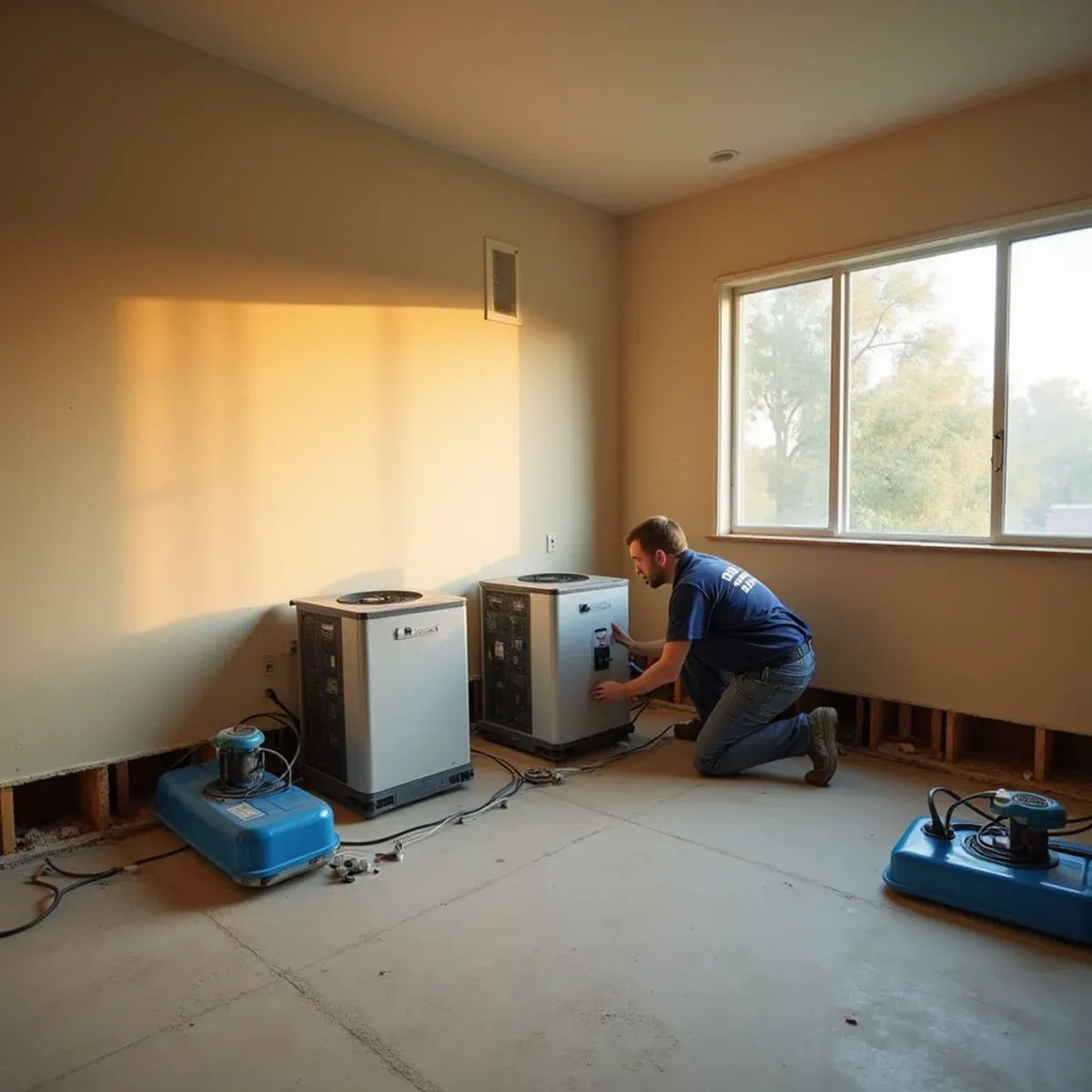
Point six air movers at a wet manufactured-home floor and you'll accomplish almost nothing. The water isn't on the floor. It's underneath the particleboard decking, sitting in the belly wrap, the plastic membrane slung under the frame that holds the insulation in place and holds water just as well. It can't evaporate up through vinyl or down through plastic. We have opened wraps in Stanton parks and found standing water from a supply leak that stopped months earlier, with the owner assuming the problem had solved itself.
Stanton has one of the larger manufactured-home populations in this part of the county, along with dense older apartment stock, and plenty of restoration companies decline both. The work is straightforward once you accept what it actually is: drop the wrap at the low point, drain it, remove insulation that's saturated, then build the drying chamber against the underside of the decking with the dehumidifier controlling that space. Site-built homes here run from slab to raised floor, so we confirm what's under you before anything gets planned.
What Stanton Changes About Structural Drying
1The belly wrap has to be opened
There is no way around this. Until the membrane is cut at the low point and the trapped water drains out, nothing above it dries, and every reading taken through the floor stays high. Cutting and resealing a belly wrap correctly is routine work for us and one reason many companies won't quote these homes at all. The repair afterward matters as much as the drainage.
2Particleboard decking has a hard limit
Once particleboard swells and loses its bond, drying will not bring it back. It may feel firmer as it dries and still have lost the strength that held a fastener. We meter it, give it a fair chance where the wetting was recent, and tell you straight when the answer is replacing decking rather than a week of equipment noise and a bill for nothing.
3Soft spots are the only warning
A manufactured-home floor doesn't stain a ceiling or drip into a room. It just goes spongy, usually near the water heater, a toilet flange or the laundry connection. We map the whole floor with a meter rather than only the area that feels wrong, because the wet zone under the decking is almost always wider than the part that gives under your foot.
How the Work Runs
The method is the same one we use on every structural drying job, documented to the IICRC S500:2025 standard. Here it is in short — the full structural drying & dehumidification process explains each stage in detail.
- Establish the dry standard
- Calculate the load and build the chamber
- Place air movers for surface evaporation
- Run LGR dehumidification to capture the moisture
- Monitor and adjust daily
- Verify, document, and demobilize
The Stanton Background Worth Knowing
Mobile and manufactured homes need a genuinely different restoration approach, and the reason is what they are built from. The floor system is typically particleboard or OSB over a wood frame with insulation and a vapor barrier belly wrap underneath — and particleboard exposed to water swells, loses structural integrity, and does not recover. It cannot be dried back to serviceable the way plywood often can.
There is more on the housing stock, drainage and plumbing history of this city on our water damage restoration in Stanton page.
Stanton at a glance
- Dominant construction era
- 1950–1975
- Foundation type
- mixed on grade
- Supply piping found here
- galvanized steel, copper, manufactured-home PEX and poly
- Drain line materials
- cast iron
- Terrain and water table
- flat, moderate water table
- Most common local failure
- underfloor leaks in manufactured homes, sealed inside the belly wrap where they cannot evaporate
- Highest-value local prevention
- checking for soft spots underfoot, because a manufactured-home floor gives no other warning
What It Costs in Stanton
We do not quote a number over the phone before seeing the property — anyone who does is guessing. The variables that actually move the price on a structural drying job are size of the drying chamber, class of water intrusion, material types involved, and they are broken down in full on the structural drying & dehumidification page. The assessment and the written estimate are free anywhere in Stanton, day or night, with no obligation.
Structural Drying Questions from Stanton Homeowners
It depends on how long it's been wet and what the decking has done. If the leak is recent and the particleboard hasn't swelled and delaminated, opening the belly wrap, draining it and drying the cavity from below can save the floor. If the decking has lost its bond, drying won't restore its strength and replacement is the real answer. We meter that area and the surrounding floor first, then tell you which one you're dealing with.
Three to five days covers most residential losses. Saturated hardwood, plaster, or a concrete slab can run seven or more. We will give you an estimated window after the first readings and update you daily — and equipment comes out when the numbers say so, not on a fixed schedule.
We would rather you did not. Drying is a continuous process, and every hour off extends the total run — which usually costs more than the sleep is worth. If noise is genuinely unmanageable we can often reconfigure the chamber or reposition units to reduce it. Talk to us instead of unplugging them.
Yes, and we say so explicitly because a lot of companies will not. Manufactured homes need a different approach — opening the belly wrap to dry the floor cavity, removing saturated insulation, and honestly assessing particleboard decking, which usually cannot be dried back to serviceable.