
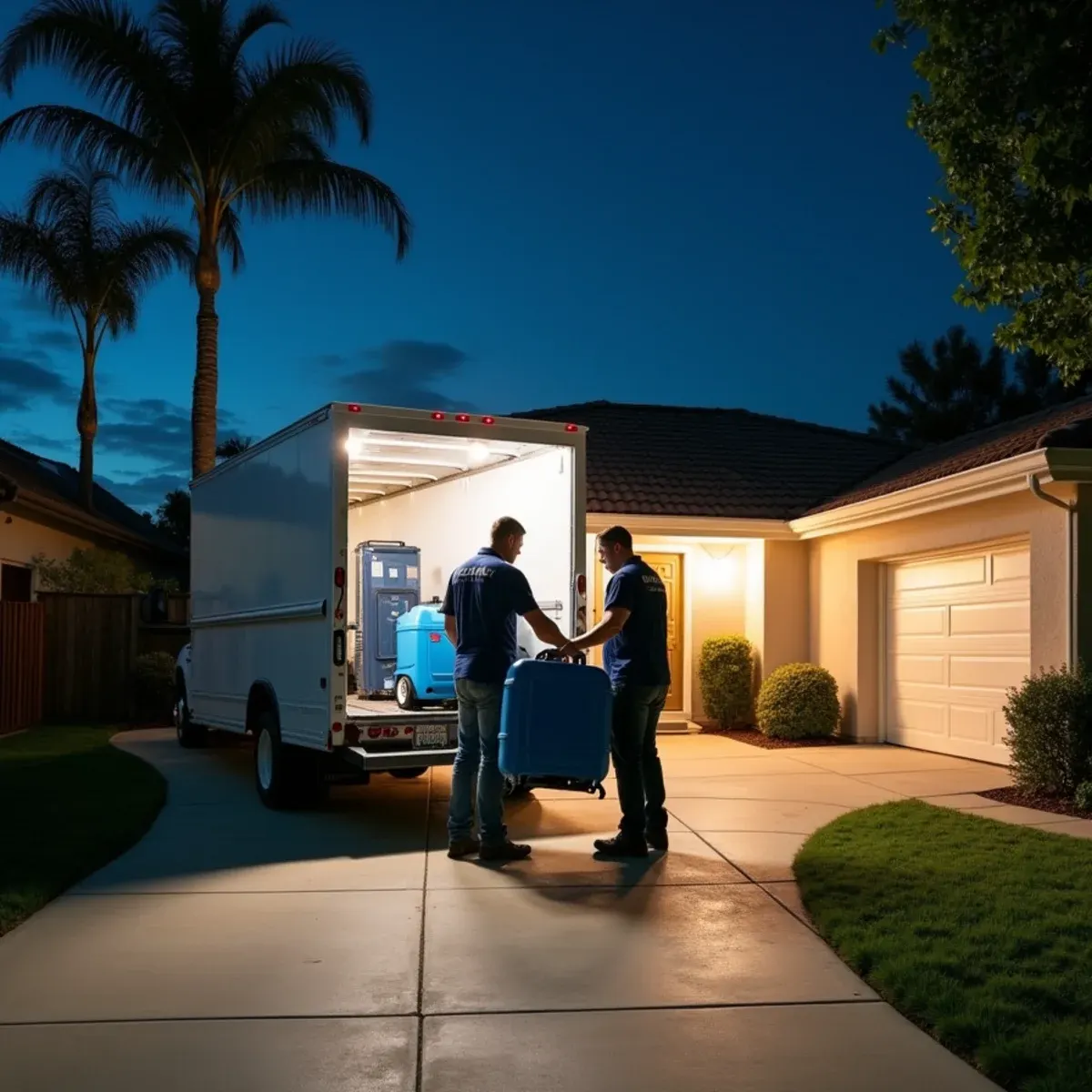
A manufactured-home floor does not dry the way a house floor does. Under the particleboard decking there's a belly wrap, a sealed membrane slung beneath the frame, and once water gets past the decking that membrane holds it like a bag. Nothing evaporates. The floor stays soft, the smell arrives weeks later, and by then the decking has swelled and lost its strength. Stanton has one of the larger manufactured-home populations in this part of the county, and plenty of restoration companies simply decline the address.
We don't. Drying one properly means opening the wrap from below at the low points, draining it, drying the cavity and the decking with directed airflow, then patching the membrane so it does its job again afterward. The city's older apartment buildings off Beach Boulevard are a separate problem: high density, shared walls, and water heater or laundry failures that reach a neighbor before anyone notices. Both are jobs where getting there quickly matters more than how much equipment comes off the truck.
What Stanton Changes About Emergency Restoration
1The belly wrap holds water for months
The membrane under a manufactured home is built to keep weather and rodents out, which means it also keeps water in. We've opened wraps months after a small supply leak and found standing water with rotted decking above it. Drying from inside the coach alone does nothing for that cavity. The wrap has to be opened, drained and dried, then sealed back up.
2Soft underfoot is the only warning
Particleboard decking gives one sign before it fails, and that's a spongy feeling near a toilet, tub or water heater. There's usually no stain and no drip to see. If a spot flexes underfoot in your coach, treat it as water until a moisture meter says otherwise. Caught early, the decking usually stays. Caught late, a section of floor leaves with it.
3Park rules, HCD, and tight access
Work on a manufactured home runs under different rules than a stick-built house, and most parks want notice before anyone goes under a coach or stages equipment on the pad. We handle those conversations so the job doesn't stop halfway through. Crawl access under a coach is tight, and that constraint drives where equipment goes rather than the other way around.
How the Work Runs
The method is the same one we use on every emergency restoration job, documented to the IICRC S500:2025 standard. Here it is in short — the full emergency water damage restoration process explains each stage in detail.
- Call answered and crew dispatched
- Arrival, safety check, and moisture mapping
- Documentation before anything is touched
- Extraction
- Controlled structural drying
- Cleaning, sanitizing, and final verification
The Stanton Background Worth Knowing
Mobile and manufactured homes need a genuinely different restoration approach, and the reason is what they are built from. The floor system is typically particleboard or OSB over a wood frame with insulation and a vapor barrier belly wrap underneath — and particleboard exposed to water swells, loses structural integrity, and does not recover. It cannot be dried back to serviceable the way plywood often can.
There is more on the housing stock, drainage and plumbing history of this city on our water damage restoration in Stanton page.
Stanton at a glance
- Dominant construction era
- 1950–1975
- Foundation type
- mixed on grade
- Supply piping found here
- galvanized steel, copper, manufactured-home PEX and poly
- Drain line materials
- cast iron
- Terrain and water table
- flat, moderate water table
- Most common local failure
- underfloor leaks in manufactured homes, sealed inside the belly wrap where they cannot evaporate
- Highest-value local prevention
- checking for soft spots underfoot, because a manufactured-home floor gives no other warning
What It Costs in Stanton
We do not quote a number over the phone before seeing the property — anyone who does is guessing. The variables that actually move the price on a emergency restoration job are water category, affected square footage and number of rooms, how many days of equipment, and they are broken down in full on the emergency water damage restoration page. The assessment and the written estimate are free anywhere in Stanton, day or night, with no obligation.
Emergency Restoration Questions from Stanton Homeowners
Yes, and sooner than you'd think. In a manufactured home the water usually sits under the decking inside the belly wrap where you'll never see it. Sponginess is the decking losing strength, and that doesn't reverse on its own. We can meter the area and check the cavity from below without tearing up your floor. If it reads dry, you've lost an hour. If it reads wet, you've probably saved the floor.
We commit to being on-site within 60 minutes of a confirmed emergency call anywhere in Cypress, and we credit $100 off your invoice if we miss it. Most of the time we are there in 30 to 45 minutes because our trucks stage on Katella Avenue, right here in the city.
No. The emergency assessment and written estimate are free, 24 hours a day. You are not obligated to hire us after we walk the property, and we will tell you plainly if we think the damage is small enough to handle yourself.
Yes, and we say so explicitly because a lot of companies will not. Manufactured homes need a different approach — opening the belly wrap to dry the floor cavity, removing saturated insulation, and honestly assessing particleboard decking, which usually cannot be dried back to serviceable.