
A manufactured home does not flood the way a stick-built house does. Under the floor there is a belly wrap — a sealed membrane slung beneath the joists holding insulation and ductwork — and when ground water gets in, that wrap turns into a bag. It cannot drain and it cannot evaporate. Stanton has one of the largest manufactured-home populations in this part of the county, and most restoration companies decline the work, which is why we see coaches months after a storm with soft particleboard decking and an odor nobody can locate.
The rest of Stanton shapes flood work too. Older apartment buildings along the Beach Boulevard corridor and around Harry M. Dotson Park sit close together on small lots with little permeable ground, so a heavy storm has nowhere to go except toward doorways. Foundations are mixed and construction runs from the early fifties through the mid-seventies, so two houses on the same block can need entirely different approaches once the standing water is out and the drying plan gets written.
What Stanton Changes About Flood Cleanup
1Draining and drying the belly wrap
There is no way around opening it. We cut controlled access points along the low side, drain the trapped water, remove saturated insulation as contaminated material, then dry the floor decking and framing from underneath before closing the wrap back up with proper sealing tape. Skipping that step is why so many flooded coaches still smell a year later, no matter what was done to the floor above.
2Particleboard decking has a short window
Manufactured-home floors are usually particleboard, and particleboard does not tolerate saturation — it swells, loses its bond, and never returns to strength. By the time you can feel a soft spot underfoot, the decking has been wet for a while. Sections often have to be cut out and replaced. The earlier we get underneath, the smaller that cut ends up being.
3Park rules and a different policy
A manufactured home is frequently insured on its own form rather than a standard homeowners policy, and the park may have its own requirements about access, utilities and who signs off on work at the site. We work with both, keep site documentation separate from unit documentation, and are direct about what a ground-source flood exclusion means before anyone starts hoping otherwise.
How the Work Runs
The method is the same one we use on every flood cleanup job, documented to the IICRC S500:2025 standard. Here it is in short — the full flood damage cleanup process explains each stage in detail.
- Safety assessment and utility check
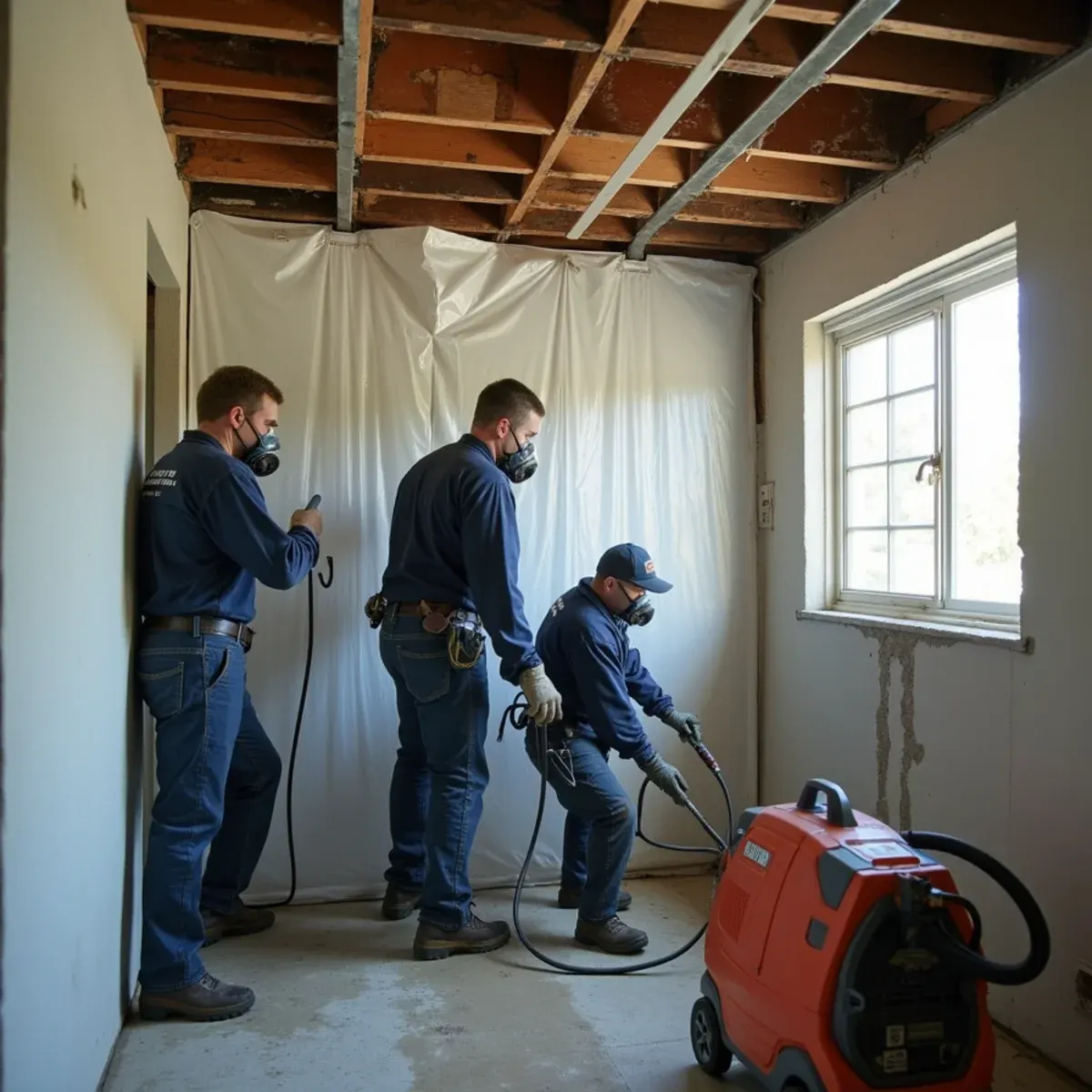
- Containment and negative air
- Documentation and contents triage
- Extraction and controlled demolition
- Cleaning and disinfection
- Structural drying and clearance
The Stanton Background Worth Knowing
Mobile and manufactured homes need a genuinely different restoration approach, and the reason is what they are built from. The floor system is typically particleboard or OSB over a wood frame with insulation and a vapor barrier belly wrap underneath — and particleboard exposed to water swells, loses structural integrity, and does not recover. It cannot be dried back to serviceable the way plywood often can.
There is more on the housing stock, drainage and plumbing history of this city on our water damage restoration in Stanton page.
Stanton at a glance
- Dominant construction era
- 1950–1975
- Foundation type
- mixed on grade
- Supply piping found here
- galvanized steel, copper, manufactured-home PEX and poly
- Drain line materials
- cast iron
- Terrain and water table
- flat, moderate water table
- Most common local failure
- underfloor leaks in manufactured homes, sealed inside the belly wrap where they cannot evaporate
- Highest-value local prevention
- checking for soft spots underfoot, because a manufactured-home floor gives no other warning
What It Costs in Stanton
We do not quote a number over the phone before seeing the property — anyone who does is guessing. The variables that actually move the price on a flood cleanup job are how high the water reached, how long it sat before extraction, contents volume in the flooded area, and they are broken down in full on the flood damage cleanup page. The assessment and the written estimate are free anywhere in Stanton, day or night, with no obligation.
Flood Cleanup Questions from Stanton Homeowners
Yes, and the intact-looking floor is the trap. Water that gets into the belly wrap sits against the underside of the decking with no airflow, so the top surface stays normal while the bottom degrades and growth builds in the insulation. We open the wrap, check moisture content in the decking and joists, and only close it back up when the readings say it is dry. If it truly is dry, we tell you that and leave.
Yes. Water that crossed soil, pavement, or a storm drain is Category 3 by IICRC classification regardless of appearance — it carries bacteria, fuel and oil residue, lawn chemicals, and whatever else was on the ground. Do not walk through it in open shoes, and keep children and pets out of the area entirely.
If the water came from outside across the ground, almost certainly not — that requires separate flood insurance. If it came from a failed water heater, a burst pipe, or a supply line inside the garage, it is usually covered. We document the source carefully because that distinction determines everything.
Yes, and we say so explicitly because a lot of companies will not. Manufactured homes need a different approach — opening the belly wrap to dry the floor cavity, removing saturated insulation, and honestly assessing particleboard decking, which usually cannot be dried back to serviceable.