
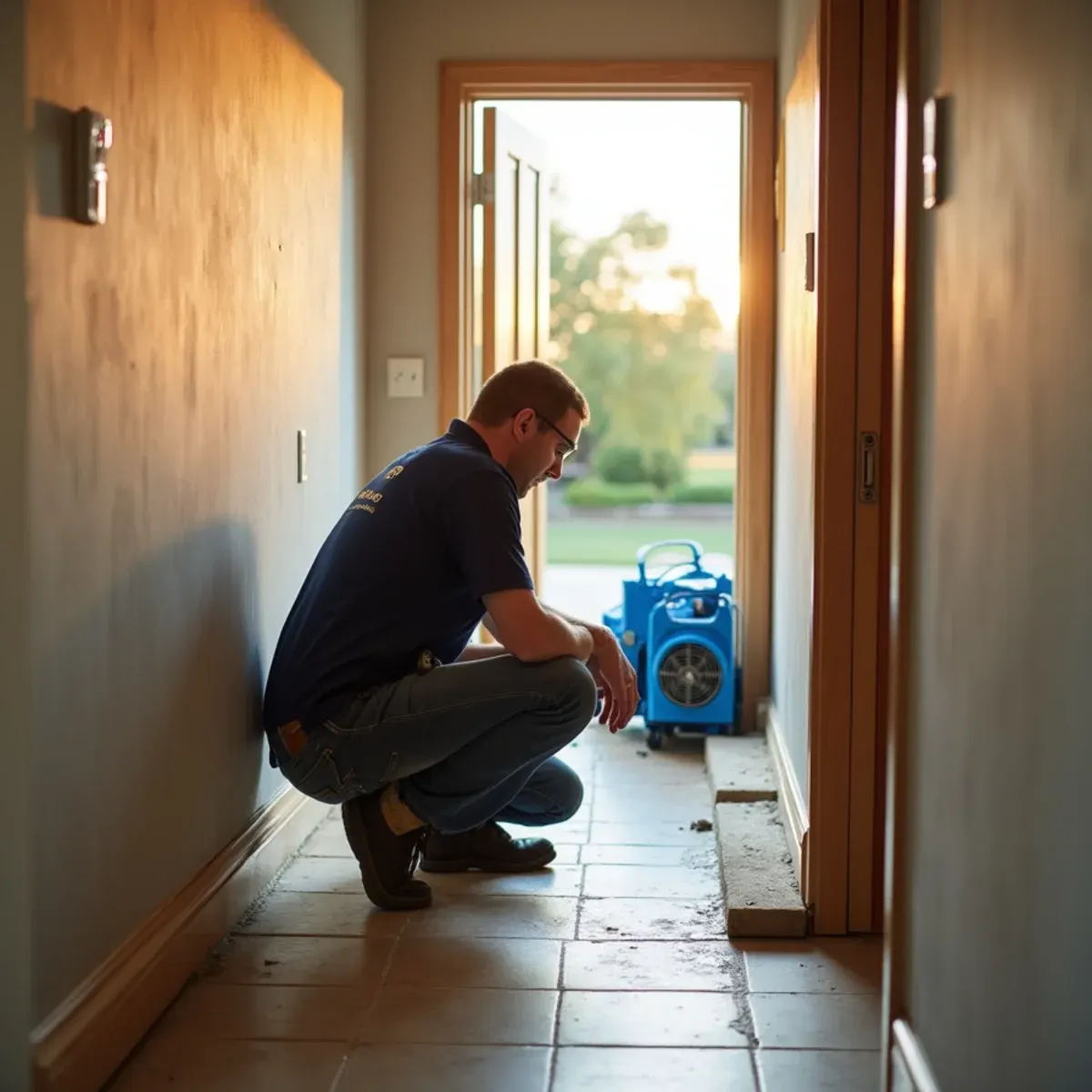
The supply line under a manufactured home lets go, and nothing happens. No puddle, no stain, no sound. The water goes straight down into the belly wrap, the sealed membrane slung beneath the floor, and it stays there. Insulation soaks, the particleboard decking above it starts drinking from underneath, and the first sign the family gets is a floor that feels slightly soft near the hall. That can be months after the break. Stanton has one of the largest manufactured-home populations in this part of the county, and this is the failure we see here more than any other.
It is also the job most restoration companies decline. Manufactured homes need the belly wrap opened and reclosed properly, PEX and polybutylene fittings understood rather than guessed at, and drying done from below as well as above. We do that work. Stanton is dense and mixed beyond the parks, too, with older apartment buildings along the Beach Boulevard corridor running galvanized and copper, and stick-built single-family homes near Stanton Central Park. The address on the phone changes the plan completely, so we ask about the construction before we load the truck.
What Stanton Changes About Burst Pipe Damage
1The belly wrap holds water for months
A belly wrap is designed to keep road spray and rodents out, which also means it keeps water in. A broken supply line above it fills the membrane like a shallow tray. Nothing evaporates. We cut and drain it deliberately at low points, pull saturated insulation, dry the underside of the deck directly, then patch the wrap so it still does its job. Skipping that step guarantees a return visit.
2Particleboard decking is on a short clock
Most manufactured-home floors are particleboard, not plywood. Once it takes on water from below it swells, loses fastener grip, and does not recover the way plywood does. There is a real window where drying saves the deck and after that only replacement works. That is why we treat any soft spot underfoot as urgent rather than cosmetic, and why we meter the deck from the crawl side.
3Older apartments on the same block
Stanton's density means we are often working a 1960s apartment building a street away from a mobile home park. Those buildings run galvanized and copper in shared plumbing walls, so a break there escalates unit to unit instead of downward into a membrane. Same city, opposite behavior. We confirm which we are walking into before deciding what equipment comes off the truck.
How the Work Runs
The method is the same one we use on every burst pipe damage job, documented to the IICRC S500:2025 standard. Here it is in short — the full burst pipe water damage repair process explains each stage in detail.
- Stop the source
- Locate the failure precisely
- Coordinate the plumbing repair
- Extract and open only what must be opened
- Cavity and structural drying
- Rebuild and finish
The Stanton Background Worth Knowing
Mobile and manufactured homes need a genuinely different restoration approach, and the reason is what they are built from. The floor system is typically particleboard or OSB over a wood frame with insulation and a vapor barrier belly wrap underneath — and particleboard exposed to water swells, loses structural integrity, and does not recover. It cannot be dried back to serviceable the way plywood often can.
There is more on the housing stock, drainage and plumbing history of this city on our water damage restoration in Stanton page.
Stanton at a glance
- Dominant construction era
- 1950–1975
- Foundation type
- mixed on grade
- Supply piping found here
- galvanized steel, copper, manufactured-home PEX and poly
- Drain line materials
- cast iron
- Terrain and water table
- flat, moderate water table
- Most common local failure
- underfloor leaks in manufactured homes, sealed inside the belly wrap where they cannot evaporate
- Highest-value local prevention
- checking for soft spots underfoot, because a manufactured-home floor gives no other warning
What It Costs in Stanton
We do not quote a number over the phone before seeing the property — anyone who does is guessing. The variables that actually move the price on a burst pipe damage job are how long the line ran before discovery, which floor it happened on, hot line versus cold line, and they are broken down in full on the burst pipe water damage repair page. The assessment and the written estimate are free anywhere in Stanton, day or night, with no obligation.
Burst Pipe Damage Questions from Stanton Homeowners
Yes. The belly wrap is the reason the job takes a specific method, not a reason to walk away. We open it at low points to release trapped water, remove the wet insulation instead of trying to dry it in place, dry the underside of the floor deck and the cavity above it, then reseal the wrap. We meter the decking through the process, because particleboard either recovers within a window or it does not.
We restore the water damage and coordinate the plumbing repair, working with your plumber or bringing in a licensed one from our network. Handling both under one schedule is what keeps a burst pipe from turning into two weeks of contractor coordination.
More than people expect. A half-inch supply line at typical residential pressure moves in the range of 8 to 10 gallons a minute. That is roughly 500 gallons in an hour — comparable to filling a small backyard pool inside your walls and floor.
Yes, and we say so explicitly because a lot of companies will not. Manufactured homes need a different approach — opening the belly wrap to dry the floor cavity, removing saturated insulation, and honestly assessing particleboard decking, which usually cannot be dried back to serviceable.