
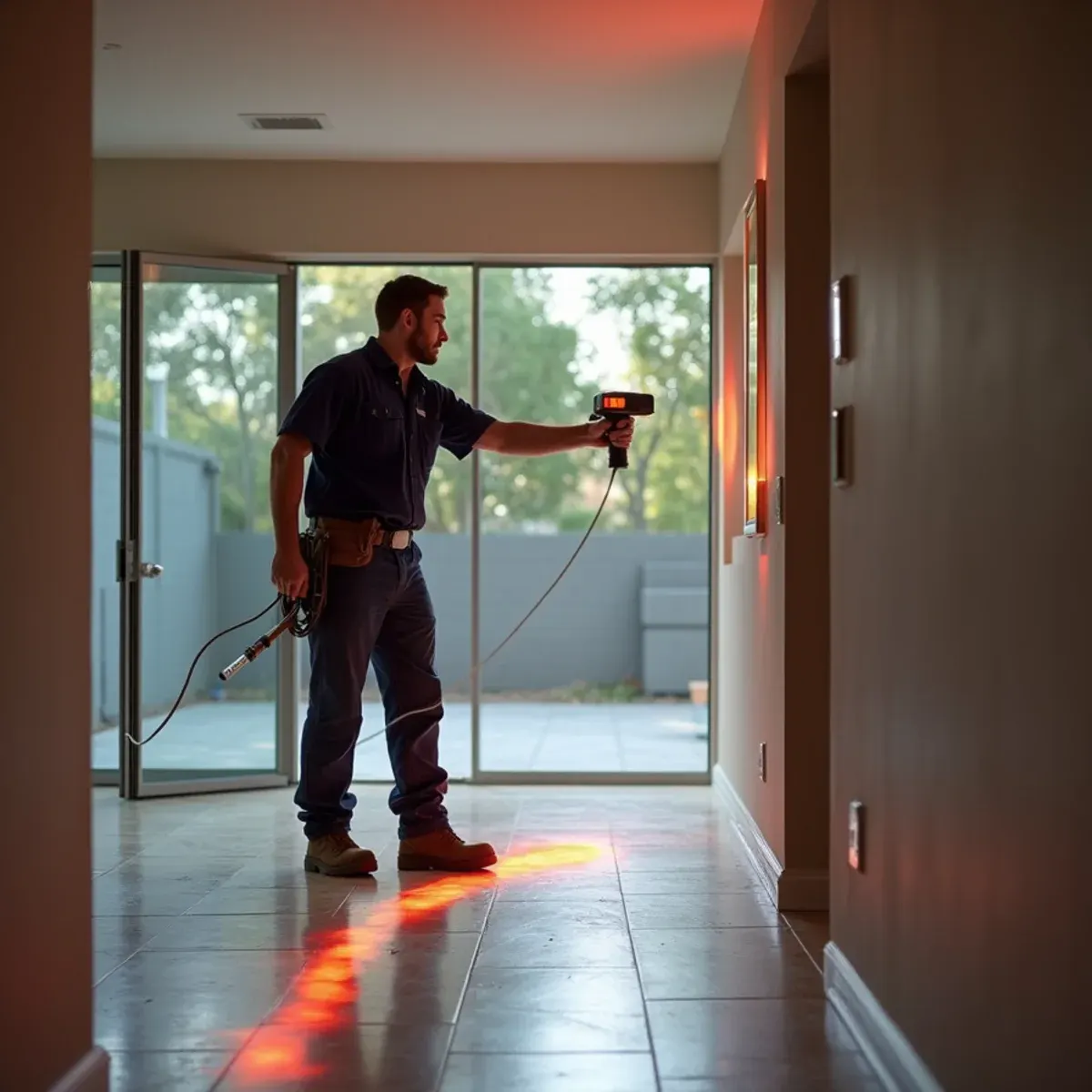
Plenty of Stanton homes don't have a slab to leak under. The city carries a significant manufactured-home population, and in those homes the supply lines run in the belly, PEX or older poly sealed inside a wrap beneath particleboard decking. A leak there behaves nothing like a slab leak. It can't evaporate and it can't drain, so it sits against the underside of your floor for months, and the first sign is usually a soft spot underfoot in front of the kitchen sink rather than water anyone can see.
For the parts of Stanton that are on slab, the older apartment buildings and the single-family blocks off the Beach Boulevard corridor, it's conventional galvanized and copper of 1950s to 1970s vintage with all the usual under-slab behavior. What isn't conventional is finding someone willing to handle both. A lot of restoration companies decline manufactured homes outright. We don't, and the honest reason we say so up front is that a wrapped underfloor takes different access, different equipment, and a slower drying plan than a concrete slab ever does.
What Stanton Changes About Slab Leak Damage
1The belly wrap holds water for months
A manufactured home's supply lines run inside a sealed underfloor wrap. Water that gets in can't evaporate and can't drain, so it sits against the underside of the decking until somebody notices a soft spot. Drying that cavity means opening and draining the wrap, not pointing air movers at the floor above it. Anyone telling you otherwise has not worked on these homes.
2Particleboard decking rarely comes back
The decking under most manufactured-home floors is particleboard, and once it has been wet for weeks it swells, loses strength and stays soft. We meter it and we'll dry whatever can be dried. We'll also say plainly when a section needs replacing, rather than let you find out a year from now when a chair leg goes through it.
3Older apartments with one shared shutoff
Stanton's older apartment stock is dense, mostly on slab, and frequently served by a single shutoff with no signage anywhere near it. When a line under the ground floor lets go, the minutes spent hunting for that valve are where most of the damage happens. We ask managers to mark it, photograph it, and keep the key with whoever answers the phone at midnight.
How the Work Runs
The method is the same one we use on every slab leak damage job, documented to the IICRC S500:2025 standard. Here it is in short — the full slab leak water damage repair process explains each stage in detail.
- Confirm it is actually a slab leak
- Electronic leak location
- Choose the repair approach with you
- Dry the slab and the affected assemblies
- Address the flooring and wall base
- Restore the floor and finish
The Stanton Background Worth Knowing
Mobile and manufactured homes need a genuinely different restoration approach, and the reason is what they are built from. The floor system is typically particleboard or OSB over a wood frame with insulation and a vapor barrier belly wrap underneath — and particleboard exposed to water swells, loses structural integrity, and does not recover. It cannot be dried back to serviceable the way plywood often can.
There is more on the housing stock, drainage and plumbing history of this city on our water damage restoration in Stanton page.
Stanton at a glance
- Dominant construction era
- 1950–1975
- Foundation type
- mixed on grade
- Supply piping found here
- galvanized steel, copper, manufactured-home PEX and poly
- Drain line materials
- cast iron
- Terrain and water table
- flat, moderate water table
- Most common local failure
- underfloor leaks in manufactured homes, sealed inside the belly wrap where they cannot evaporate
- Highest-value local prevention
- checking for soft spots underfoot, because a manufactured-home floor gives no other warning
What It Costs in Stanton
We do not quote a number over the phone before seeing the property — anyone who does is guessing. The variables that actually move the price on a slab leak damage job are how long the leak ran undetected, flooring type over the leak, repair method chosen, and they are broken down in full on the slab leak water damage repair page. The assessment and the written estimate are free anywhere in Stanton, day or night, with no obligation.
Slab Leak Damage Questions from Stanton Homeowners
That spongy feel is the only warning a manufactured-home floor gives, and it usually means a supply line has been leaking into the belly wrap for a while. There's nothing to see because the water is sealed underneath you. Don't wait for it to surface. We check with a moisture meter first, and if the decking reads wet, the wrap gets opened and drained before anything else happens.
The meter test is the first step: shut off every fixture and watch the low-flow indicator. If it moves and nothing is wet above the floor, suspect the slab. Warm spots on the floor, running-water sounds from below, and flooring that lifts or cups without an obvious cause all point the same direction. We confirm it with thermal imaging and moisture mapping at no charge.
Not always. Depending on where the leak is and the condition of the system, rerouting the line overhead through the attic and walls avoids opening the concrete entirely. When a spot repair is the better option, precise electronic location keeps the opening small — typically a couple of feet, not a trench across the room.
Yes, and we say so explicitly because a lot of companies will not. Manufactured homes need a different approach — opening the belly wrap to dry the floor cavity, removing saturated insulation, and honestly assessing particleboard decking, which usually cannot be dried back to serviceable.