
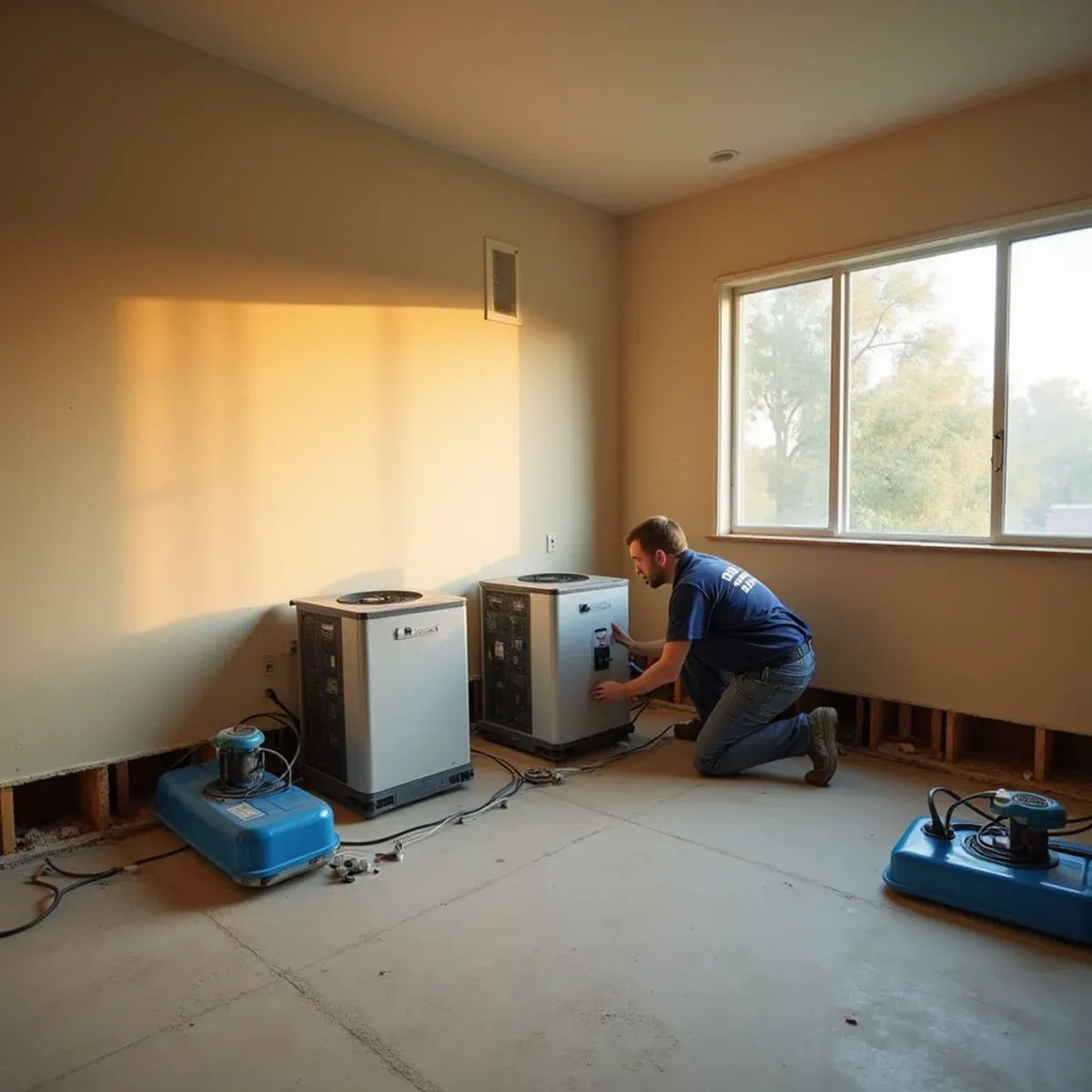
Most Garden Grove houses we dry are full. Three generations, sometimes two families, one kitchen, and nowhere for anybody to go for four days. That changes how the chamber gets built. We zone the house so the wet section is sealed and under negative pressure while the kitchen and at least one bathroom stay in service, place air movers where they aren't blowing into rooms people sleep in, and set the dehumidifier so its warm discharge doesn't turn a bedroom into an oven. The drying still has to be right. It also has to be livable.
The city went from farmland to a finished suburb in about fifteen years, so most of what we work in is 1950s and 60s slab-on-grade with galvanized or early copper, plumbing sized for a small postwar family and now carrying eight or ten people's daily cycles. Angle stops, supply risers and washer hoses wear out years ahead of schedule. Near Historic Main Street and around Garden Grove Park it's the same story: a slow leak behind a wall found late, with a wet area far wider than the mark on the drywall.
What Garden Grove Changes About Structural Drying
1Zoning a house nobody can leave
Containment here isn't about dust. It's about giving a family the rest of their home while we work: sealed barriers, negative pressure toward the equipment, and a route to the kitchen and a bathroom that doesn't cross the wet zone. We'll also agree on quiet hours where equipment can shift without stretching the schedule, and say so honestly when it can't.
2Heavy fixture use means slow leaks
A house running double or triple the fixture cycles it was designed for wears out valves and hoses early, and those failures usually seep rather than burst. Slow wetting drives moisture deeper into bottom plates, framing and slab, so the drying schedule runs longer than the size of the stain suggests. We map to the meter's edge, not the water mark's edge.
3Every reading written down and shared
In a house with several adults, and often a landlord or an extended family member handling the claim, verbal updates get lost. Each visit produces a logged set of readings with the date, the location and the equipment on site, in a form you can hand an adjuster or forward to a relative. It also proves the structure reached its dry standard rather than merely feeling dry.
How the Work Runs
The method is the same one we use on every structural drying job, documented to the IICRC S500:2025 standard. Here it is in short — the full structural drying & dehumidification process explains each stage in detail.
- Establish the dry standard
- Calculate the load and build the chamber
- Place air movers for surface evaporation
- Run LGR dehumidification to capture the moisture
- Monitor and adjust daily
- Verify, document, and demobilize
The Garden Grove Background Worth Knowing
A 1958 tract home was plumbed for a family of four with one bathroom in regular use, one washing machine, and a single water heater sized to match. Many Garden Grove homes today support considerably more than that, and the plumbing feels it.
There is more on the housing stock, drainage and plumbing history of this city on our water damage restoration in Garden Grove page.
Garden Grove at a glance
- Dominant construction era
- 1950–1970
- Foundation type
- slab on grade
- Supply piping found here
- galvanized steel, under-slab copper
- Drain line materials
- cast iron, clay
- Terrain and water table
- flat, moderate water table
- Most common local failure
- accelerated wear on angle stops, supply risers and washing machine hoses from far higher fixture cycle counts
- Highest-value local prevention
- shorter replacement intervals on every wear item — hoses at five years without exception
What It Costs in Garden Grove
We do not quote a number over the phone before seeing the property — anyone who does is guessing. The variables that actually move the price on a structural drying job are size of the drying chamber, class of water intrusion, material types involved, and they are broken down in full on the structural drying & dehumidification page. The assessment and the written estimate are free anywhere in Garden Grove, day or night, with no obligation.
Structural Drying Questions from Garden Grove Homeowners
In most cases, yes. We seal the wet area into its own zone under negative pressure, keep the kitchen and a bathroom outside that zone, and lay equipment and cords clear of walking paths. It's noisy and warmer than normal, and we won't pretend otherwise. Where the wet area includes the only kitchen or the only bathroom, we'll tell you early so you can plan, instead of you discovering it on day two.
Three to five days covers most residential losses. Saturated hardwood, plaster, or a concrete slab can run seven or more. We will give you an estimated window after the first readings and update you daily — and equipment comes out when the numbers say so, not on a fixed schedule.
We would rather you did not. Drying is a continuous process, and every hour off extends the total run — which usually costs more than the sleep is worth. If noise is genuinely unmanageable we can often reconfigure the chamber or reposition units to reduce it. Talk to us instead of unplugging them.
Yes, all five ZIP codes — 92840, 92841, 92843, 92844, and 92845 — for both residential and commercial properties. Response time runs about twenty-five to thirty-five minutes depending on where in the city.