
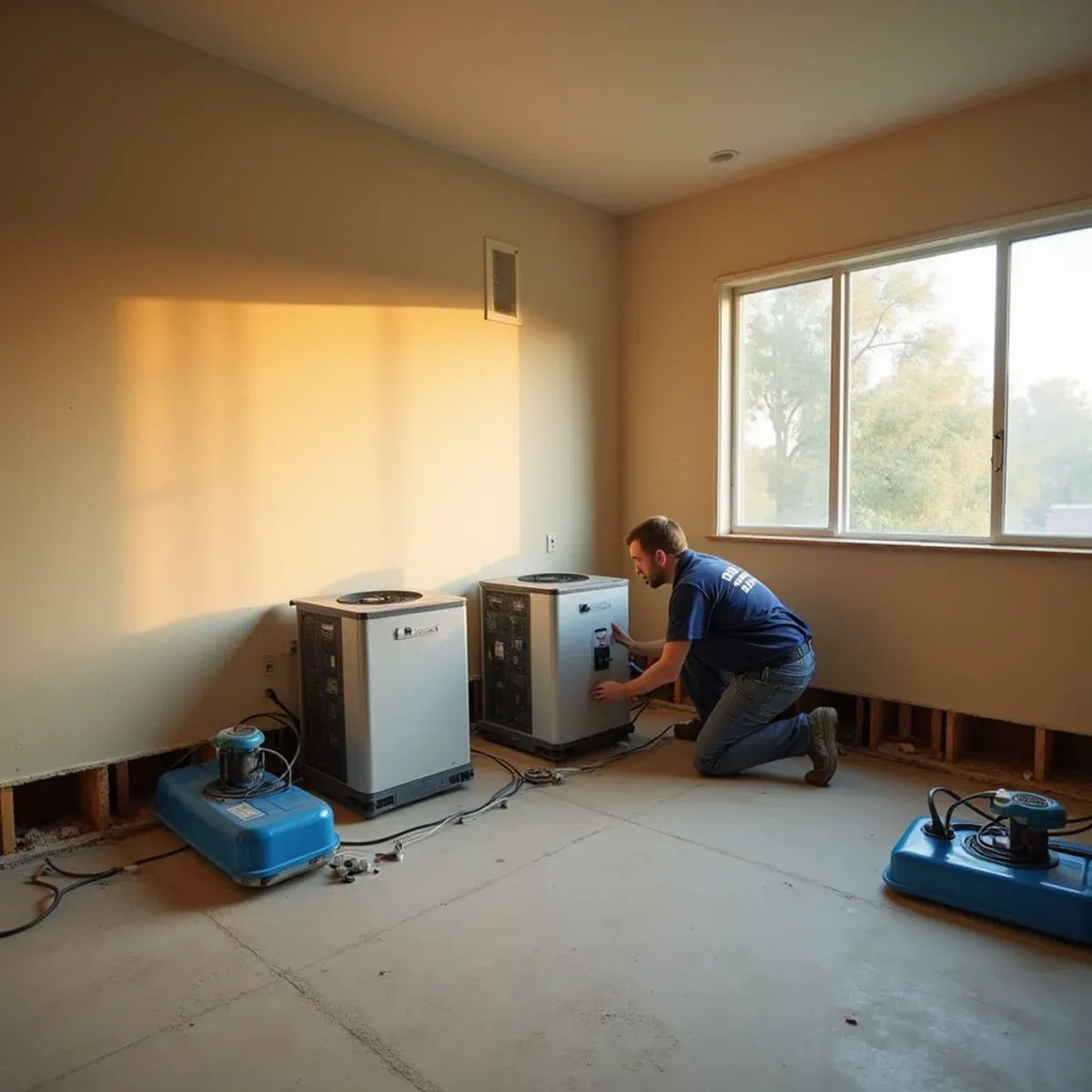
A slab in Westminster is never bone dry, and a drying plan that waits for one will run equipment a week past the point of doing any good. The ground sits low and flat near the Bolsa Chica channel with the water table close beneath it, so concrete here carries a higher baseline moisture load than concrete a few miles inland. That's why the first readings we take come off unaffected slab in the same building. That number becomes the target. Anything lower is chasing a figure the building never had.
The other half of our work is along Bolsa Avenue. Little Saigon packs restaurants, markets and small retail into buildings put up in the 1950s and 60s for something else entirely: commercial kitchens on old slabs, walk-ins against exterior walls, tile laid over two or three older floor coverings. Drying a working restaurant means containment the health inspector accepts, equipment that runs overnight and comes down before service, and readings that tell us whether yesterday's progress held or something under the tile is still feeding it.
What Westminster Changes About Structural Drying
1The dry standard comes from your own slab
IICRC S500:2025 asks for a dry standard drawn from unaffected material in the same structure, and in Westminster that instruction earns its keep. We record slab and wall readings in a dry part of the building before the first air mover runs, then dry to those. Without that step, an ordinary Westminster slab reading looks like an emergency and the job never officially ends.
2Test before new flooring goes down
Most flooring failures we get called back to look at here aren't leaks. They're a floor installed over a slab that was still releasing vapor. In-situ relative humidity probes set into the concrete give a number the adhesive manufacturer will actually stand behind. Waiting the extra days for that test is far cheaper than lifting a new floor and doing the whole room twice.
3Restaurant drying between services
Independent kitchens on Bolsa can't close for a week. We build hard containment between the wet area and the dining room, run heavy equipment overnight, and pull back whatever is in the way before doors open. Where water traveled under layered tile, we open a small section rather than guessing, because sealed layers hold moisture no amount of surface airflow will reach.
How the Work Runs
The method is the same one we use on every structural drying job, documented to the IICRC S500:2025 standard. Here it is in short — the full structural drying & dehumidification process explains each stage in detail.
- Establish the dry standard
- Calculate the load and build the chamber
- Place air movers for surface evaporation
- Run LGR dehumidification to capture the moisture
- Monitor and adjust daily
- Verify, document, and demobilize
The Westminster Background Worth Knowing
Westminster's shallow groundwater means many slabs here carry a higher baseline moisture load than slabs a few miles inland. In an undamaged home with breathable flooring that is usually a non-issue. It becomes an issue in two situations.
There is more on the housing stock, drainage and plumbing history of this city on our water damage restoration in Westminster page.
Westminster at a glance
- Dominant construction era
- 1950–1970
- Foundation type
- slab on grade
- Supply piping found here
- under-slab copper, galvanized steel
- Drain line materials
- cast iron
- Terrain and water table
- coastal-flat, shallow water table
- Most common local failure
- flooring installed over a slab that was never tested and is still releasing vapor
- Highest-value local prevention
- in-situ slab relative humidity testing before any new floor goes down
What It Costs in Westminster
We do not quote a number over the phone before seeing the property — anyone who does is guessing. The variables that actually move the price on a structural drying job are size of the drying chamber, class of water intrusion, material types involved, and they are broken down in full on the structural drying & dehumidification page. The assessment and the written estimate are free anywhere in Westminster, day or night, with no obligation.
Structural Drying Questions from Westminster Homeowners
Around here it's often the slab itself. With the water table this shallow, concrete holds and releases vapor as a background condition, and a surface meter can't tell that apart from a live leak. We compare readings against unaffected slab in the same building and, where new flooring is planned, set in-situ probes into the concrete for a proper number. That comparison usually settles the question in one visit, without opening anything.
Three to five days covers most residential losses. Saturated hardwood, plaster, or a concrete slab can run seven or more. We will give you an estimated window after the first readings and update you daily — and equipment comes out when the numbers say so, not on a fixed schedule.
We would rather you did not. Drying is a continuous process, and every hour off extends the total run — which usually costs more than the sleep is worth. If noise is genuinely unmanageable we can often reconfigure the chamber or reposition units to reduce it. Talk to us instead of unplugging them.
Westminster has a shallow water table, so slabs here carry more baseline moisture than slabs further inland. Normally that is harmless, but it matters when installing flooring over the slab and it means drying after a loss takes longer. We test with in-situ relative humidity probes before any new floor goes down.