
People here get turned away. Midway City is about a square mile of unincorporated Orange County wedged between Westminster and Huntington Beach, no city hall, roughly 8,500 residents, and companies that build service lists from city names skip right over it. We don't. Permitting runs through the county rather than a city building department, which matters the moment drying turns into repairs, and knowing that in advance saves the better part of a week. For the drying itself, the more important fact is that this housing is older on average than the cities on either side.
It's a genuine mix: 1940s and 50s single-family, some of it on raised foundations, a substantial number of mobile and manufactured homes, and modest multi-family. The ground sits low near the Bolsa Avenue corridor with a shallow water table underneath, so a crawl space here carries moisture even in a dry month, and the dry standard for a subfloor has to come from that reality instead of a generic target. In the manufactured homes, water goes under the decking into the belly wrap and stays there, which is different work with different equipment.
What Midway City Changes About Structural Drying
1County permitting, not a city department
There is no Midway City building department. Anything moving past drying into structural repair goes through Orange County, and the timeline and inspection process are not the same as Westminster's next door. We plan for that from the first visit, so the drying work and the repair schedule line up instead of the job stalling once the equipment comes out.
2Crawl spaces that are never truly dry
Sitting low with a shallow water table, the crawl under an older home here carries moisture year round. Drying to a textbook number would mean running equipment forever. We set the standard from unaffected framing in the same crawl, dry the wet zone to match it, and note that baseline in the log so nobody later reads a normal number as an unfinished job.
3Two housing types on the same street
A site-built 1950s house and the manufactured home next door need entirely different drying approaches: one is cavity and crawl work, the other means opening a belly wrap and drying decking from underneath. We confirm which we're dealing with before quoting equipment or time, because guessing wrong here costs days and a great deal of unnecessary noise.
How the Work Runs
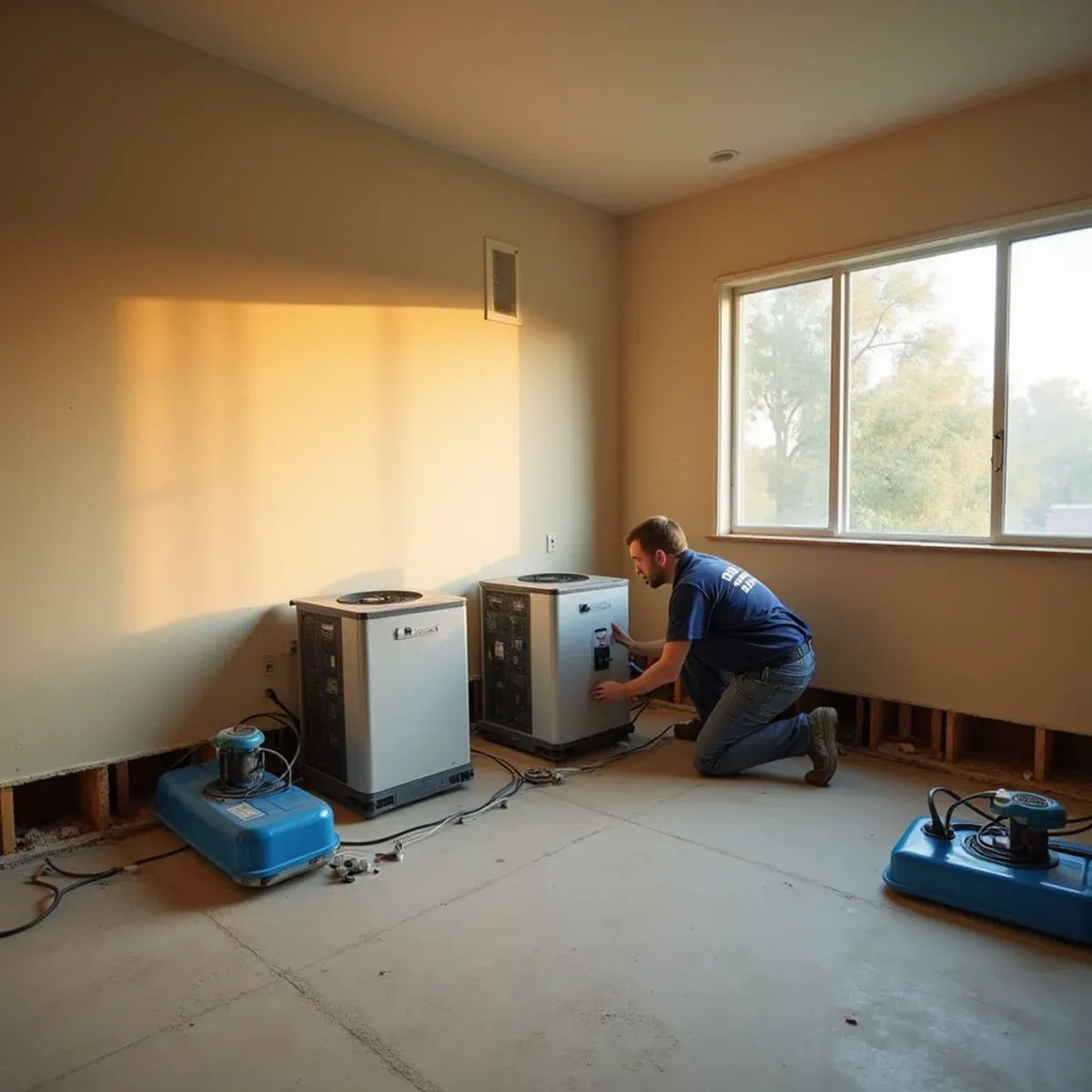
The method is the same one we use on every structural drying job, documented to the IICRC S500:2025 standard. Here it is in short — the full structural drying & dehumidification process explains each stage in detail.
- Establish the dry standard
- Calculate the load and build the chamber
- Place air movers for surface evaporation
- Run LGR dehumidification to capture the moisture
- Monitor and adjust daily
- Verify, document, and demobilize
The Midway City Background Worth Knowing
Midway City's housing stock is older than its neighbors on average, with a good deal of it predating 1960, and it includes a substantial mobile home population. That combination produces a specific mix of problems.
There is more on the housing stock, drainage and plumbing history of this city on our water damage restoration in Midway City page.
Midway City at a glance
- Dominant construction era
- 1940–1960
- Foundation type
- mixed on grade
- Supply piping found here
- galvanized steel, copper, manufactured-home supply lines
- Drain line materials
- cast iron, clay
- Terrain and water table
- coastal-flat, shallow water table
- Most common local failure
- manufactured-home underfloor leaks trapped in the belly wrap, which can sit for months
- Highest-value local prevention
- treating any spongy floor area as a moisture problem until a meter says otherwise
What It Costs in Midway City
We do not quote a number over the phone before seeing the property — anyone who does is guessing. The variables that actually move the price on a structural drying job are size of the drying chamber, class of water intrusion, material types involved, and they are broken down in full on the structural drying & dehumidification page. The assessment and the written estimate are free anywhere in Midway City, day or night, with no obligation.
Structural Drying Questions from Midway City Homeowners
Drying itself doesn't need a permit, so nothing changes there. What changes is the repair work afterward, which goes through Orange County rather than a city department, with its own process and timing. Your insurance works the same way it would anywhere else. The practical difference is finding a company that actually comes out here, and scheduling repairs around county inspections instead of a city counter a few blocks away.
Three to five days covers most residential losses. Saturated hardwood, plaster, or a concrete slab can run seven or more. We will give you an estimated window after the first readings and update you daily — and equipment comes out when the numbers say so, not on a fixed schedule.
We would rather you did not. Drying is a continuous process, and every hour off extends the total run — which usually costs more than the sleep is worth. If noise is genuinely unmanageable we can often reconfigure the chamber or reposition units to reduce it. Talk to us instead of unplugging them.
Yes, fully. It is about a fourteen-minute run from our Cypress base — closer than several cities we serve routinely — and the 60-minute response commitment applies here the same as anywhere else in our area.