
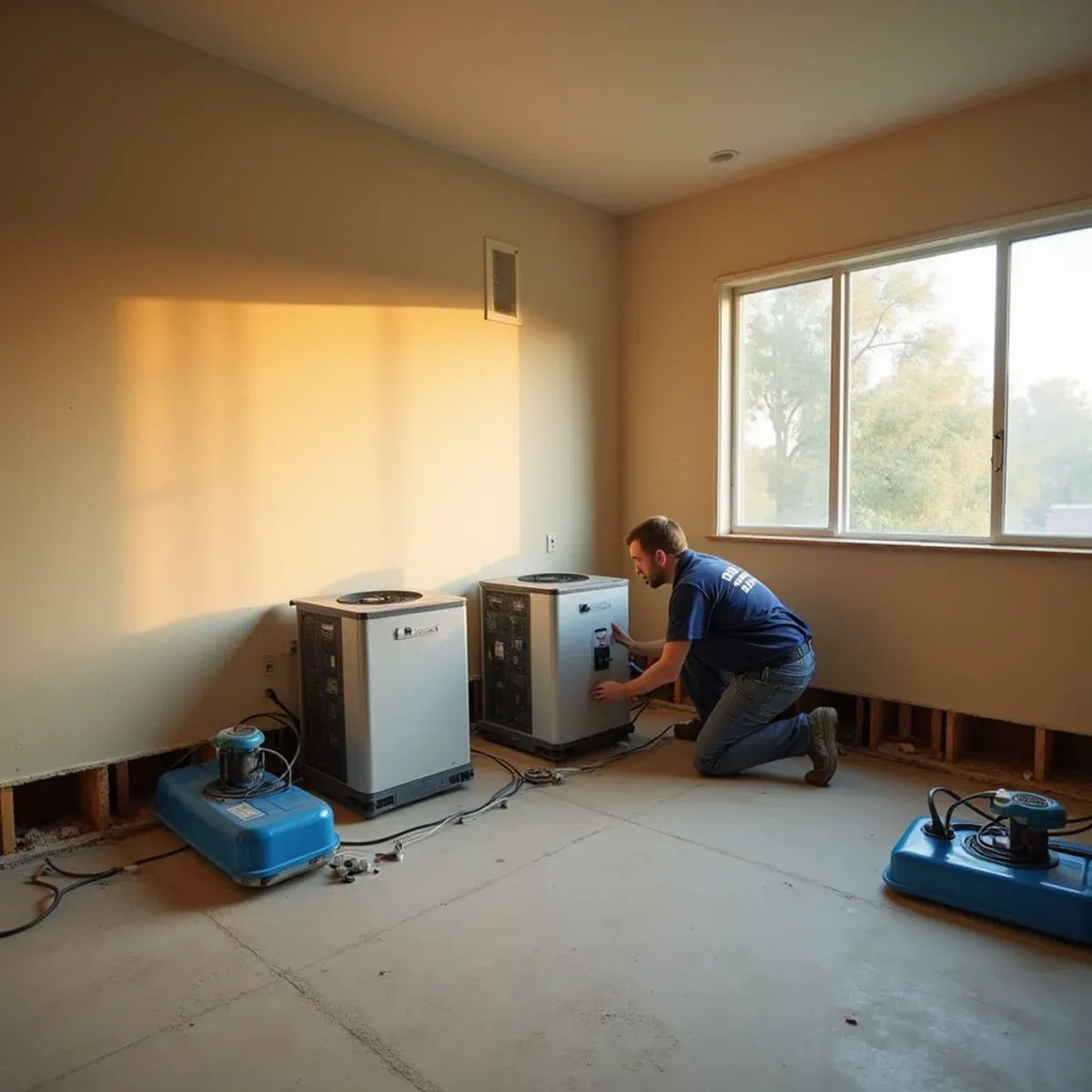
The expensive part of an apartment loss in Buena Park usually isn't the water. It's the four days a unit can't be rented and the two neighbors who now have wet drywall on a shared wall. Drying a stack of units is a different animal than drying a house. The chamber has to cross doors belonging to different tenants, the panel in a 1960s building limits how many air movers a unit can actually run, and somebody has to be able to say later exactly which unit got what equipment on which day.
This city carries far more multi-family and hospitality than its neighbors: substantial apartment stock alongside the hotels and restaurants strung along Beach Boulevard near Knott's Berry Farm, plus the 1950s and 60s tracts out toward Ralph B. Clark Regional Park. A hotel room out of service costs money every night it sits, so we build tight containment, run the loud equipment on a schedule that fits occupancy, and dry in place wherever the materials allow. Each affected unit gets its own moisture map and its own daily log.
What Buena Park Changes About Structural Drying
1Circuit capacity limits equipment in older units
A 1960s apartment panel was never designed to feed six air movers and a dehumidifier in one unit. We map the circuits before loading them, run cords to separate breakers, and bring distribution when a building can't support the load any other way. Sometimes the honest answer is that drying takes an extra day because the electrical won't safely support finishing sooner.
2One loss, several tenants and policies
When a riser fails, the wet units belong to different renters with different contents policies while the building belongs to one owner. We document each unit separately from the first hour: its own moisture readings, its own photos, its own drying log. That separation is what keeps a four-unit claim from turning into an argument about who caused what, months after the equipment is gone.
3Keeping hotel rooms and restaurants earning
Along the Beach Boulevard corridor, closure costs more than the restoration does. We contain the affected rooms so adjacent ones stay sellable, stage the noisiest work overnight, and set equipment where housekeeping and guests aren't stepping over hoses. Drying in place matters more here than almost anywhere, because demolition means a room out of inventory for weeks instead of days.
How the Work Runs
The method is the same one we use on every structural drying job, documented to the IICRC S500:2025 standard. Here it is in short — the full structural drying & dehumidification process explains each stage in detail.
- Establish the dry standard
- Calculate the load and build the chamber
- Place air movers for surface evaporation
- Run LGR dehumidification to capture the moisture
- Monitor and adjust daily
- Verify, document, and demobilize
The Buena Park Background Worth Knowing
Buena Park has a large apartment and condominium stock, and multi-unit water losses are a meaningful share of our work here. A supply line failure in a second-floor unit reaches the unit below within minutes and frequently affects three or four units before anyone finds the shutoff.
There is more on the housing stock, drainage and plumbing history of this city on our water damage restoration in Buena Park page.
Buena Park at a glance
- Dominant construction era
- 1950–1975
- Foundation type
- slab on grade
- Supply piping found here
- galvanized steel, under-slab copper
- Drain line materials
- cast iron
- Terrain and water table
- flat, moderate water table
- Most common local failure
- multi-unit escalation, where one riser or supply failure reaches three or four units before anyone finds the shutoff
- Highest-value local prevention
- posting the main shutoff location and an emergency contact where tenants will actually see it
What It Costs in Buena Park
We do not quote a number over the phone before seeing the property — anyone who does is guessing. The variables that actually move the price on a structural drying job are size of the drying chamber, class of water intrusion, material types involved, and they are broken down in full on the structural drying & dehumidification page. The assessment and the written estimate are free anywhere in Buena Park, day or night, with no obligation.
Structural Drying Questions from Buena Park Homeowners
Usually yes. We contain the wet rooms with sealed barriers and hold them under negative pressure so the corridor and neighboring rooms stay unaffected, then verify with readings on the far side of each shared wall. The limiting factor is normally power rather than containment, and occasionally the wet wall assembly extends into the next room, which mapping finds. We'll tell you upfront which rooms have to come out of inventory and for how long.
Three to five days covers most residential losses. Saturated hardwood, plaster, or a concrete slab can run seven or more. We will give you an estimated window after the first readings and update you daily — and equipment comes out when the numbers say so, not on a fixed schedule.
We would rather you did not. Drying is a continuous process, and every hour off extends the total run — which usually costs more than the sleep is worth. If noise is genuinely unmanageable we can often reconfigure the chamber or reposition units to reduce it. Talk to us instead of unplugging them.
Regularly. Multi-unit losses get documented unit by unit with separate photographs, moisture maps, and drying logs, which is what lets several owners, an HOA, and multiple carriers each resolve their portion without disputing a single blended invoice.