
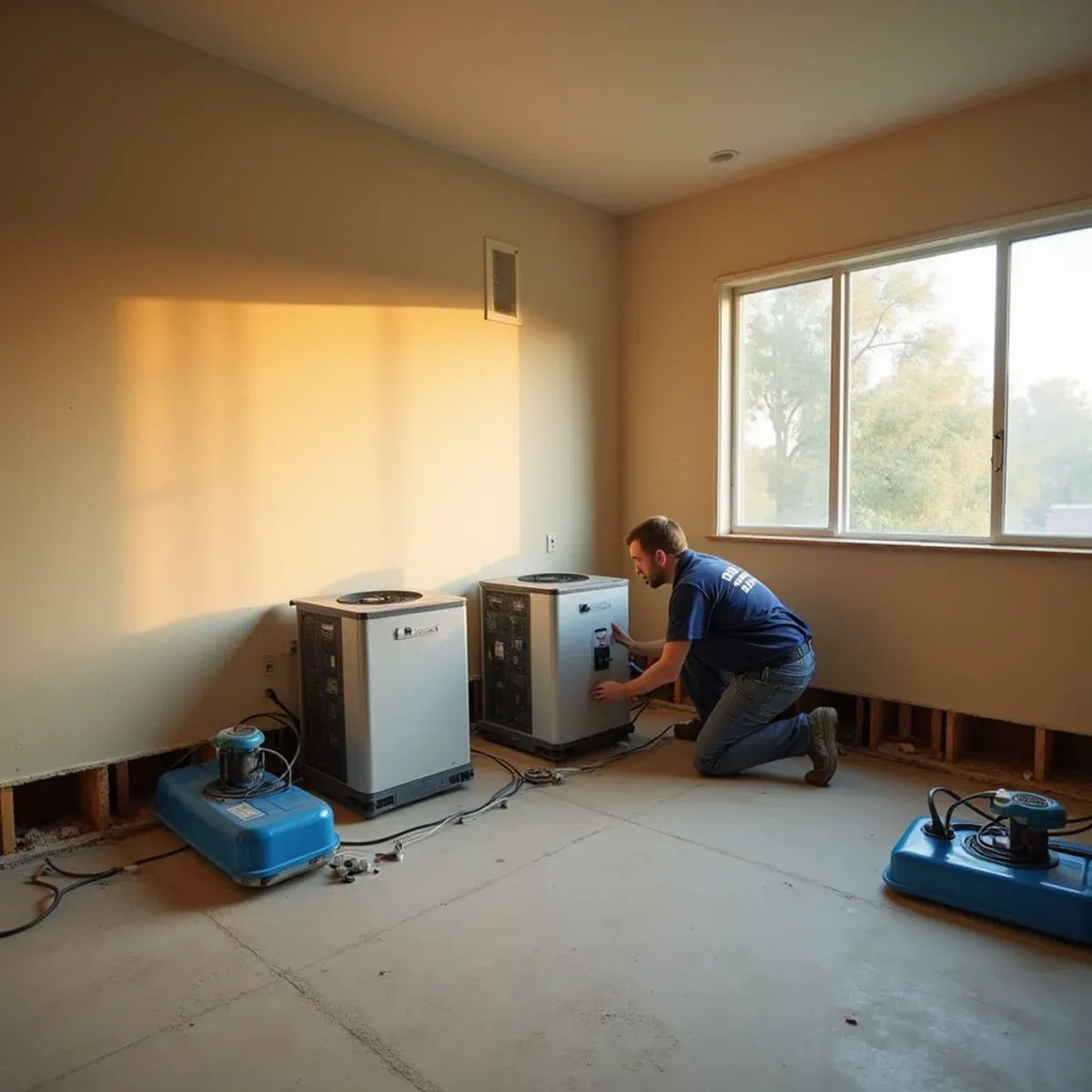
The angle stop behind an upstairs toilet weeps for a week before anyone sees anything. Nothing shows on the second floor. The water runs along the subfloor, finds a joist bay, and turns up as a soft brown ring on the living room ceiling six feet from the bathroom. That is the standard La Palma loss. This city went up with more two-story homes than the tracts around it, and in a two-story house the wet material is the sandwich between the floors, not the room you happen to be standing in.
La Palma filled in almost entirely between 1960 and 1980, on slab, with copper underneath, and the homes near Central Park and along the Walker Street corridor have been maintained well enough that owners assume the plumbing got the same attention. It didn't. Those supply lines are original. When one lets go, the drying chamber has to enclose the ceiling cavity below and the room above at the same time, with dehumidification sized for both volumes. We open small inspection holes to reach the cavity rather than taking a ceiling down.
What La Palma Changes About Structural Drying
1Drying the sandwich between two floors
A closed floor assembly won't dry from either room. We open small holes at the ends of the wet joist bays, push dry air through the cavity, and pull it out under negative pressure so moisture leaves the building instead of soaking the drywall it passes on the way. Readings come off the subfloor above and the ceiling below, and both faces have to hit the dry standard.
2Repeat floor plans make water predictable
With a handful of plans repeated across the city, we generally know where the upstairs plumbing wall lands, which direction the joists run, and where a leak in that wall will surface downstairs. That saves inspection holes and guesswork. It also lets us size the equipment load from real room volumes on the first visit instead of adding fans on day two.
3Confirm the main shutoff still turns
Nothing dries while water is still arriving. In houses this age the main valve has often sat untouched for decades and seizes exactly when it's needed. Find yours, turn it once, and if it fights you, have it replaced before it matters. Ten minutes on a Saturday is worth more than any equipment we own on the night a second-floor line fails.
How the Work Runs
The method is the same one we use on every structural drying job, documented to the IICRC S500:2025 standard. Here it is in short — the full structural drying & dehumidification process explains each stage in detail.
- Establish the dry standard
- Calculate the load and build the chamber
- Place air movers for surface evaporation
- Run LGR dehumidification to capture the moisture
- Monitor and adjust daily
- Verify, document, and demobilize
The La Palma Background Worth Knowing
There is a pattern we see repeatedly in La Palma. A homeowner has taken excellent care of a house for thirty years — new roof, dual-pane windows, updated electrical panel, remodeled kitchen. Then a slab leak runs for eight months under the living room and nobody catches it, because there was never anything to see.
There is more on the housing stock, drainage and plumbing history of this city on our water damage restoration in La Palma page.
La Palma at a glance
- Dominant construction era
- 1960–1980
- Foundation type
- slab on grade
- Supply piping found here
- under-slab copper
- Drain line materials
- cast iron, ABS
- Terrain and water table
- flat, moderate water table
- Most common local failure
- second-floor supply and fixture failures that travel through the floor assembly into the ceiling below
- Highest-value local prevention
- knowing where the main shutoff is and confirming it still turns, because two-story losses double in size in minutes
What It Costs in La Palma
We do not quote a number over the phone before seeing the property — anyone who does is guessing. The variables that actually move the price on a structural drying job are size of the drying chamber, class of water intrusion, material types involved, and they are broken down in full on the structural drying & dehumidification page. The assessment and the written estimate are free anywhere in La Palma, day or night, with no obligation.
Structural Drying Questions from La Palma Homeowners
Most of the time, no. We drill small access holes at the ends of the wet joist bays and move dry air through the cavity, in one end and out the other, which leaves the ceiling intact and patchable with a few coin-sized repairs. Removal becomes the honest answer when the drywall has lost its bond, when insulation is saturated, or when the water was contaminated. We meter first and tell you which situation you're in before anything comes down.
Three to five days covers most residential losses. Saturated hardwood, plaster, or a concrete slab can run seven or more. We will give you an estimated window after the first readings and update you daily — and equipment comes out when the numbers say so, not on a fixed schedule.
We would rather you did not. Drying is a continuous process, and every hour off extends the total run — which usually costs more than the sleep is worth. If noise is genuinely unmanageable we can often reconfigure the chamber or reposition units to reduce it. Talk to us instead of unplugging them.
Typically fifteen to twenty minutes. La Palma borders Cypress directly to the north, so it is one of the fastest calls we run and the 60-minute commitment applies in full.