
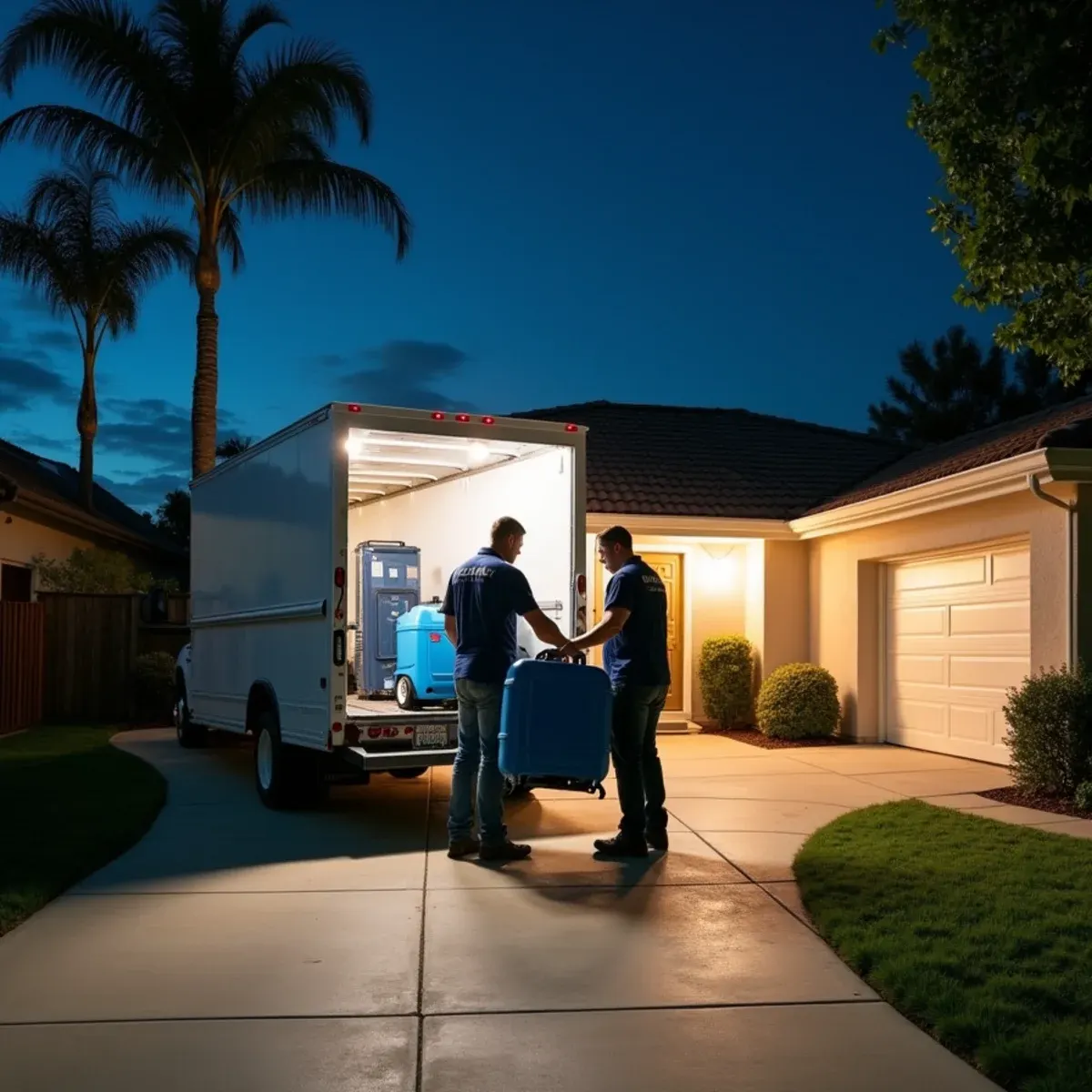
A well-kept house and a well-kept plumbing system are two different things. La Palma has an unusually high share of long-tenured owners, and it shows in the paint, the roofs and the yards through the Walker Street tracts. What all that maintenance never reached is the under-slab copper installed between 1965 and 1980, sitting in soil chemistry nobody has looked at since the day the slab was poured. From the curb these houses look twenty years old. The supply lines beneath them are pushing fifty.
The second thing that makes this city different is height. More two-story homes were built here than in the neighboring tracts, and a failure at an upstairs angle stop, toilet supply or shower pan does not stay upstairs. Water spreads sideways across the subfloor inside a sealed floor assembly, then finds a light fixture or a seam and comes through a downstairs ceiling that can be a full room away from the source. Finding that source before anyone cuts drywall is most of the job in a La Palma two-story.
What La Palma Changes About Emergency Restoration
1Upstairs source, downstairs ceiling stain
In a two-story floor assembly, water travels along the subfloor and drops wherever it finds a penetration. The ceiling stain marks the exit, not the failure. We meter the upstairs floor and scan the cavity from below before opening anything, so the cut lands on wet framing instead of adding a second hole in a ceiling that was perfectly fine.
2Under-slab copper nobody has inspected
Copper run under a slab in the 1970s is now decades into pitting from the outside in, and the first sign is often a warm patch on the floor or a meter that never quite stops turning. Slab work in La Palma is usually a reroute rather than a dig, and either way our part is drying the slab and the wall base to a documented standard afterward.
3Finding a shutoff that still turns
On a two-story failure, minutes decide whether you lose a ceiling or a floor. A lot of the original main shutoffs in this city are seized from forty years of never being used, and a valve you cannot turn is not a shutoff. Find yours this week, turn it, and if it fights you, replace it before you need it at midnight.
How the Work Runs
The method is the same one we use on every emergency restoration job, documented to the IICRC S500:2025 standard. Here it is in short — the full emergency water damage restoration process explains each stage in detail.
- Call answered and crew dispatched
- Arrival, safety check, and moisture mapping
- Documentation before anything is touched
- Extraction
- Controlled structural drying
- Cleaning, sanitizing, and final verification
The La Palma Background Worth Knowing
There is a pattern we see repeatedly in La Palma. A homeowner has taken excellent care of a house for thirty years — new roof, dual-pane windows, updated electrical panel, remodeled kitchen. Then a slab leak runs for eight months under the living room and nobody catches it, because there was never anything to see.
There is more on the housing stock, drainage and plumbing history of this city on our water damage restoration in La Palma page.
La Palma at a glance
- Dominant construction era
- 1960–1980
- Foundation type
- slab on grade
- Supply piping found here
- under-slab copper
- Drain line materials
- cast iron, ABS
- Terrain and water table
- flat, moderate water table
- Most common local failure
- second-floor supply and fixture failures that travel through the floor assembly into the ceiling below
- Highest-value local prevention
- knowing where the main shutoff is and confirming it still turns, because two-story losses double in size in minutes
What It Costs in La Palma
We do not quote a number over the phone before seeing the property — anyone who does is guessing. The variables that actually move the price on a emergency restoration job are water category, affected square footage and number of rooms, how many days of equipment, and they are broken down in full on the emergency water damage restoration page. The assessment and the written estimate are free anywhere in La Palma, day or night, with no obligation.
Emergency Restoration Questions from La Palma Homeowners
It's common in these plans. The wet spot upstairs can sit under a vanity, inside a wall or beneath tile that hides it, while water runs along a joist bay and exits through a ceiling penetration ten feet away. We meter the upstairs floor, scan the ceiling from below, and open the smallest access that confirms the path. Only then does equipment go in, because guessing at the source usually means repairing two ceilings instead of one.
We commit to being on-site within 60 minutes of a confirmed emergency call anywhere in Cypress, and we credit $100 off your invoice if we miss it. Most of the time we are there in 30 to 45 minutes because our trucks stage on Katella Avenue, right here in the city.
No. The emergency assessment and written estimate are free, 24 hours a day. You are not obligated to hire us after we walk the property, and we will tell you plainly if we think the damage is small enough to handle yourself.
Typically fifteen to twenty minutes. La Palma borders Cypress directly to the north, so it is one of the fastest calls we run and the 60-minute commitment applies in full.