
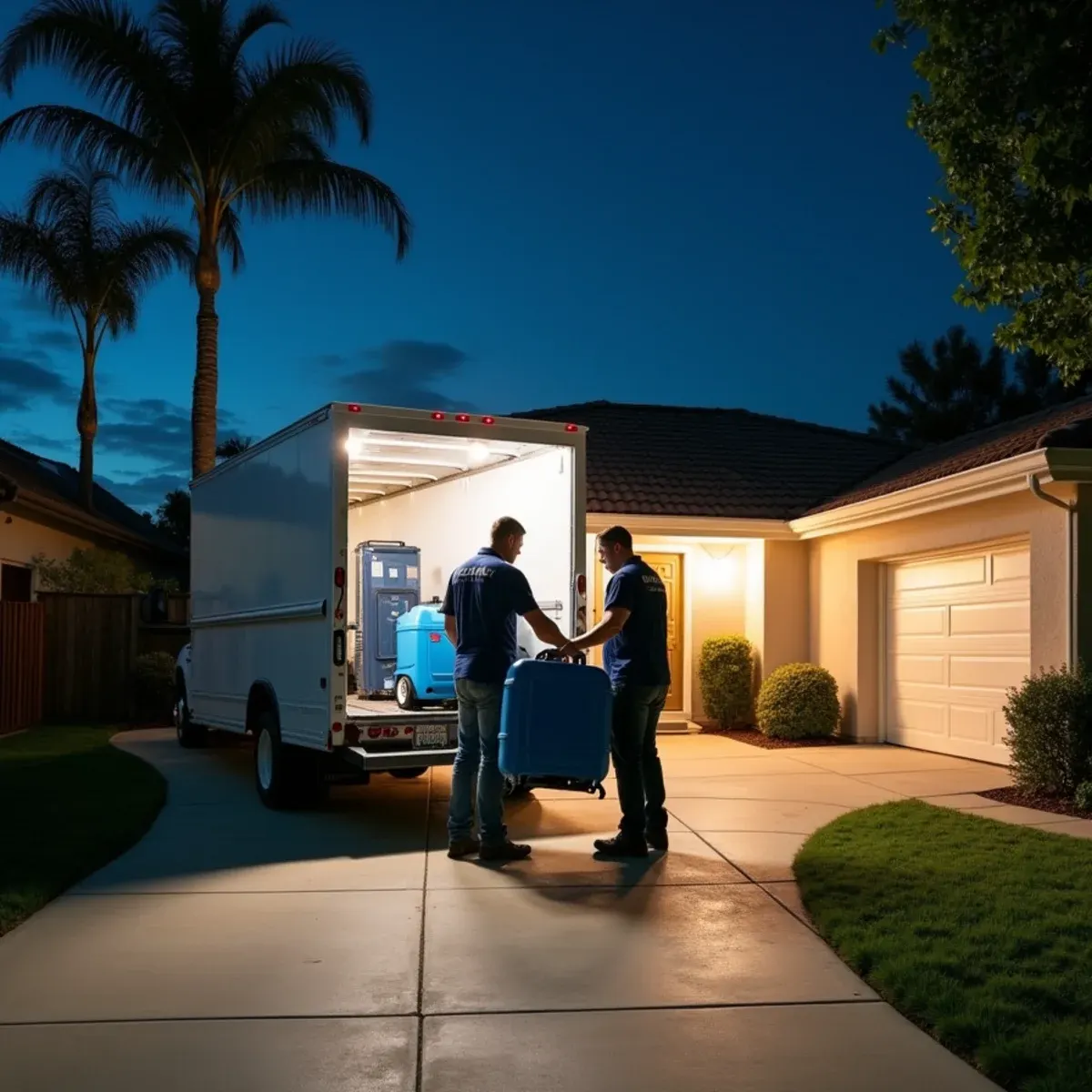
The instinct after a flood is to throw the windows open. Within a couple of miles of the coast, that often makes things worse. Costa Mesa sits close enough to the water that the marine layer keeps outdoor humidity high for much of the year, especially overnight and in the morning, so open windows can pull moist air into a house we are trying to dry. Here we close the building, condition the air with dehumidification, and control airflow deliberately instead of hoping the outside will help.
The city gives us three distinct building problems. The Eastside is small 1920s to 1940s cottages on raised foundations under a heavy tree canopy, where crawl spaces stay damp for weeks. Mesa Verde is 1960s slab tract on under-slab copper. The Westside mixes industrial buildings with housing. The Santa Ana River runs the western edge and the water table is shallow across a lot of the city, which affects low-lying garages and additions near Fairview Park and Talbert. We are about twenty minutes north in Cypress.
What Costa Mesa Changes About Emergency Restoration
1Open windows are the wrong instinct here
Drying works on vapor pressure difference, not on fresh air. When the marine layer is in and the outdoor dew point is high, opening a Costa Mesa house adds moisture to the load our dehumidifiers have to remove. We seal the affected area, run closed drying, and monitor grains per pound inside and out so the call is based on numbers rather than instinct.
2Eastside crawl spaces stay wet
Under those Eastside cottages, the vents that are supposed to dry the space bring in humid coastal air for a good part of the year, and the shade from the mature canopy means the ground under the house rarely sees any warmth. A plumbing leak into that environment does not evaporate away. We dry the space mechanically, check whether a ground vapor retarder exists, and meter joists and subfloor rather than judging by feel.
3Shallow groundwater near the river
In the lower parts of the city toward the Santa Ana River, Fairview Park and Talbert, groundwater sits close to the surface. That shows up as slabs and garage floors that never fully dry, standing water that returns after extraction, and moisture pushing up through flooring adhesive. We distinguish that from an active plumbing leak early, because they call for completely different work and only one of them is a restoration job.
How the Work Runs
The method is the same one we use on every emergency restoration job, documented to the IICRC S500:2025 standard. Here it is in short — the full emergency water damage restoration process explains each stage in detail.
- Call answered and crew dispatched
- Arrival, safety check, and moisture mapping
- Documentation before anything is touched
- Extraction
- Controlled structural drying
- Cleaning, sanitizing, and final verification
The Costa Mesa Background Worth Knowing
Under a raised Eastside cottage there is bare soil, and that soil is supposed to stay dry because the foundation vents exchange air with the outside. That system depends on the outside air being drier than the space under the house. For a good part of the year in Costa Mesa it is not. The marine layer holds humidity high through the night and well into the morning, so the crawl space never gets the dry stretch it needs, and moisture that arrives from a plumbing drip, a downspout, or an irrigation line just accumulates.
There is more on the housing stock, drainage and plumbing history of this city on our water damage restoration in Costa Mesa page.
Costa Mesa at a glance
- Dominant construction era
- 1920–1980
- Foundation type
- mixed on grade
- Supply piping found here
- original 1920s–1940s piping on the Eastside, galvanized steel, under-slab copper
- Drain line materials
- cast iron, clay
- Terrain and water table
- coastal-flat, shallow water table
- Most common local failure
- crawl-space moisture under Eastside cottages, held in by a marine layer that slows every natural drying process
- Highest-value local prevention
- confirming crawl-space vents are actually open and that the ground under the house is dry
What It Costs in Costa Mesa
We do not quote a number over the phone before seeing the property — anyone who does is guessing. The variables that actually move the price on a emergency restoration job are water category, affected square footage and number of rooms, how many days of equipment, and they are broken down in full on the emergency water damage restoration page. The assessment and the written estimate are free anywhere in Costa Mesa, day or night, with no obligation.
Emergency Restoration Questions from Costa Mesa Homeowners
Because the air you are drying into is wetter. Every drying job is a race between how fast moisture leaves materials and how much the surrounding air can hold, and Costa Mesa's marine influence loads that air before we start. Raised-foundation cottages under a heavy canopy make it slower still. We would rather run two or three extra days and hit the documented dry standard under S500:2025 than pull equipment on schedule and leave wet framing behind a finished wall.
We commit to being on-site within 60 minutes of a confirmed emergency call anywhere in Cypress, and we credit $100 off your invoice if we miss it. Most of the time we are there in 30 to 45 minutes because our trucks stage on Katella Avenue, right here in the city.
No. The emergency assessment and written estimate are free, 24 hours a day. You are not obligated to hire us after we walk the property, and we will tell you plainly if we think the damage is small enough to handle yourself.
Almost always the crawl space. On these raised 1920s to 1940s houses the soil under the floor stays damp when the foundation vents are blocked and the marine layer keeps outside air humid overnight. That moisture moves up through the subfloor and into the rooms above it. Before assuming anything, walk your perimeter and see whether a planter, a poured patio or landscaping has covered the vents that are supposed to be breathing.