
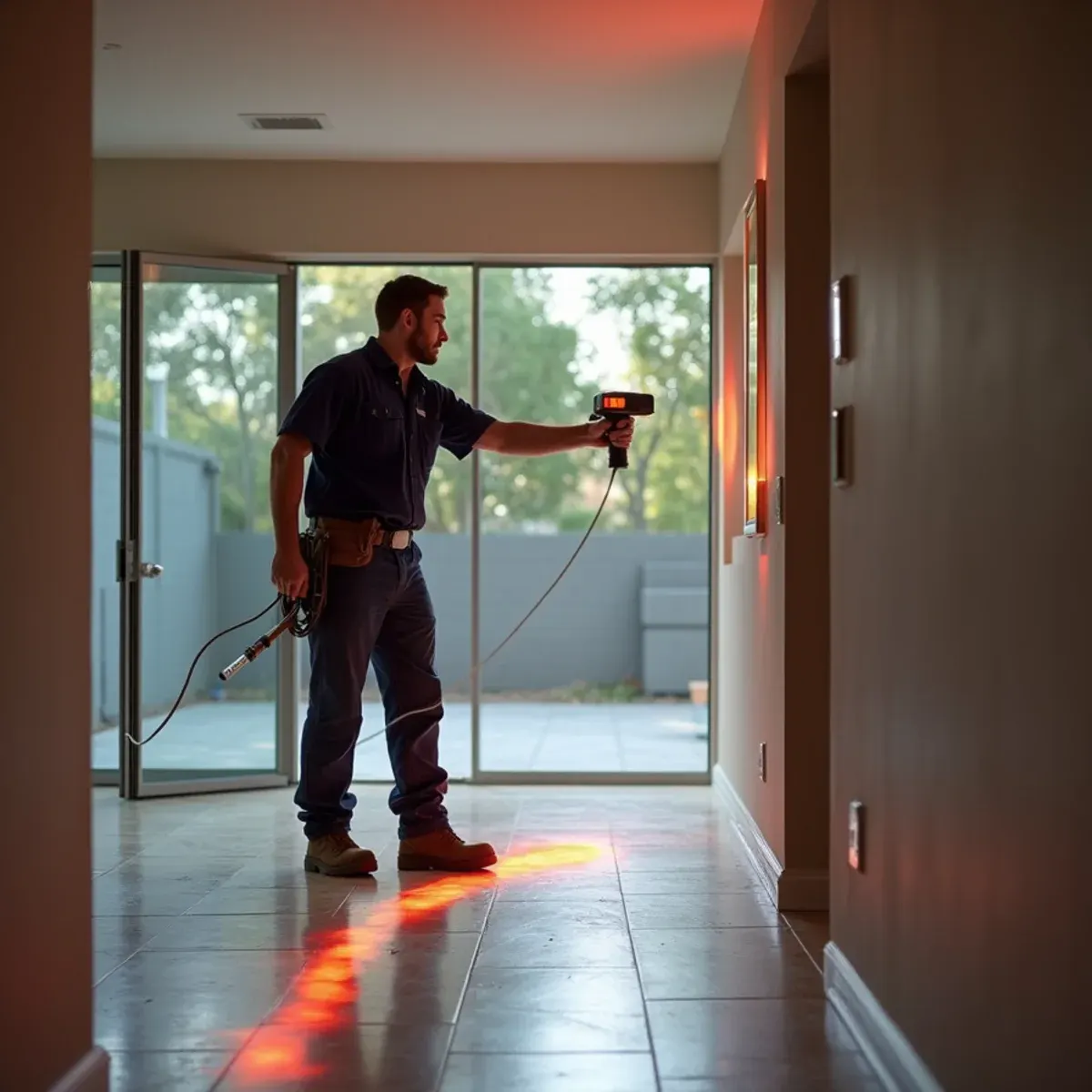
The repair is rarely the long part of a Costa Mesa slab leak. The drying is. You're close enough to the coast that the marine layer holds humidity most mornings, and the water table near the Santa Ana River and Fairview Park sits shallow. Concrete that would release its moisture in a week inland can take considerably longer here, and no amount of air movement fixes that on its own — you have to close the space and dehumidify it.
Where the service applies is worth saying plainly. Eastside Costa Mesa is mostly 1920s to 1940s cottages on raised foundations, so those are crawl-space leaks, not slab leaks. Mesa Verde, College Park and Halecrest are 1960s slab tract with under-slab copper, and that's the real population. Before any flooring goes back down we set in-situ relative humidity probes in the slab, because a surface meter on a Costa Mesa slab will tell you what you want to hear.
What Costa Mesa Changes About Slab Leak Damage
1Marine humidity lengthens every drying job
The morning marine layer keeps outdoor humidity high enough that open-window drying works against you here. We close the affected area, dehumidify, and manage the chamber rather than the whole house. It adds equipment days compared with an inland job, and we'd rather say that at the start than surprise you with a longer schedule halfway through.
2Shallow groundwater confuses the diagnosis
Near the Santa Ana River, Fairview Park and the low ground on the Westside, subgrade moisture can be high without any plumbing failure at all. A damp slab edge is not automatically a slab leak. We confirm with a meter test and pressure isolation before we tell you what you're dealing with, because opening concrete to chase groundwater helps nobody.
3Eastside cottages sit on raised floors
The 1920s to 1940s cottages east of Newport Boulevard were built on raised foundations under heavy tree canopy. Those are crawl-space leaks, and the marine layer that slows drying above ground does the same underneath. Mesa Verde, College Park and Halecrest are where the actual slab work is, on under-slab copper that's now around sixty years old.
How the Work Runs
The method is the same one we use on every slab leak damage job, documented to the IICRC S500:2025 standard. Here it is in short — the full slab leak water damage repair process explains each stage in detail.
- Confirm it is actually a slab leak
- Electronic leak location
- Choose the repair approach with you
- Dry the slab and the affected assemblies
- Address the flooring and wall base
- Restore the floor and finish
The Costa Mesa Background Worth Knowing
Under a raised Eastside cottage there is bare soil, and that soil is supposed to stay dry because the foundation vents exchange air with the outside. That system depends on the outside air being drier than the space under the house. For a good part of the year in Costa Mesa it is not. The marine layer holds humidity high through the night and well into the morning, so the crawl space never gets the dry stretch it needs, and moisture that arrives from a plumbing drip, a downspout, or an irrigation line just accumulates.
There is more on the housing stock, drainage and plumbing history of this city on our water damage restoration in Costa Mesa page.
Costa Mesa at a glance
- Dominant construction era
- 1920–1980
- Foundation type
- mixed on grade
- Supply piping found here
- original 1920s–1940s piping on the Eastside, galvanized steel, under-slab copper
- Drain line materials
- cast iron, clay
- Terrain and water table
- coastal-flat, shallow water table
- Most common local failure
- crawl-space moisture under Eastside cottages, held in by a marine layer that slows every natural drying process
- Highest-value local prevention
- confirming crawl-space vents are actually open and that the ground under the house is dry
What It Costs in Costa Mesa
We do not quote a number over the phone before seeing the property — anyone who does is guessing. The variables that actually move the price on a slab leak damage job are how long the leak ran undetected, flooring type over the leak, repair method chosen, and they are broken down in full on the slab leak water damage repair page. The assessment and the written estimate are free anywhere in Costa Mesa, day or night, with no obligation.
Slab Leak Damage Questions from Costa Mesa Homeowners
Longer than you'd like, and we won't give you a number before we measure. Costa Mesa slabs give up moisture slowly because of the marine humidity and the shallow water table, so we set in-situ relative humidity probes in the concrete and read them over days, not hours. Surface meters will read dry while the slab below is still wet, and that's how flooring failures and denied warranty claims happen.
The meter test is the first step: shut off every fixture and watch the low-flow indicator. If it moves and nothing is wet above the floor, suspect the slab. Warm spots on the floor, running-water sounds from below, and flooring that lifts or cups without an obvious cause all point the same direction. We confirm it with thermal imaging and moisture mapping at no charge.
Not always. Depending on where the leak is and the condition of the system, rerouting the line overhead through the attic and walls avoids opening the concrete entirely. When a spot repair is the better option, precise electronic location keeps the opening small — typically a couple of feet, not a trench across the room.
Almost always the crawl space. On these raised 1920s to 1940s houses the soil under the floor stays damp when the foundation vents are blocked and the marine layer keeps outside air humid overnight. That moisture moves up through the subfloor and into the rooms above it. Before assuming anything, walk your perimeter and see whether a planter, a poured patio or landscaping has covered the vents that are supposed to be breathing.