
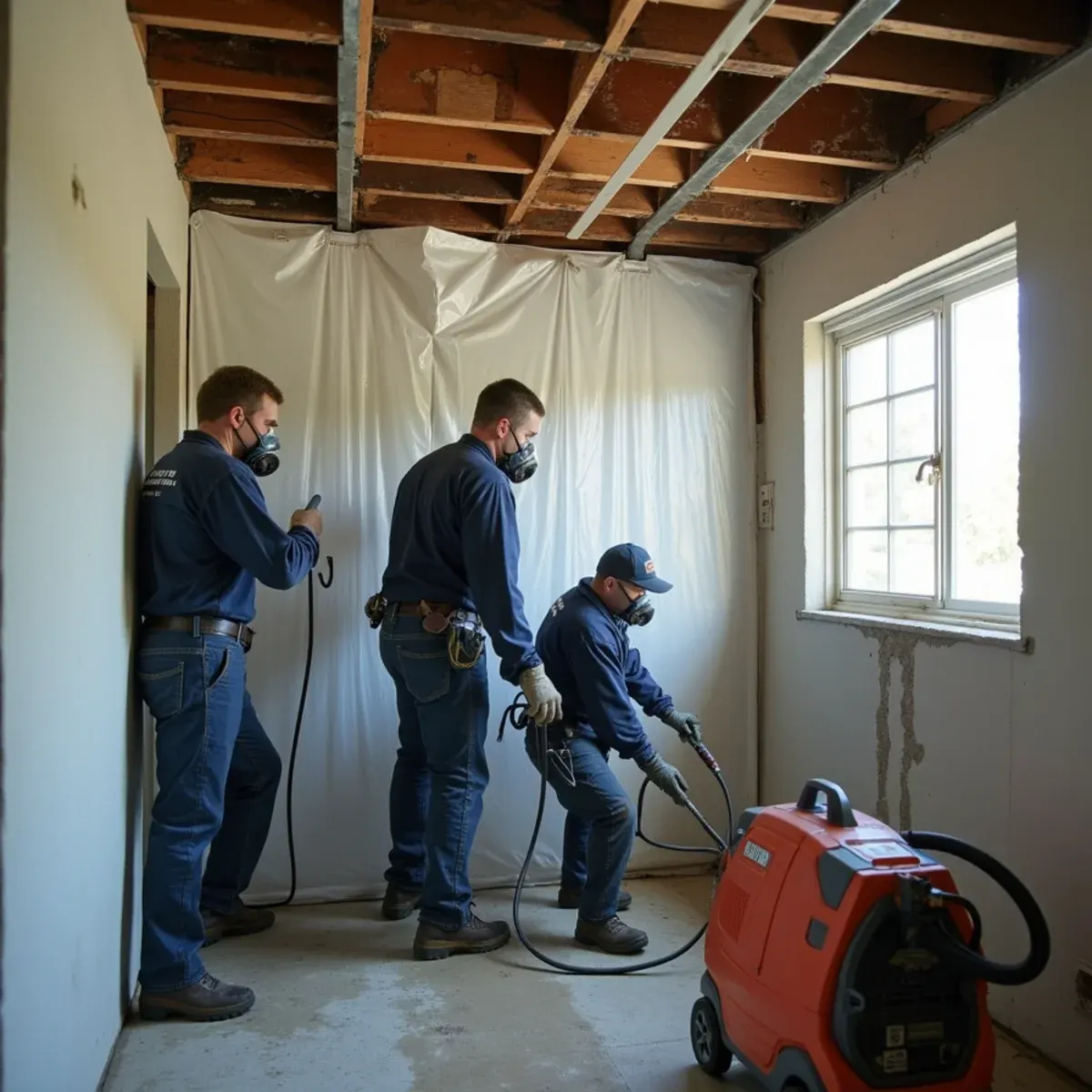
The hardest part of a Costa Mesa flood job is the air. We are close enough to the water that the marine layer holds ambient humidity high for days at a stretch, and a shallow water table keeps soil moisture up underneath. Open a window and set fans, which works fine at an inland address, and here you are pushing damp air across wet material for a week with nothing to show for it. Drying in Costa Mesa is a closed, dehumidified operation from the first hour, or it is not really drying at all.
The building stock makes it harder. Eastside cottages from the twenties through the forties sit on raised foundations under a heavy tree canopy, with dirt crawl spaces that hold ground water and vents that accomplish very little in a wet week. Mesa Verde is 1960s slab tract, where flood water spreads flat and fast. The Westside mixes housing with industrial buildings, which changes what runoff has crossed before it reaches a home. The Santa Ana River runs the western edge, and low ground near it fills first.
What Costa Mesa Changes About Flood Cleanup
1Dehumidification, not ventilation, does the work
IICRC S500:2025 frames the drying goal in terms of achieving and holding a vapor pressure differential, and on this coast you cannot get one from outside air. We build containment, run refrigerant or desiccant dehumidifiers sized to the wet volume, and monitor daily with readings rather than by feel. Jobs here routinely run longer than the same loss inland, and we tell you that before we start rather than after.
2Eastside crawl spaces stay wet for weeks
Under a 1930s cottage off 20th Street or Orange Avenue, floodwater sits on soil that was already damp from a high water table. Natural drying essentially stops. We pump, remove saturated debris and vapor barrier, disinfect the grade, then dry joists and subfloor with the crawl space contained and treated as its own drying chamber. Left alone, this is exactly where the odor and the growth start.
3Westside runoff carries an industrial load
Storm water that crosses Westside yards, alleys and light industrial parcels before entering a house is dirtier than the same volume in a purely residential tract. That does not change the category — ground floodwater is Category 3 regardless — but it changes our PPE, our disposal handling, and how aggressive we are about removing porous material that took it up.
How the Work Runs
The method is the same one we use on every flood cleanup job, documented to the IICRC S500:2025 standard. Here it is in short — the full flood damage cleanup process explains each stage in detail.
- Safety assessment and utility check
- Containment and negative air
- Documentation and contents triage
- Extraction and controlled demolition
- Cleaning and disinfection
- Structural drying and clearance
The Costa Mesa Background Worth Knowing
Under a raised Eastside cottage there is bare soil, and that soil is supposed to stay dry because the foundation vents exchange air with the outside. That system depends on the outside air being drier than the space under the house. For a good part of the year in Costa Mesa it is not. The marine layer holds humidity high through the night and well into the morning, so the crawl space never gets the dry stretch it needs, and moisture that arrives from a plumbing drip, a downspout, or an irrigation line just accumulates.
There is more on the housing stock, drainage and plumbing history of this city on our water damage restoration in Costa Mesa page.
Costa Mesa at a glance
- Dominant construction era
- 1920–1980
- Foundation type
- mixed on grade
- Supply piping found here
- original 1920s–1940s piping on the Eastside, galvanized steel, under-slab copper
- Drain line materials
- cast iron, clay
- Terrain and water table
- coastal-flat, shallow water table
- Most common local failure
- crawl-space moisture under Eastside cottages, held in by a marine layer that slows every natural drying process
- Highest-value local prevention
- confirming crawl-space vents are actually open and that the ground under the house is dry
What It Costs in Costa Mesa
We do not quote a number over the phone before seeing the property — anyone who does is guessing. The variables that actually move the price on a flood cleanup job are how high the water reached, how long it sat before extraction, contents volume in the flooded area, and they are broken down in full on the flood damage cleanup page. The assessment and the written estimate are free anywhere in Costa Mesa, day or night, with no obligation.
Flood Cleanup Questions from Costa Mesa Homeowners
Usually not. On the Eastside especially you are working against ambient humidity from the marine layer and moisture rising out of soil that sits above a shallow water table. Both keep pushing vapor back into the structure. What matters is the trend in daily readings, not the calendar. If the numbers are moving down slowly under sealed containment, the system is working. If they are flat two days running, we change the equipment plan, and we show you the log either way.
Yes. Water that crossed soil, pavement, or a storm drain is Category 3 by IICRC classification regardless of appearance — it carries bacteria, fuel and oil residue, lawn chemicals, and whatever else was on the ground. Do not walk through it in open shoes, and keep children and pets out of the area entirely.
If the water came from outside across the ground, almost certainly not — that requires separate flood insurance. If it came from a failed water heater, a burst pipe, or a supply line inside the garage, it is usually covered. We document the source carefully because that distinction determines everything.
Almost always the crawl space. On these raised 1920s to 1940s houses the soil under the floor stays damp when the foundation vents are blocked and the marine layer keeps outside air humid overnight. That moisture moves up through the subfloor and into the rooms above it. Before assuming anything, walk your perimeter and see whether a planter, a poured patio or landscaping has covered the vents that are supposed to be breathing.