
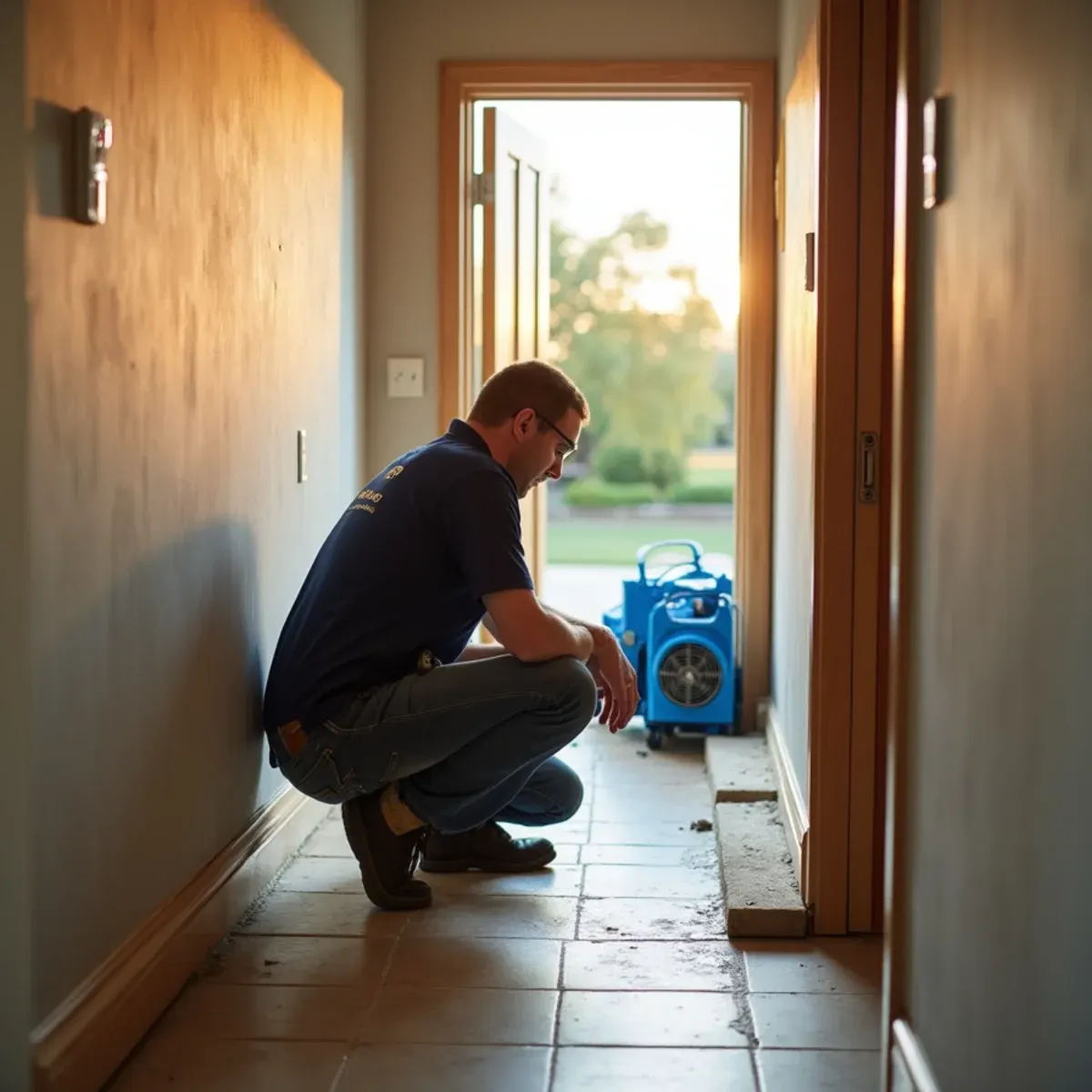
Don't open the windows. It's the first thing people do after a supply line bursts, and in Costa Mesa it usually makes the drying take longer. We're close enough to the coast that outdoor air often carries a dew point high enough to add moisture to a wall cavity rather than pull it out. Cavity drying here has to run as a closed system: the house sealed, low-grain refrigerant dehumidifiers carrying the load, and air directed into the stud bays through small ports instead of hoping ambient conditions do the work for us.
The building stock splits sharply across the city. Eastside cottages from the 1920s through the 1940s sit on raised foundations with original piping, shallow irregular cavities and board sheathing, all under a heavy tree canopy that keeps the ground damp. Mesa Verde and College Park are 1960s slab tract with copper. The Westside mixes housing with industrial buildings. Add a shallow water table and the Santa Ana River along the western edge, and hitting the drying targets in IICRC S500:2025 takes real equipment here, not just patience.
What Costa Mesa Changes About Burst Pipe Damage
1Coastal dew point slows cavity drying
Marine air raises the moisture content of everything you bring into the house, including the air you'd otherwise use to dry a wall. On Costa Mesa jobs we seal the affected area, control the whole environment with dehumidification, and track grain depression rather than relative humidity alone. Homeowners sometimes think we're being overcautious keeping the house shut up. The daily readings are what settle that.
2Eastside crawl spaces collect the runoff
On a raised-foundation cottage, water from a burst supply line in a wall eventually drops out of the bay and lands on the dirt below. Under a heavy canopy with a shallow water table, that ground was already damp. We check the crawl space on every Eastside call, because a wet subgrade keeps feeding the floor assembly and will hold your readings above standard no matter what we do upstairs.
3Shallow prewar cavities limit access
True-dimension framing, board sheathing and old plaster leave far less room to work than a modern wall. Injection ports have to be placed precisely, airflow metered so we're not packing insulation into a corner, and there's often original wallpaper or a lath backing that changes how fast the bay gives up moisture. It's slower work on the Eastside and we schedule the time for it honestly.
How the Work Runs
The method is the same one we use on every burst pipe damage job, documented to the IICRC S500:2025 standard. Here it is in short — the full burst pipe water damage repair process explains each stage in detail.
- Stop the source
- Locate the failure precisely
- Coordinate the plumbing repair
- Extract and open only what must be opened
- Cavity and structural drying
- Rebuild and finish
The Costa Mesa Background Worth Knowing
Under a raised Eastside cottage there is bare soil, and that soil is supposed to stay dry because the foundation vents exchange air with the outside. That system depends on the outside air being drier than the space under the house. For a good part of the year in Costa Mesa it is not. The marine layer holds humidity high through the night and well into the morning, so the crawl space never gets the dry stretch it needs, and moisture that arrives from a plumbing drip, a downspout, or an irrigation line just accumulates.
There is more on the housing stock, drainage and plumbing history of this city on our water damage restoration in Costa Mesa page.
Costa Mesa at a glance
- Dominant construction era
- 1920–1980
- Foundation type
- mixed on grade
- Supply piping found here
- original 1920s–1940s piping on the Eastside, galvanized steel, under-slab copper
- Drain line materials
- cast iron, clay
- Terrain and water table
- coastal-flat, shallow water table
- Most common local failure
- crawl-space moisture under Eastside cottages, held in by a marine layer that slows every natural drying process
- Highest-value local prevention
- confirming crawl-space vents are actually open and that the ground under the house is dry
What It Costs in Costa Mesa
We do not quote a number over the phone before seeing the property — anyone who does is guessing. The variables that actually move the price on a burst pipe damage job are how long the line ran before discovery, which floor it happened on, hot line versus cold line, and they are broken down in full on the burst pipe water damage repair page. The assessment and the written estimate are free anywhere in Costa Mesa, day or night, with no obligation.
Burst Pipe Damage Questions from Costa Mesa Homeowners
Longer than the same job inland, and the marine layer is why. When the outdoor dew point is high, opening the house adds moisture to the cavities instead of removing it, so we seal up and run low-grain dehumidifiers to control the whole environment. Prewar cottages with shallow cavities and board sheathing also hold water where we have to reach through ports. We take daily readings and target the dry standard measured in an unaffected room of your own house.
We restore the water damage and coordinate the plumbing repair, working with your plumber or bringing in a licensed one from our network. Handling both under one schedule is what keeps a burst pipe from turning into two weeks of contractor coordination.
More than people expect. A half-inch supply line at typical residential pressure moves in the range of 8 to 10 gallons a minute. That is roughly 500 gallons in an hour — comparable to filling a small backyard pool inside your walls and floor.
Almost always the crawl space. On these raised 1920s to 1940s houses the soil under the floor stays damp when the foundation vents are blocked and the marine layer keeps outside air humid overnight. That moisture moves up through the subfloor and into the rooms above it. Before assuming anything, walk your perimeter and see whether a planter, a poured patio or landscaping has covered the vents that are supposed to be breathing.