
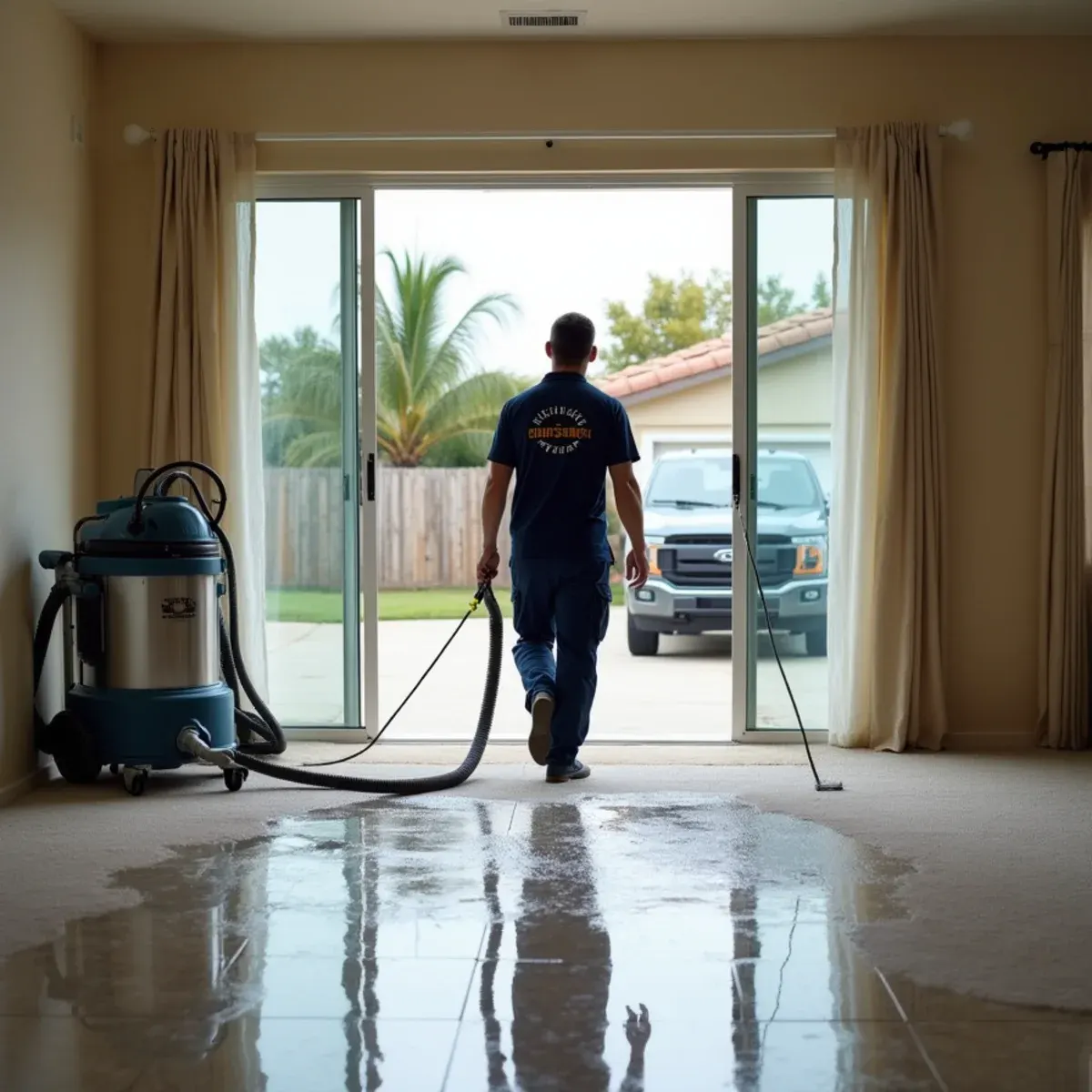
Costa Mesa is where the old rule earns its keep: every gallon you extract is a gallon you don't have to evaporate. Close to the coast, with a marine layer sitting over the city many mornings and a shallow water table under the western flats near the Santa Ana River, ambient conditions do less drying work for you here than almost anywhere inland we serve. A loss that would air-dry acceptably in Placentia will sit damp in Costa Mesa. So we extract harder and longer before we start setting air movers, and we plan on dehumidification carrying more of the load.
The building stock splits three ways and each behaves differently. Eastside cottages from the twenties through the forties sit on raised foundations under heavy tree canopy, so water goes down into the crawl and stays there — that's pump work, plus removal of soaked insulation and any wet stored items. Mesa Verde is 1960s slab tract with carpet over pad, standard weighted extraction territory. The Westside mixes industrial buildings with housing, which means we sometimes bring commercial-scale equipment to a residential street.
What Costa Mesa Changes About Water Extraction
1Humid air slows every drying stage
When outside air is already carrying a lot of moisture, opening windows doesn't help and can hurt. That raises the value of mechanical extraction. IICRC S500:2025 puts bulk water removal ahead of evaporation for exactly this reason, and in Costa Mesa the gap between the two is wider than inland. We extract in more passes than a typical job and re-extract after the first hour once water migrates back up out of the pad.
2Eastside crawl spaces hold water long-term
Under the older cottages off 19th and along the Eastside streets, a leak drains into dirt that is already damp from a shallow water table and shaded ground. There's often standing water in the low corner and saturated fiberglass hanging between joists. We pump the free water, cut out and bag the wet insulation, and confirm the crawl vents are actually open before we consider the space handled.
3Westside mixed use needs commercial gear
On the Westside, a residential loss can share a wall with a shop or a converted industrial building, and floor assemblies aren't residential-standard. Sealed concrete, epoxy coatings and unusual slab penetrations change how water moves. We bring higher-capacity extraction and treat the shared assembly as a single drying environment rather than stopping at the property line on the floor plan.
How the Work Runs
The method is the same one we use on every water extraction job, documented to the IICRC S500:2025 standard. Here it is in short — the full water extraction & removal process explains each stage in detail.
- Bulk removal with submersible pumps
- Truck-mounted extraction on carpet and pad
- Hard-surface and specialty extraction
- Cavity and void extraction
- Removing what cannot be saved
- Post-extraction moisture reading
The Costa Mesa Background Worth Knowing
Under a raised Eastside cottage there is bare soil, and that soil is supposed to stay dry because the foundation vents exchange air with the outside. That system depends on the outside air being drier than the space under the house. For a good part of the year in Costa Mesa it is not. The marine layer holds humidity high through the night and well into the morning, so the crawl space never gets the dry stretch it needs, and moisture that arrives from a plumbing drip, a downspout, or an irrigation line just accumulates.
There is more on the housing stock, drainage and plumbing history of this city on our water damage restoration in Costa Mesa page.
Costa Mesa at a glance
- Dominant construction era
- 1920–1980
- Foundation type
- mixed on grade
- Supply piping found here
- original 1920s–1940s piping on the Eastside, galvanized steel, under-slab copper
- Drain line materials
- cast iron, clay
- Terrain and water table
- coastal-flat, shallow water table
- Most common local failure
- crawl-space moisture under Eastside cottages, held in by a marine layer that slows every natural drying process
- Highest-value local prevention
- confirming crawl-space vents are actually open and that the ground under the house is dry
What It Costs in Costa Mesa
We do not quote a number over the phone before seeing the property — anyone who does is guessing. The variables that actually move the price on a water extraction job are volume and depth of water, flooring type, contamination level, and they are broken down in full on the water extraction & removal page. The assessment and the written estimate are free anywhere in Costa Mesa, day or night, with no obligation.
Water Extraction Questions from Costa Mesa Homeowners
That's the most common Costa Mesa mistake. Marine air is often carrying more moisture than the air inside your house, so ventilating pulls humidity in and stalls drying. Fans without dehumidification just move wet air around and can push moisture deeper into walls. The right sequence is maximum extraction first, the house closed up, then dehumidifiers doing the removal and air movers assisting. We monitor indoor humidity daily to confirm it's actually falling.
For a typical single-room residential loss, extraction runs one to three hours. Multi-room losses or Category 3 water can take most of a day because of containment setup and material removal. We will give you a realistic timeframe after the walkthrough, before we start.
Often we can save the carpet and only replace the pad, which is the cheaper and less disruptive path. The deciding factors are water category, how long it sat, and whether the pad is a moisture barrier type. Clean water caught quickly usually means the carpet stays.
Almost always the crawl space. On these raised 1920s to 1940s houses the soil under the floor stays damp when the foundation vents are blocked and the marine layer keeps outside air humid overnight. That moisture moves up through the subfloor and into the rooms above it. Before assuming anything, walk your perimeter and see whether a planter, a poured patio or landscaping has covered the vents that are supposed to be breathing.