
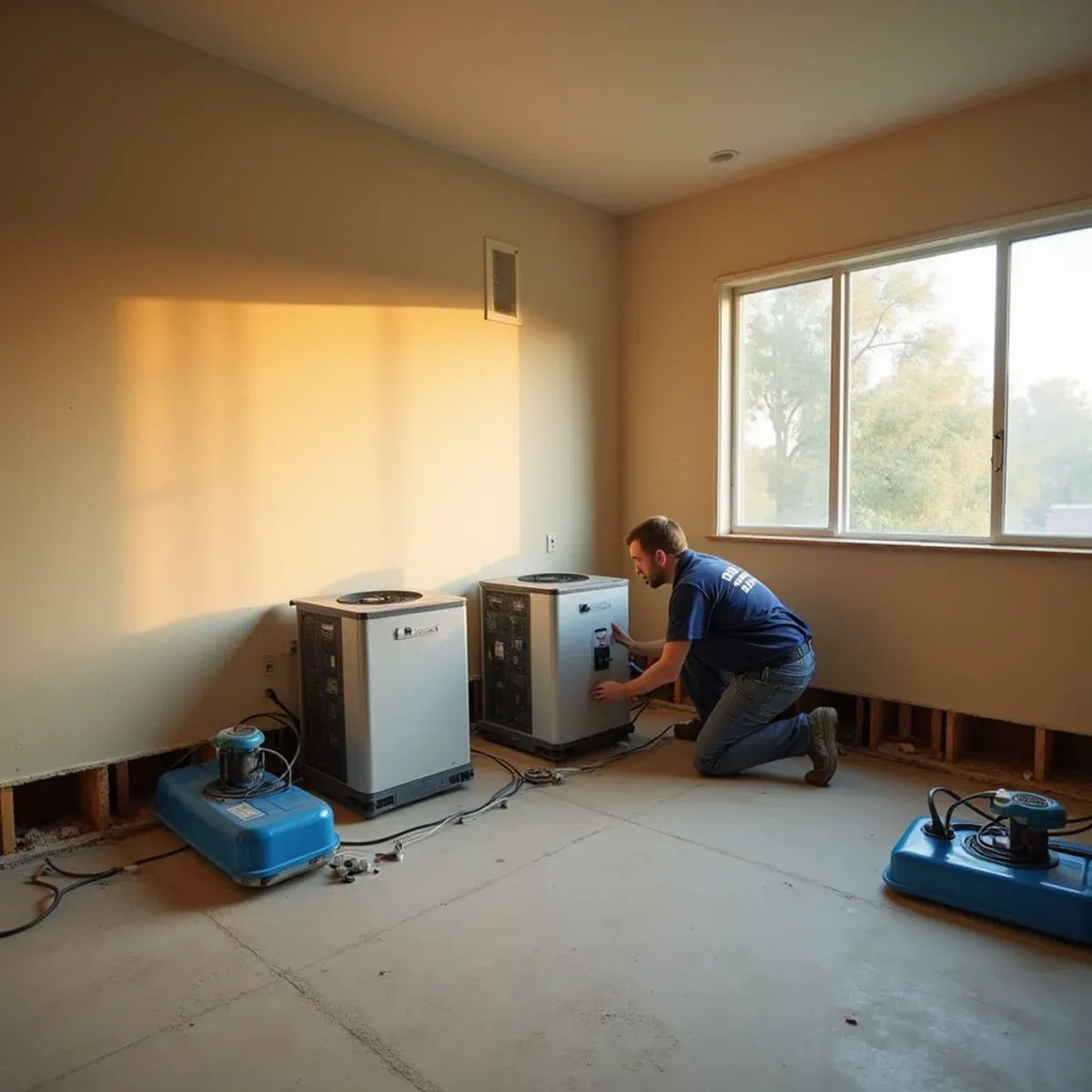
Opening the windows is the worst thing you can do in Costa Mesa. Marine air moving in off the coast can sit near saturation for most of the day, and every hour of it undoes what the equipment accomplished overnight. Drying works on the difference between the moisture in your materials and the moisture in the air around them, so on the Eastside and through College Park we seal the chamber first and let LGR dehumidification set the conditions rather than borrowing air from outside that's wetter than what's already in the room.
The Eastside's 1920s-to-1940s cottages add a second load from below. They sit on raised foundations over ground with a shallow water table, close to the Santa Ana River, under a canopy heavy enough to keep the crawl space cool and damp year-round. Water evaporating from that soil goes straight into the floor assembly and stays. We put a vapor retarder over the dirt and dry the underfloor as its own chamber. Mesa Verde's 1960s slab tract moves faster, but even there the schedule runs longer than inland.
What Costa Mesa Changes About Structural Drying
1Sealed chamber beats an open window
Ventilation only dries when outside air is drier than inside air. Within a couple of miles of the coast that's untrue for much of the day, so opening the house adds moisture instead of removing it. We seal the affected area, control temperature and let LGR dehumidification set the grain depth. Windows stay closed until the log gives us a reason to change that.
2Shallow ground water loads Eastside crawl spaces
The Eastside's raised-foundation cottages sit over ground that holds moisture, near the Santa Ana River and under a canopy that keeps the crawl space shaded and cool. Water evaporating off that soil goes straight up into the floor assembly. We lay a vapor retarder over the dirt and dry the underfloor as its own chamber before we do anything to the rooms above it.
3Coastal jobs run longer, and we say so
A comparable loss in Mesa Verde or Halecrest usually takes more days than the same loss inland, because the ambient conditions we're working against are simply wetter. We'd rather set that expectation on the first visit than quietly extend the schedule later. What we won't do is pull equipment early to hit a number. Material readings decide when the job ends, not the calendar.
How the Work Runs
The method is the same one we use on every structural drying job, documented to the IICRC S500:2025 standard. Here it is in short — the full structural drying & dehumidification process explains each stage in detail.
- Establish the dry standard
- Calculate the load and build the chamber
- Place air movers for surface evaporation
- Run LGR dehumidification to capture the moisture
- Monitor and adjust daily
- Verify, document, and demobilize
The Costa Mesa Background Worth Knowing
Under a raised Eastside cottage there is bare soil, and that soil is supposed to stay dry because the foundation vents exchange air with the outside. That system depends on the outside air being drier than the space under the house. For a good part of the year in Costa Mesa it is not. The marine layer holds humidity high through the night and well into the morning, so the crawl space never gets the dry stretch it needs, and moisture that arrives from a plumbing drip, a downspout, or an irrigation line just accumulates.
There is more on the housing stock, drainage and plumbing history of this city on our water damage restoration in Costa Mesa page.
Costa Mesa at a glance
- Dominant construction era
- 1920–1980
- Foundation type
- mixed on grade
- Supply piping found here
- original 1920s–1940s piping on the Eastside, galvanized steel, under-slab copper
- Drain line materials
- cast iron, clay
- Terrain and water table
- coastal-flat, shallow water table
- Most common local failure
- crawl-space moisture under Eastside cottages, held in by a marine layer that slows every natural drying process
- Highest-value local prevention
- confirming crawl-space vents are actually open and that the ground under the house is dry
What It Costs in Costa Mesa
We do not quote a number over the phone before seeing the property — anyone who does is guessing. The variables that actually move the price on a structural drying job are size of the drying chamber, class of water intrusion, material types involved, and they are broken down in full on the structural drying & dehumidification page. The assessment and the written estimate are free anywhere in Costa Mesa, day or night, with no obligation.
Structural Drying Questions from Costa Mesa Homeowners
Ambient conditions. Marine air near the coast carries more moisture, so the equipment starts from a wetter baseline and every open door sets it back. Your raised foundation adds a second load, evaporation from crawl-space soil sitting over a shallow water table. An inland slab house has neither problem. We keep the chamber sealed, dry the crawl space as its own zone, and go by daily material readings rather than a target number of days.
Three to five days covers most residential losses. Saturated hardwood, plaster, or a concrete slab can run seven or more. We will give you an estimated window after the first readings and update you daily — and equipment comes out when the numbers say so, not on a fixed schedule.
We would rather you did not. Drying is a continuous process, and every hour off extends the total run — which usually costs more than the sleep is worth. If noise is genuinely unmanageable we can often reconfigure the chamber or reposition units to reduce it. Talk to us instead of unplugging them.
Almost always the crawl space. On these raised 1920s to 1940s houses the soil under the floor stays damp when the foundation vents are blocked and the marine layer keeps outside air humid overnight. That moisture moves up through the subfloor and into the rooms above it. Before assuming anything, walk your perimeter and see whether a planter, a poured patio or landscaping has covered the vents that are supposed to be breathing.