
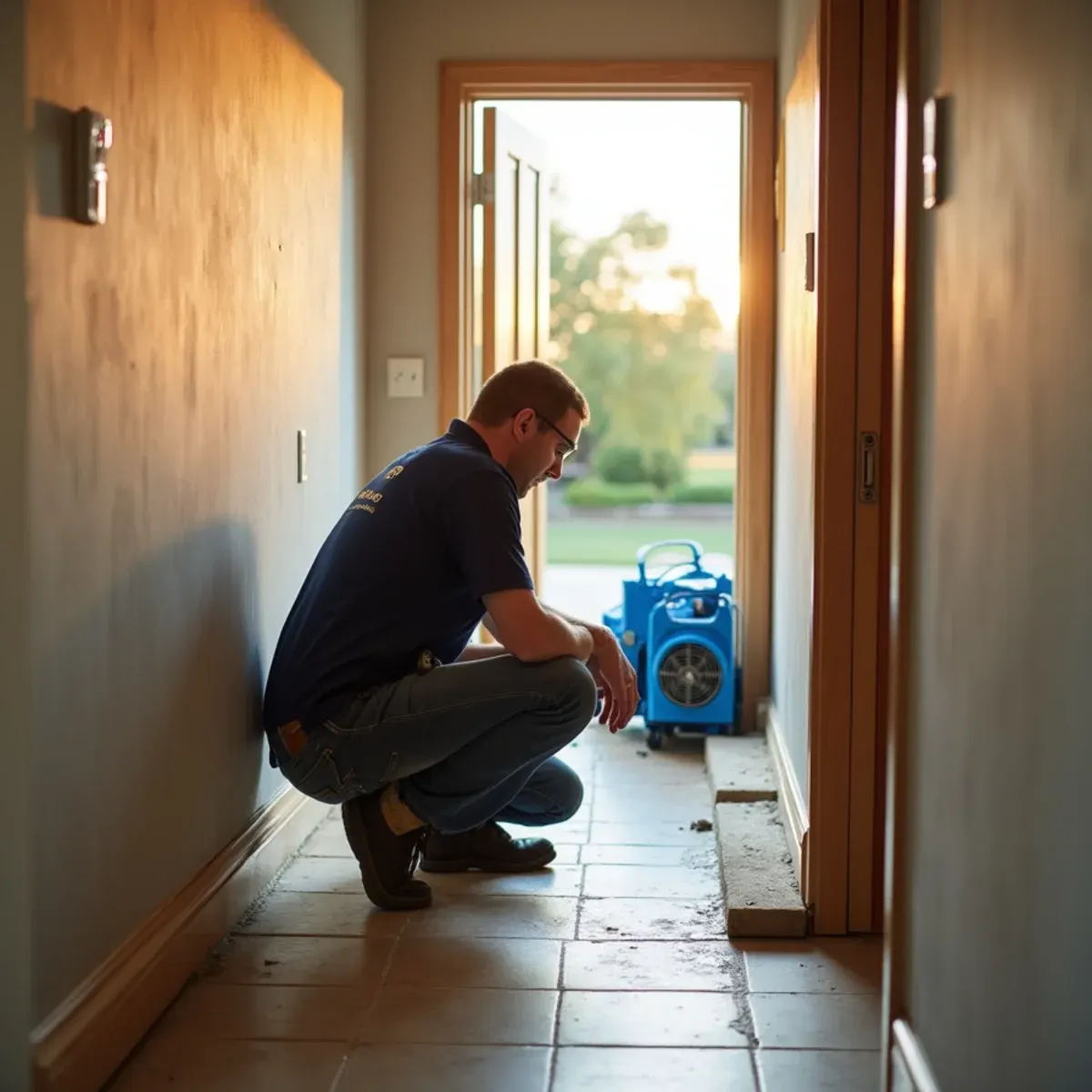
Not every wet reading in Fountain Valley is your pipe. This city was built on drained wetland that old maps called Gospel Swamp, and it has one of the shallowest water tables in Orange County, which is where the name comes from. Slab vapor emission is a routine background condition here rather than a red flag. So after a supply line breaks and gets repaired, a meter on the slab will still read elevated, and plenty of homeowners are told they have a second leak when what they have is the ground doing what it has always done.
The fix is baseline measurement before drying starts. We take readings in an unaffected section of the same slab, then dry the affected area to that standard rather than to an arbitrary number. The tract stock helps, being largely 1960s and 1970s slab on grade with under-slab copper laid out to a handful of plans between Brookhurst and Mile Square Regional Park. On dead-flat ground a break inside a wall does not run downhill toward anything. It spreads outward in every direction under the flooring, so the wet area is usually wider and shallower than people expect.
What Fountain Valley Changes About Burst Pipe Damage
1Vapor emission is background, not evidence
A slab in Fountain Valley releases moisture continuously because groundwater is close beneath it. That means a surface moisture meter alone cannot tell you whether a repaired burst pipe is truly dry. We use in-situ relative humidity probes and a comparison reading from an unaffected area, which is what IICRC S500:2025 expects, and we show you both numbers rather than asking you to take our word for it.
2Dead-flat ground spreads water outward
There is no grade here to send water anywhere. When a supply line breaks in a wall and reaches the slab, it fans out under vinyl, laminate or carpet pad in a rough circle rather than running to a low corner. The result is a large lightly wet area instead of a small saturated one. We map the full perimeter with meters, because the visible edge always falls short.
3Uniform tracts, predictable pipe routes
Fountain Valley was built out fast to a limited set of plans, so wet walls sit in familiar places. Between the kitchen, the laundry and the hall bath, we can usually anticipate the run before the thermal camera confirms it. That means less exploratory cutting and a smaller opening in your drywall, which matters when the rebuild is coming out of the same claim as the drying.
How the Work Runs
The method is the same one we use on every burst pipe damage job, documented to the IICRC S500:2025 standard. Here it is in short — the full burst pipe water damage repair process explains each stage in detail.
- Stop the source
- Locate the failure precisely
- Coordinate the plumbing repair
- Extract and open only what must be opened
- Cavity and structural drying
- Rebuild and finish
The Fountain Valley Background Worth Knowing
Groundwater beneath Fountain Valley sits close enough to the surface that moisture vapor migration up through concrete slabs is a routine background condition rather than an anomaly. Homeowners here regularly describe a slab that feels cool and damp, or a closet on an exterior wall that never quite feels dry, without any leak at all.
There is more on the housing stock, drainage and plumbing history of this city on our water damage restoration in Fountain Valley page.
Fountain Valley at a glance
- Dominant construction era
- 1960–1980
- Foundation type
- slab on grade
- Supply piping found here
- under-slab copper
- Drain line materials
- cast iron
- Terrain and water table
- flat, shallow water table
- Most common local failure
- slab vapor emission mistaken for a leak, and flooring failures caused by installing over an untested slab
- Highest-value local prevention
- clearing the yard and area drains before the season, because a blocked drain on dead-flat ground ponds water against the house
What It Costs in Fountain Valley
We do not quote a number over the phone before seeing the property — anyone who does is guessing. The variables that actually move the price on a burst pipe damage job are how long the line ran before discovery, which floor it happened on, hot line versus cold line, and they are broken down in full on the burst pipe water damage repair page. The assessment and the written estimate are free anywhere in Fountain Valley, day or night, with no obligation.
Burst Pipe Damage Questions from Fountain Valley Homeowners
In Fountain Valley it is frequently both, and only a proper test separates them. Surface meters read the top few millimeters and are easily fooled here. In-situ probes drilled into the slab measure relative humidity at depth and give a number a flooring manufacturer will actually accept. If the affected area matches an unaffected part of the same slab, the pipe damage is dry and what remains is the background condition your floor has to be specified for.
We restore the water damage and coordinate the plumbing repair, working with your plumber or bringing in a licensed one from our network. Handling both under one schedule is what keeps a burst pipe from turning into two weeks of contractor coordination.
More than people expect. A half-inch supply line at typical residential pressure moves in the range of 8 to 10 gallons a minute. That is roughly 500 gallons in an hour — comparable to filling a small backyard pool inside your walls and floor.
The city sits on former wetland with one of the shallowest water tables in Orange County, so moisture vapor migrating up through slabs is a normal background condition here rather than a defect. It matters most when installing flooring over the slab, which is why we test with in-situ RH probes before anything goes back down.