
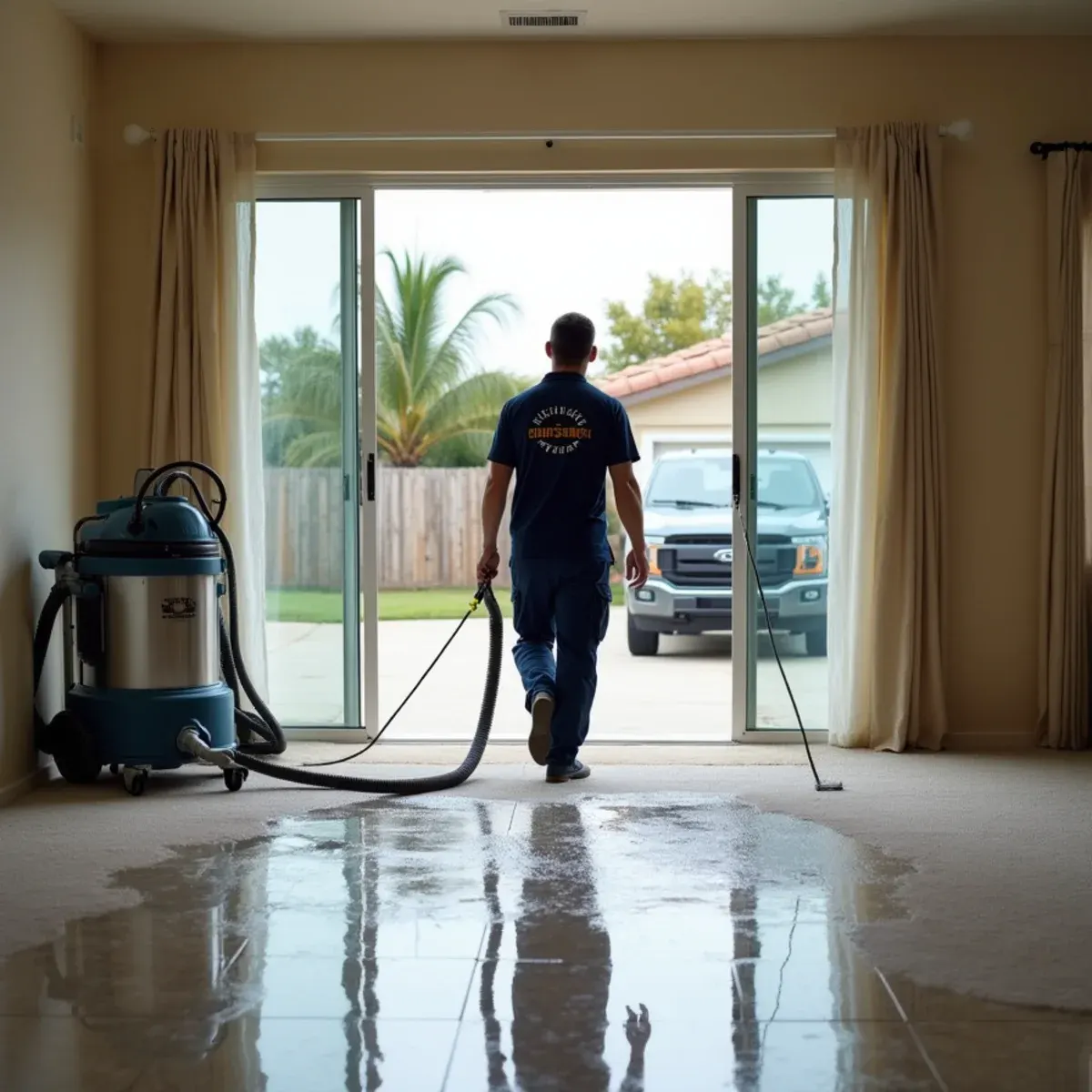
A supply line lets go in an upstairs bathroom on a Tuesday morning. By the time someone gets home, the water has already found the edge of the floor assembly and started running along the joists. La Palma has a higher share of two-story homes than the cities around it, and that single fact changes extraction more than anything else about the place. The standing water you can see upstairs is only part of the job. The rest is sitting in an enclosed cavity you can't reach with any wand.
The city filled in almost entirely between 1960 and 1980, and the homes near Central Park and along the Walker Street corridor have generally been held by the same families for a long time. They're kept up well, which is exactly what makes people slow to believe the water is coming from their own plumbing. Downstairs on the slab we pump and run weighted extraction over carpet. Upstairs and in the ceiling we make controlled openings and pull water out of the cavity before the drywall has to give way first.
What La Palma Changes About Water Extraction
1Two floors, two extraction zones
An upstairs failure is never a one-room job in these houses. We work the source floor and the ceiling below at the same time, because water in a joist bay migrates while you're busy elsewhere. Weighted extraction upstairs stops the pad from feeding the assembly; cavity extraction below removes what already dropped. Doing one and not the other is why ceilings fail a week after the water is supposedly gone.
2Under-slab copper nobody has touched
Because these homes have been maintained so well, owners assume the plumbing has been kept up too. The under-slab supply lines usually haven't been. When one opens up on the ground floor, water travels along the top of the slab under carpet and vinyl plank and shows up in a room away from the break. We map the wet footprint with meters first so extraction covers the real area, not the obvious one.
3Find your shutoff before you need it
The single biggest variable in how much we have to extract here is how long the water ran. In a two-story home the volume reaching the floor assembly scales directly with minutes. Locate your main shutoff now, and turn it to confirm it still moves — plenty of valves in this city haven't been operated since installation and seize in place at exactly the wrong moment.
How the Work Runs
The method is the same one we use on every water extraction job, documented to the IICRC S500:2025 standard. Here it is in short — the full water extraction & removal process explains each stage in detail.
- Bulk removal with submersible pumps
- Truck-mounted extraction on carpet and pad
- Hard-surface and specialty extraction
- Cavity and void extraction
- Removing what cannot be saved
- Post-extraction moisture reading
The La Palma Background Worth Knowing
There is a pattern we see repeatedly in La Palma. A homeowner has taken excellent care of a house for thirty years — new roof, dual-pane windows, updated electrical panel, remodeled kitchen. Then a slab leak runs for eight months under the living room and nobody catches it, because there was never anything to see.
There is more on the housing stock, drainage and plumbing history of this city on our water damage restoration in La Palma page.
La Palma at a glance
- Dominant construction era
- 1960–1980
- Foundation type
- slab on grade
- Supply piping found here
- under-slab copper
- Drain line materials
- cast iron, ABS
- Terrain and water table
- flat, moderate water table
- Most common local failure
- second-floor supply and fixture failures that travel through the floor assembly into the ceiling below
- Highest-value local prevention
- knowing where the main shutoff is and confirming it still turns, because two-story losses double in size in minutes
What It Costs in La Palma
We do not quote a number over the phone before seeing the property — anyone who does is guessing. The variables that actually move the price on a water extraction job are volume and depth of water, flooring type, contamination level, and they are broken down in full on the water extraction & removal page. The assessment and the written estimate are free anywhere in La Palma, day or night, with no obligation.
Water Extraction Questions from La Palma Homeowners
Usually a small, deliberate opening, yes. A stain means water crossed the drywall, and in a two-story assembly there's almost always more sitting on top of it than what shows through. We meter the ceiling first and open only where readings justify it, then extract from inside the bay. It's a far smaller repair than waiting for insulation and drywall to hold that water until the assembly lets go on its own.
For a typical single-room residential loss, extraction runs one to three hours. Multi-room losses or Category 3 water can take most of a day because of containment setup and material removal. We will give you a realistic timeframe after the walkthrough, before we start.
Often we can save the carpet and only replace the pad, which is the cheaper and less disruptive path. The deciding factors are water category, how long it sat, and whether the pad is a moisture barrier type. Clean water caught quickly usually means the carpet stays.
Typically fifteen to twenty minutes. La Palma borders Cypress directly to the north, so it is one of the fastest calls we run and the 60-minute commitment applies in full.