
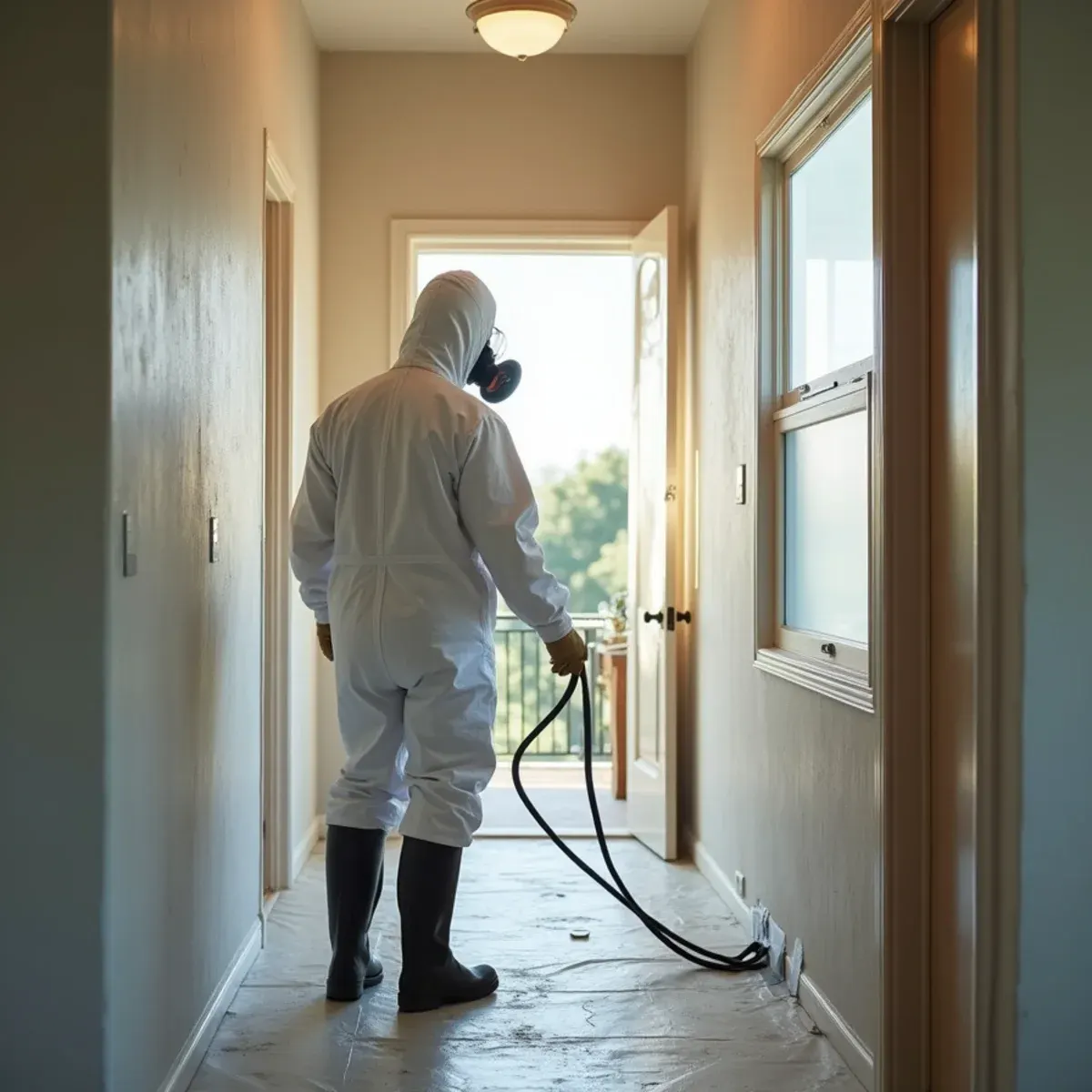
The hardest conversation we have in Santa Ana is about what cannot be saved. In Floral Park, French Park and Washington Square, the houses are full of material with no modern equivalent: three-coat plaster over wood lath, old-growth fir framing, quarter-sawn oak floors milled from trees that no longer exist at that size. All of it is porous, and porous plus Category 3 water is a removal, not a cleaning. We have had homeowners ask us to try anyway. We have tried on clean-water losses and succeeded. With sewage, there is no back side of a plaster wall to reach.
The county's oldest city also has the county's oldest drain lines under the county's oldest street trees. Clay laterals with mortared joints, roots ninety years into finding them, and grades that have shifted since the twenties. Outside the historic districts the picture changes completely, into dense postwar apartment stock around the civic core where the problem is shared cast iron stacks and multiple occupied units rather than irreplaceable finishes. The same city, the same night, two entirely different jobs.
What Santa Ana Changes About Sewage Cleanup
1What comes out and why
Plaster holds several times what drywall holds and keeps it deep in the material, and the keys gripping the lath soften once saturated. Sewage-contaminated plaster gets removed. We cut to a line we can defend with meter readings rather than an arbitrary height, keep sound dry lath in place where the repair allows, and give you the reasoning in writing rather than asking you to take it on faith.
2Documenting irreplaceable material before removal
Before anything comes out of a historic-district home we record it: plaster coat thickness and sand texture, floor board width and grain orientation, baseboard and casing profiles, trim species. We save clean offcuts as physical samples. It costs us an hour and it is the difference between a repair that disappears into the room and one that announces itself for the next fifty years.
3Clay laterals under ninety-year-old trees
The mature canopy that makes these streets what they are also sends roots into every mortared clay joint under them. Once the cleanup is complete, a camera scope tells you whether you are looking at a spot repair, a liner or a replacement, and whether any of it triggers review because of where the trench would run. Better to find that out on a weekday than during the next backup.
How the Work Runs
The method is the same one we use on every sewage cleanup job, documented to the IICRC S500:2025 standard. Here it is in short — the full sewage backup cleanup process explains each stage in detail.
- Secure the area and set containment
- Full PPE and safe extraction
- Remove contaminated porous materials
- Clean and disinfect all remaining surfaces
- Deodorize at the source
- Dry, verify, and clear
The Santa Ana Background Worth Knowing
Lath and plaster is wood strips nailed across the studs with several coats of plaster troweled over them. The plaster that squeezes through the gaps between lath forms keys that hook over the wood and hold the whole wall in place. That construction is why plaster walls last a century — and why they behave so differently from drywall when wet.
There is more on the housing stock, drainage and plumbing history of this city on our water damage restoration in Santa Ana page.
Santa Ana at a glance
- Dominant construction era
- 1900–1970
- Foundation type
- mixed on grade
- Supply piping found here
- original early-century piping, galvanized steel, copper
- Drain line materials
- cast iron, clay
- Terrain and water table
- flat, moderate water table
- Most common local failure
- plaster key failure, where wet plaster softens and releases from the wood lath holding it to the wall
- Highest-value local prevention
- starting aggressive drying within hours on any plaster loss — waiting is the one thing that costs you the wall
What It Costs in Santa Ana
We do not quote a number over the phone before seeing the property — anyone who does is guessing. The variables that actually move the price on a sewage cleanup job are affected square footage, volume of porous material removed, contents in the affected area, and they are broken down in full on the sewage backup cleanup page. The assessment and the written estimate are free anywhere in Santa Ana, day or night, with no obligation.
Sewage Cleanup Questions from Santa Ana Homeowners
Not on the affected sections, and I would rather tell you that on day one than after three days of trying. Plaster is porous through its full thickness, and there is no access to the back of the wall behind the lath, so no antimicrobial reaches where the contamination actually is. What we can protect is scope and quality of repair: cut only where the meters justify it, keep the sound lath, and document the original coat thickness and texture so a plasterer can match it properly.
It depends on the source. A toilet that overflows with clean bowl water because of a stuck fill valve is Category 1 or 2 and is far less serious. A toilet that backs up from the main line is carrying waste from the whole system, and that is Category 3 — it needs the full protocol.
No. Standard practice for Category 3 water is removal and disposal of carpet and pad that were contacted. Porous materials cannot be reliably disinfected all the way through, and the health risk of leaving them is not worth the savings.
Usually, if drying starts quickly. Plaster holds much more water than drywall and dries far more slowly, so it needs more equipment and often desiccant dehumidification. The risk is the plaster keys softening and releasing from the lath, which is why waiting is the one thing that genuinely costs you the wall.