
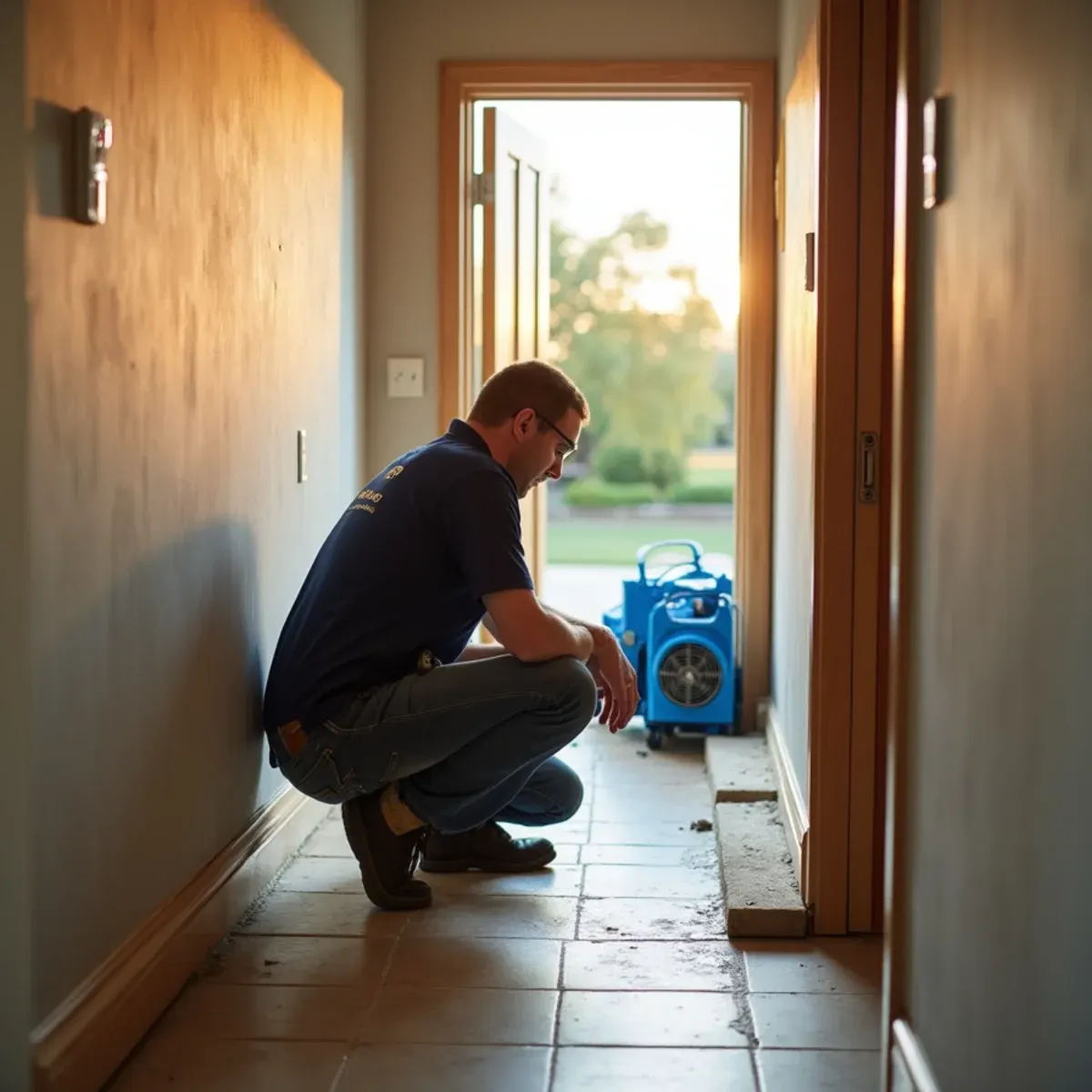
The call we get most in Downey opens with the same worry, and it isn't the water. It's the woodwork. Jean Vandruff's Cinderella Homes put turrets, scalloped bargeboard, arched openings and diamond detailing onto ordinary 1950s tract houses, and none of that trim is something you can order. When a supply line bursts behind one of those walls, the fast move is to open the whole bay and get on with it. We'd rather spend the extra two hours locating precisely and drilling drying ports where the trim isn't.
Underneath the detailing it's straightforward mid-century construction: slab on grade, galvanized supply lines with some early copper, standard drywall or plaster over the framing. Northeast Downey, Orange Estates and the Rancho Estates area all fall in that range. IICRC S500:2025 supports drying assemblies in place when the readings justify it, and on these houses the readings usually do. We're about seventeen minutes northwest of our Cypress base, and we bring trim-safe and cabinet-safe access tooling on every burst-pipe call here.
What Downey Changes About Burst Pipe Damage
1Original trim cannot be replaced
Reproduction millwork for these houses either doesn't exist or doesn't match. So our access strategy starts from the finished side you never want cut and works backward. Closet backs, cabinet toe kicks, garage-side faces of shared walls, the inside of a linen cupboard. If we do have to pull a piece of trim to reach saturated framing, it comes off whole, gets labeled, and goes back on the same wall.
21950s galvanized behind pretty walls
The charm is skin deep. The supply piping in most of these homes is the same 1950s galvanized steel we see in Bellflower, with the same corrosion pattern at the threads and the same tendency to mist rather than gush. Homeowners who assume a beautifully kept house has beautifully kept plumbing get caught by this. The age of the finish tells you nothing about the age of the pipe.
3Documentation protects the restoration
Before any drilling on a detailed home, we photograph the affected assembly from several angles with the trim intact, and we log each daily reading against the target. That record earns its keep twice: it supports the claim with your carrier, and it gives whoever closes the wall a reference for putting the room back exactly as it looked. We bill insurance directly so the documentation goes where it belongs.
How the Work Runs
The method is the same one we use on every burst pipe damage job, documented to the IICRC S500:2025 standard. Here it is in short — the full burst pipe water damage repair process explains each stage in detail.
- Stop the source
- Locate the failure precisely
- Coordinate the plumbing repair
- Extract and open only what must be opened
- Cavity and structural drying
- Rebuild and finish
The Downey Background Worth Knowing
The instinct on a wet wall is to open it, and sometimes that is correct. But IICRC S500:2025 is built around restoring rather than replacing wherever the drying goals can genuinely be met, and on a house with original arched casings and applied gingerbread, meeting those goals is worth some patience. We would rather spend three extra days with equipment running than pull a run of trim that would have to be milled from scratch to come back. The standard supports that choice and so does the arithmetic on the estimate, because custom millwork is not cheap and matching a fifties profile is not quick.
There is more on the housing stock, drainage and plumbing history of this city on our water damage restoration in Downey page.
Downey at a glance
- Dominant construction era
- 1950–1965
- Foundation type
- slab on grade
- Supply piping found here
- galvanized steel, under-slab copper
- Drain line materials
- cast iron
- Terrain and water table
- flat, moderate water table
- Most common local failure
- 1950s slab and galvanized failures in houses whose decorative woodwork makes careful, low-demolition drying worth paying for
- Highest-value local prevention
- drying in place wherever readings allow, because the trim and detailing on these houses cannot be bought
What It Costs in Downey
We do not quote a number over the phone before seeing the property — anyone who does is guessing. The variables that actually move the price on a burst pipe damage job are how long the line ran before discovery, which floor it happened on, hot line versus cold line, and they are broken down in full on the burst pipe water damage repair page. The assessment and the written estimate are free anywhere in Downey, day or night, with no obligation.
Burst Pipe Damage Questions from Downey Homeowners
Usually, yes. On Cinderella Homes we route access from the least visible side of the assembly — a closet back, a cabinet toe kick, or the garage face of a shared wall — and drill small ports for cavity drying rather than opening the finished side. If the trim itself is saturated at the base we may have to remove and re-set it, and every piece gets labeled and stored. That woodwork can't be bought, so we treat it that way.
We restore the water damage and coordinate the plumbing repair, working with your plumber or bringing in a licensed one from our network. Handling both under one schedule is what keeps a burst pipe from turning into two weeks of contractor coordination.
More than people expect. A half-inch supply line at typical residential pressure moves in the range of 8 to 10 gallons a minute. That is roughly 500 gallons in an hour — comparable to filling a small backyard pool inside your walls and floor.
Usually, yes. We go into the wall cavity through small ports low on the wall, hidden behind shoe molding or inside a closet, and dry from the inside out rather than taking the finished face off. That takes longer and needs more equipment than gutting the wall would, which is exactly the trade we think is worth making on a house with millwork that cannot be bought. Where it will not work, we tell you early.