
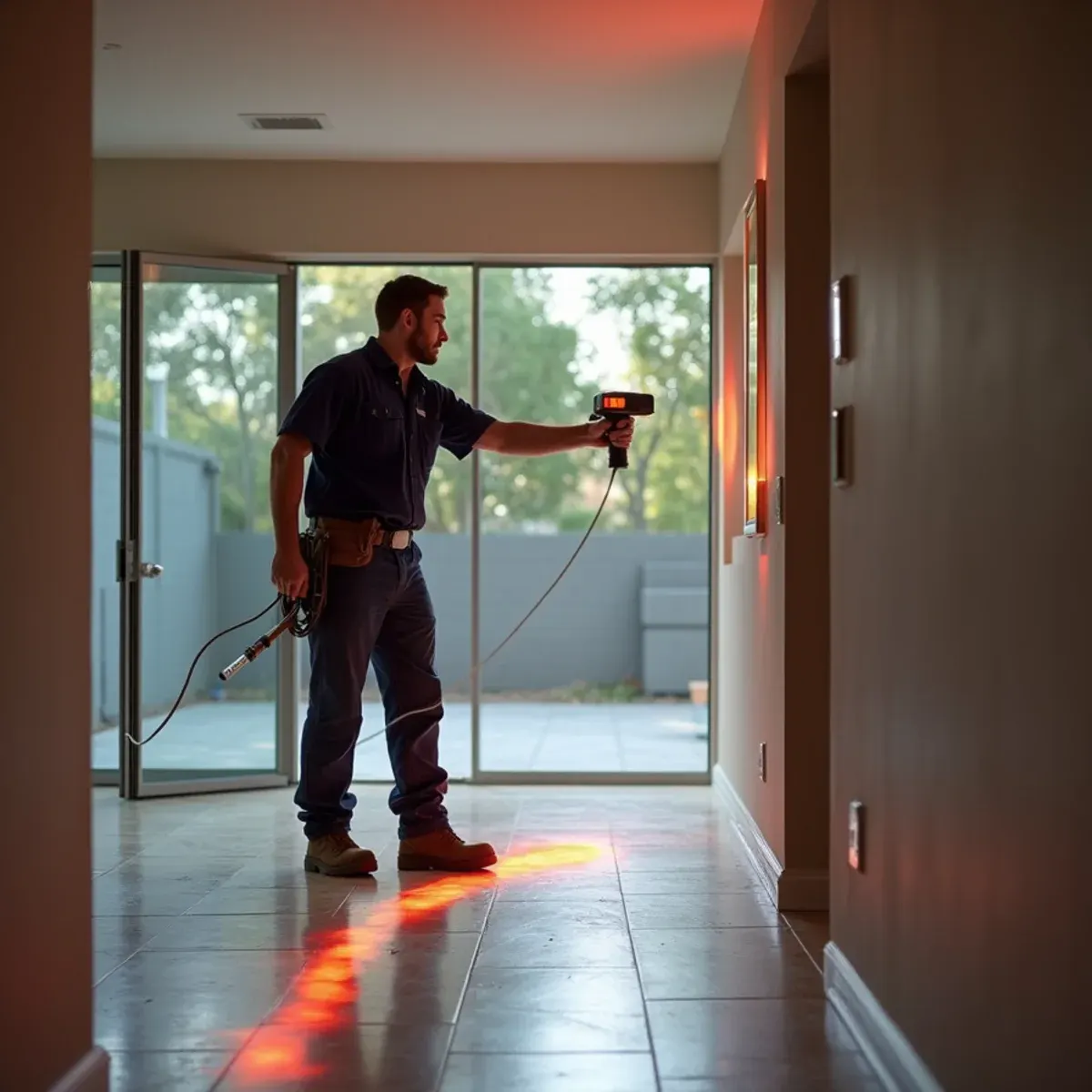
The usual workaround for a failed under-slab line is to abandon it and run new pipe around the outside of the house. On a Norwalk lot that's usually not available. These are compact postwar homes on small parcels built fast between 1945 and 1960, and the side yard is often three feet of concrete walkway with a fence tight against it, or a driveway slab exactly where the pipe would want to go. So the route goes up instead, into the attic, across, and down through interior walls. That's more drywall to patch, and here it's honestly the practical answer more often than not.
What's failing is almost always the original galvanized. Seventy years of scale narrowing the bore, velocity climbing, then a fitting giving up. If you're getting rusty water on the first draw of the morning, or the hot side has quietly lost pressure over a couple of years, that's the system telling you where it sits in its life. The other Norwalk factor is the San Gabriel River channel along the western edge. Neighborhoods near it saturate quickly in a heavy season, and small lots leave almost no open ground to absorb anything.
What Norwalk Changes About Slab Leak Damage
1Attic routing when there's no side yard
On these small lots the side yard is often a three-foot walkway with a fence against it, and sometimes a driveway slab right where new pipe would run. That rules out the exterior reroute that works on larger parcels. The route goes up through the attic and down interior walls instead: more drywall to patch afterward, but the practical answer here.
2Rusty first draw, falling hot-side pressure
Original galvanized announces itself before it fails. Scale narrows the bore, so the hot side loses pressure over a couple of years and the first draw in the morning runs discolored. Those aren't cosmetic annoyances to live around. They mean velocity has climbed inside the pipe and the fittings are eroding, which is exactly how these lines let go beneath a slab.
3Small lots leave no ground to absorb
The San Gabriel River channel along the western edge carries a very large share of regional runoff, and nearby blocks saturate quickly in a heavy season. With little open ground between the street and the house, a blocked area drain has nowhere to send water. Clear them before the season starts. It's the cheapest hour you'll spend on the house.
How the Work Runs
The method is the same one we use on every slab leak damage job, documented to the IICRC S500:2025 standard. Here it is in short — the full slab leak water damage repair process explains each stage in detail.
- Confirm it is actually a slab leak
- Electronic leak location
- Choose the repair approach with you
- Dry the slab and the affected assemblies
- Address the flooring and wall base
- Restore the floor and finish
The Norwalk Background Worth Knowing
The homes built in Norwalk during the postwar surge were built to be affordable and built fast, which was exactly the right priority at the time. Seventy years later, some of those choices have consequences.
There is more on the housing stock, drainage and plumbing history of this city on our water damage restoration in Norwalk page.
Norwalk at a glance
- Dominant construction era
- 1945–1960
- Foundation type
- slab on grade
- Supply piping found here
- original galvanized steel
- Drain line materials
- cast iron
- Terrain and water table
- flat, moderate water table
- Most common local failure
- original galvanized supply lines failing after decades of internal scaling and erosion at fittings
- Highest-value local prevention
- clearing yard and area drains before the season, since small lots leave little ground between the street and the house
What It Costs in Norwalk
We do not quote a number over the phone before seeing the property — anyone who does is guessing. The variables that actually move the price on a slab leak damage job are how long the leak ran undetected, flooring type over the leak, repair method chosen, and they are broken down in full on the slab leak water damage repair page. The assessment and the written estimate are free anywhere in Norwalk, day or night, with no obligation.
Slab Leak Damage Questions from Norwalk Homeowners
In a Norwalk house on original galvanized, that's the pipe telling you where it is in its life. Zinc wears through, the steel corrodes, scale narrows the bore and pressure falls. The same process erodes the fittings, which is what eventually lets go under a slab. It doesn't mean failure is imminent, but it does mean planning a repipe now beats reacting to one at three in the morning.
The meter test is the first step: shut off every fixture and watch the low-flow indicator. If it moves and nothing is wet above the floor, suspect the slab. Warm spots on the floor, running-water sounds from below, and flooring that lifts or cups without an obvious cause all point the same direction. We confirm it with thermal imaging and moisture mapping at no charge.
Not always. Depending on where the leak is and the condition of the system, rerouting the line overhead through the attic and walls avoids opening the concrete entirely. When a spot repair is the better option, precise electronic location keeps the opening small — typically a couple of feet, not a trench across the room.
If it is original galvanized from the postwar build-out, it has exceeded any reasonable service life. If you have had one failure, a second is a matter of when. The cheapest moment to repipe is while walls are already open for a repair — the demolition and patching are already in the scope.