
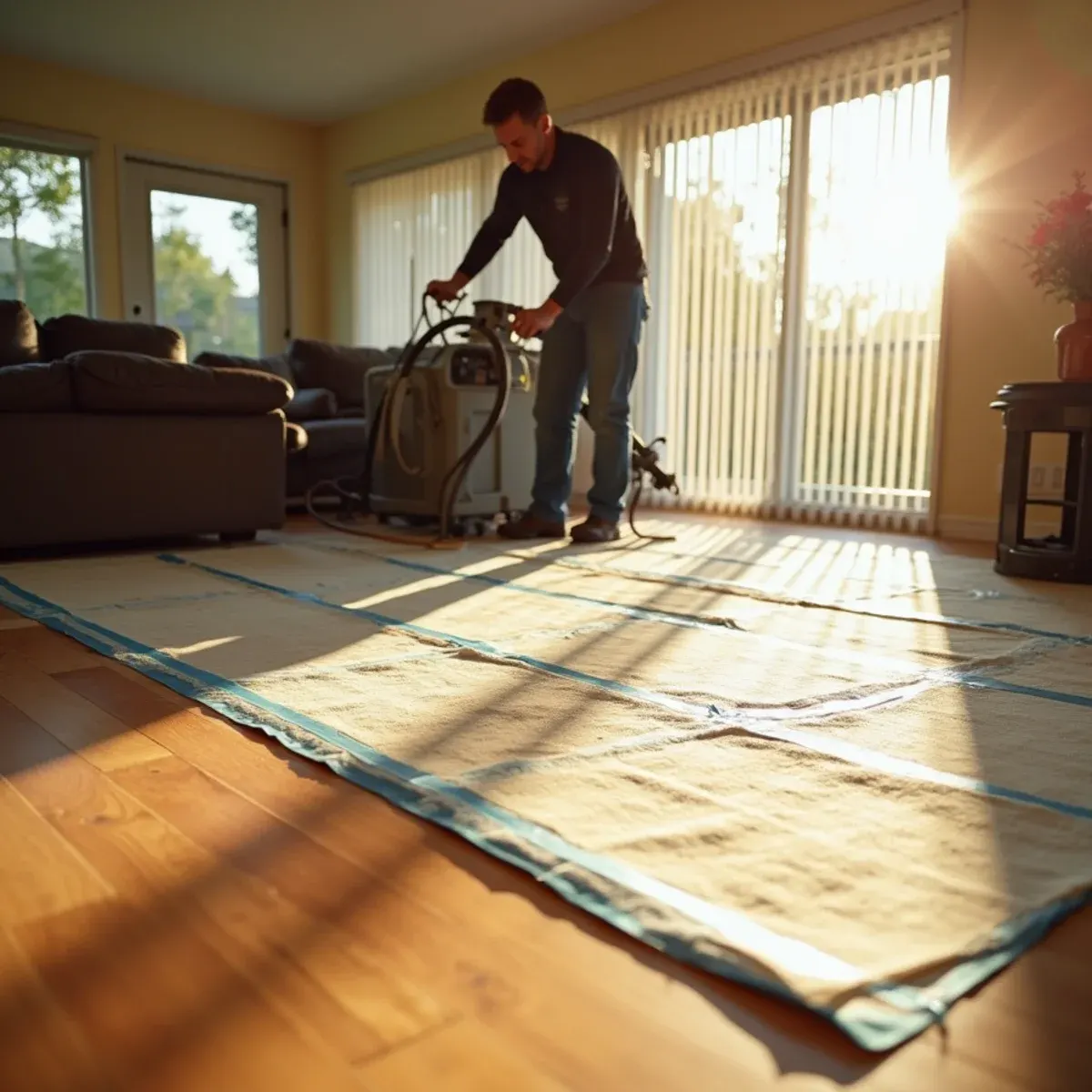
Not every floor that looks like wood can be saved, and in Paramount that matters more than in most places we work. A lot of the housing packed between the commercial corridors is rental stock where the flooring is floating laminate or thin engineered plank over 1950s slab. Laminate has a high-density fiberboard core. Once it swells at the joints, no drying system brings it back, and any company telling you otherwise is running equipment for the invoice. We test the material before setting a single piece of gear.
The houses that do have real wood here — the older Clearwater and Hynes stock, plus owner-occupied places that got a solid nail-down floor somewhere along the way — respond well to mat drying. Paramount's other complication is drainage. Lots are built out tight with very little permeable ground left, so during a heavy storm surface water has nowhere to go but toward the building. It enters low, at the slab edge, right where the flooring perimeter is most vulnerable.
What Paramount Changes About Hardwood Floor Drying
1Laminate cores don't come back
Floating laminate has a high-density fiberboard core. Once water reaches the joints, that core swells irreversibly, the edges peak, and no drying system reverses it. Engineered plank with a real wood wear layer sometimes survives. Laminate does not. We identify the material at a threshold on the first visit and tell you straight, because running fans over a dead floor helps nobody but the invoice.
2Water enters at the slab edge
Lots here are built out with very little permeable ground left, so during a heavy storm surface water has nowhere to go but toward the building. It arrives low and gets under the flooring perimeter before it ever wets the middle of the room. That's why we read the perimeter and the wall base first rather than starting with the visibly wet area.
3Homes and businesses on one block
Paramount packs housing between industrial and commercial corridors, and we regularly handle both on the same street in the same week. A warehouse office floor and a rental duplex floor need different equipment, different scheduling and different documentation. Tell us which one we're walking into when you call, so the right truck and the right crew show up the first time.
How the Work Runs
The method is the same one we use on every hardwood floor drying job, documented to the IICRC S500:2025 standard. Here it is in short — the full hardwood floor water damage drying process explains each stage in detail.
- Measure before deciding anything
- Extract from below the surface
- Control the drying rate deliberately
- Dry the subfloor and any cavity below
- Let it acclimate before judging it
- Sand and refinish only if needed
The Paramount Background Worth Knowing
On a typical Paramount lot, the house, the driveway, the walkways and the rear slab cover most of the parcel. What is left is a narrow side yard, and everything that lands on the roof and the paving is supposed to leave through a couple of small area drains. That system has no margin. When a grate silts up, when a downspout dumps straight onto paving, or when the outlet at the curb has been crushed by a parked truck, the water has no soil to soak into and nowhere else to be. It ponds against the slab edge and comes in at the lowest threshold, which is usually a garage or a side door.
There is more on the housing stock, drainage and plumbing history of this city on our water damage restoration in Paramount page.
Paramount at a glance
- Dominant construction era
- 1945–1965
- Foundation type
- slab on grade
- Supply piping found here
- original galvanized steel, copper
- Drain line materials
- cast iron
- Terrain and water table
- flat, moderate water table
- Most common local failure
- residential and commercial losses on the same block, needing very different handling
- Highest-value local prevention
- clearing area drains before the season on lots with very little permeable ground
What It Costs in Paramount
We do not quote a number over the phone before seeing the property — anyone who does is guessing. The variables that actually move the price on a hardwood floor drying job are square footage under the mat system, solid versus engineered wood, what is underneath, and they are broken down in full on the hardwood floor water damage drying page. The assessment and the written estimate are free anywhere in Paramount, day or night, with no obligation.
Hardwood Floor Drying Questions from Paramount Homeowners
Probably not, and you deserve that answer before the meter starts running. If it's laminate, the swollen joints are permanent damage to a fiberboard core, and drying only addresses what's underneath. What we can and should do is dry the slab and the wall base so the replacement floor goes down over a dry substrate, and document all of it for your carrier. If it turns out to be engineered with a wood wear layer, the conversation changes.
Frequently, yes. Cupping is caused by uneven moisture between the top and bottom of each board, and when the moisture equalizes during controlled drying, much of the deformation reverses. Full flattening can take two to four weeks of acclimation after the equipment comes out, which is why we do not recommend sanding immediately.
Five to ten days under the mat system is typical, which is longer than drywall because wood gives up moisture slowly and has to be dried at a controlled rate. Rushing it causes splitting and permanent gapping, so the extra days are doing real work.
Almost certainly your area drains. Paramount lots have very little permeable ground, so everything that falls on the roof and the paving has to leave through a couple of small drains. If a grate silts up or the outlet is crushed, the water ponds against the slab and enters at the lowest threshold, which is usually the garage. Rodding the drains and checking the outlet before the season costs far less than drying the garage wall afterward.