
A Cinderella Home is not a house you want a demolition crew walking through. Jean Vandruff's tracts brought arched doorways, turned posts, gingerbread trim and scalloped detailing to ordinary 1950s slab construction, and none of that is on a shelf anywhere. So when a galvanized line or a dishwasher lets go and the oak floor starts to cup, the temptation is to tear out the floor and the base and start over. That's the fast answer, and in this city it's usually the wrong one.
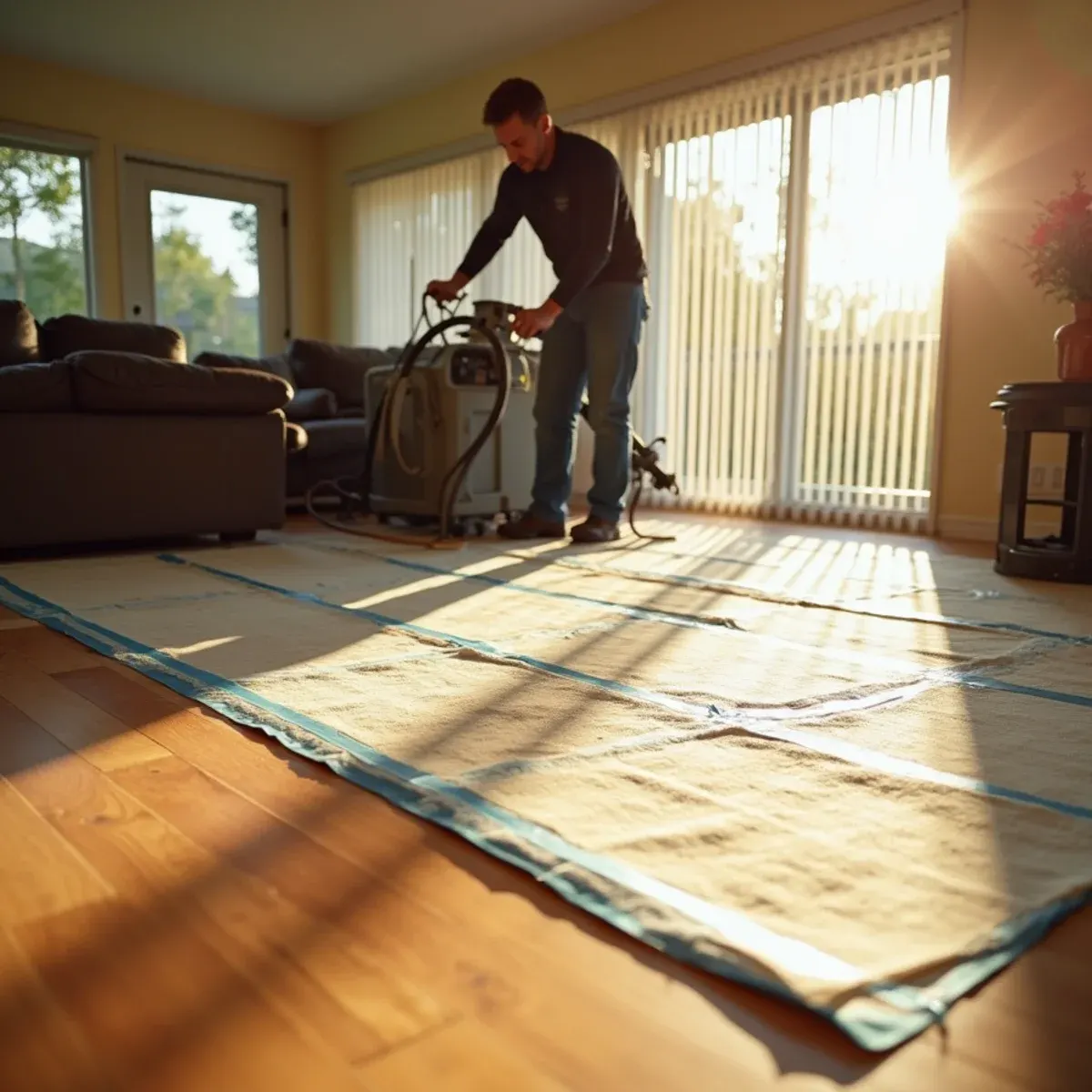
Underneath the detailing these are conventional mid-century slab houses, which means the wood floor dries from one side only and it takes patience. We set mat systems across the affected area, pull moisture up through the board seams under negative pressure, and take readings twice a day. Baseboards come off carefully and go back on, numbered. In houses around Orange Estates and the older Northeast Downey streets, keeping the original casing intact is often worth more to the owner than the flooring itself.
What Downey Changes About Hardwood Floor Drying
1Trim comes off numbered, not broken
Baseboard, casing and the decorative details on a Cinderella Home aren't replaceable. When we need base removed to get airflow behind it, it comes off with a shim and a flat bar, gets numbered on the back, and goes back exactly where it was. It's slower work. On these houses it's the part owners thank us for a year later.
2One drying direction over 1950s slab
There's no crawl space under a Downey tract house, so everything has to come up through the boards. Mat systems make that workable, but it takes patience and daily readings rather than a fixed number of days. Anyone quoting a three-day dry-out on a slab-borne wood floor before taking a single reading is guessing at your floor and your money.
3Galvanized behind original walls
Plenty of these houses still have stretches of original galvanized supply and cast-iron drain. Both fail quietly — a weep inside a wall reaches the flooring long before it shows on the plaster. If we're already drying a floor, that's the right moment to have the supply lines scoped, because a second loss through the same wall undoes everything we just did.
How the Work Runs
The method is the same one we use on every hardwood floor drying job, documented to the IICRC S500:2025 standard. Here it is in short — the full hardwood floor water damage drying process explains each stage in detail.
- Measure before deciding anything
- Extract from below the surface
- Control the drying rate deliberately
- Dry the subfloor and any cavity below
- Let it acclimate before judging it
- Sand and refinish only if needed
The Downey Background Worth Knowing
The instinct on a wet wall is to open it, and sometimes that is correct. But IICRC S500:2025 is built around restoring rather than replacing wherever the drying goals can genuinely be met, and on a house with original arched casings and applied gingerbread, meeting those goals is worth some patience. We would rather spend three extra days with equipment running than pull a run of trim that would have to be milled from scratch to come back. The standard supports that choice and so does the arithmetic on the estimate, because custom millwork is not cheap and matching a fifties profile is not quick.
There is more on the housing stock, drainage and plumbing history of this city on our water damage restoration in Downey page.
Downey at a glance
- Dominant construction era
- 1950–1965
- Foundation type
- slab on grade
- Supply piping found here
- galvanized steel, under-slab copper
- Drain line materials
- cast iron
- Terrain and water table
- flat, moderate water table
- Most common local failure
- 1950s slab and galvanized failures in houses whose decorative woodwork makes careful, low-demolition drying worth paying for
- Highest-value local prevention
- drying in place wherever readings allow, because the trim and detailing on these houses cannot be bought
What It Costs in Downey
We do not quote a number over the phone before seeing the property — anyone who does is guessing. The variables that actually move the price on a hardwood floor drying job are square footage under the mat system, solid versus engineered wood, what is underneath, and they are broken down in full on the hardwood floor water damage drying page. The assessment and the written estimate are free anywhere in Downey, day or night, with no obligation.
Hardwood Floor Drying Questions from Downey Homeowners
It shouldn't. We remove only what's necessary for airflow, usually the base and shoe, and it comes off carefully with backing shims so the paint edge doesn't tear. Casings on arched openings generally stay put; we get air behind them through the base cavity instead. If a piece has already swollen past saving we'll show you before removing it. On these houses the detailing is often worth more than the flooring.
Frequently, yes. Cupping is caused by uneven moisture between the top and bottom of each board, and when the moisture equalizes during controlled drying, much of the deformation reverses. Full flattening can take two to four weeks of acclimation after the equipment comes out, which is why we do not recommend sanding immediately.
Five to ten days under the mat system is typical, which is longer than drywall because wood gives up moisture slowly and has to be dried at a controlled rate. Rushing it causes splitting and permanent gapping, so the extra days are doing real work.
Usually, yes. We go into the wall cavity through small ports low on the wall, hidden behind shoe molding or inside a closet, and dry from the inside out rather than taking the finished face off. That takes longer and needs more equipment than gutting the wall would, which is exactly the trade we think is worth making on a house with millwork that cannot be bought. Where it will not work, we tell you early.