
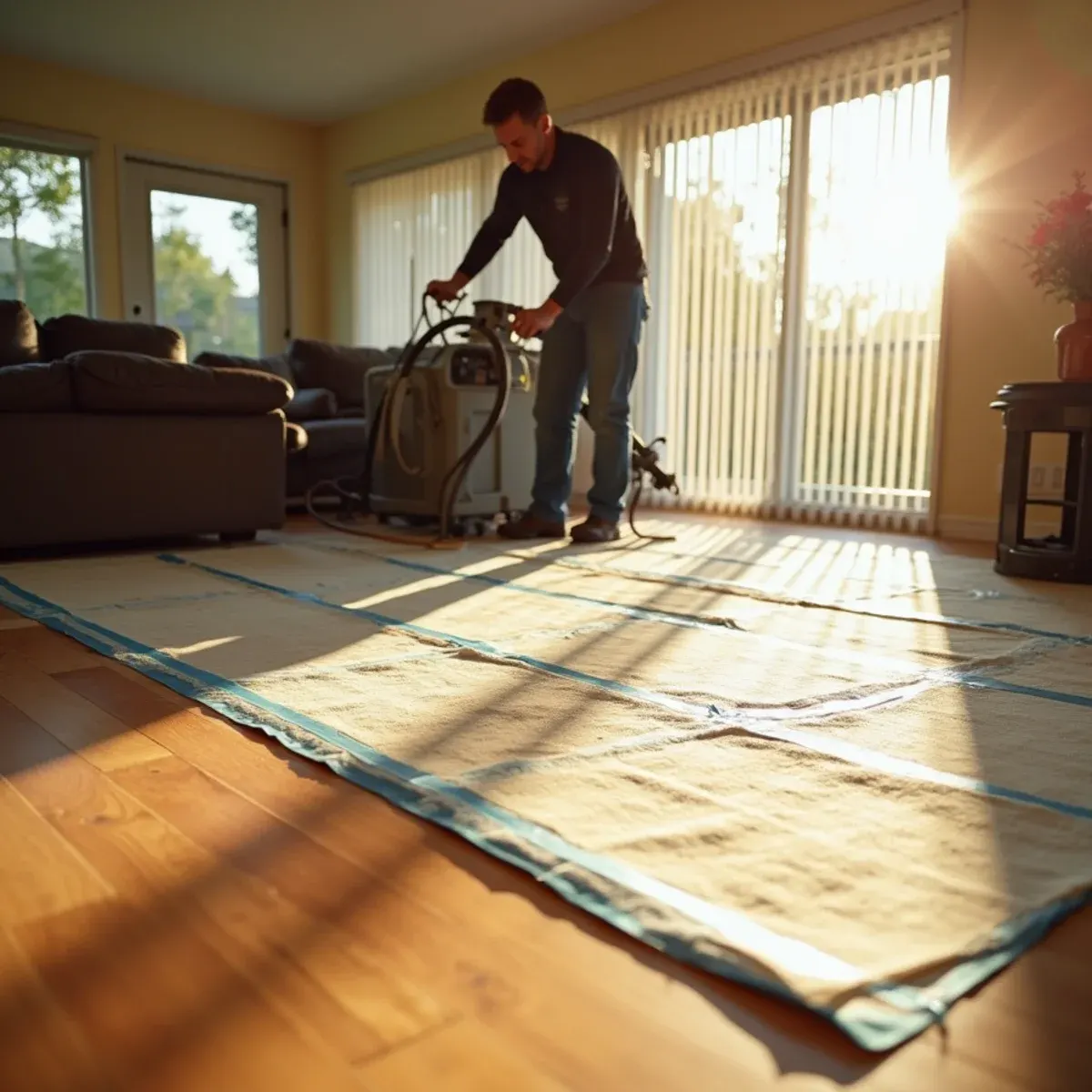
Here's something worth knowing before you get a quote: in Brea, the older house usually has the better odds. The small early-century places near downtown were built with solid oak or fir over a plank subfloor, and solid wood has enough thickness that severe cupping is still reversible once the moisture leaves evenly. The 1990s and 2000s hillside tracts up toward Carbon Canyon have wider engineered plank over slab, which looks better dry and behaves worse wet. Same city, opposite outcomes.
The two halves of town fail differently too. Downtown, it's a galvanized supply line or a cast-iron drain letting go inside a wall and wicking into the floor over days. Up in Olinda Ranch and Country Hills, it's canyon runoff during a concentrated storm — a v-ditch that filled with brush, then water across a pad and in at a door. One is clean water caught reasonably early. The other arrives dirty, and that changes the whole conversation about what stays down.
What Brea Changes About Hardwood Floor Drying
1Downtown's solid oak has thickness to spare
The small early-century houses near downtown were built with solid strip flooring over a plank subfloor. Solid wood can cup severely and still return flat once moisture leaves evenly, and if it needs a sanding afterward there's usually material left to take. That's the biggest single reason our salvage rate is better on the old side of Brea than up in the newer hillside tracts.
2Canyon runoff arrives dirty
Storm water coming off the Carbon Canyon side isn't clean. It carries brush debris, silt and whatever the v-ditch collected since spring. Once that gets under a floor, drying alone isn't enough — the substrate has to be cleaned, which usually means opening a section at the entry point. We'd rather remove two rows of board than seal contamination under a floor you live on.
3Hillside pads and where water enters
On the tracts toward Olinda Ranch and Country Hills, water almost never comes in the front door. It enters at a garage step-down, a side-yard gate low point, or a slider on the uphill elevation. Knowing the entry point tells us which direction it traveled beneath the flooring, and that's where we start taking readings rather than where the stain happens to show.
How the Work Runs
The method is the same one we use on every hardwood floor drying job, documented to the IICRC S500:2025 standard. Here it is in short — the full hardwood floor water damage drying process explains each stage in detail.
- Measure before deciding anything
- Extract from below the surface
- Control the drying rate deliberately
- Dry the subfloor and any cavity below
- Let it acclimate before judging it
- Sand and refinish only if needed
The Brea Background Worth Knowing
Brea's hillside tracts were designed to handle rain. Terrace drains catch runoff partway up a slope, v-ditches carry it around the toe, area drains take the flat yard, and everything ties into a system that moves water past the house rather than through it. The design works. What fails is maintenance. Over a dry summer those inlets fill with eucalyptus leaf litter, decomposed granite, and whatever the wind brought down the canyon, and nobody looks at them because they sit on a slope behind a fence. The first hard storm of the season finds every one that is blocked.
There is more on the housing stock, drainage and plumbing history of this city on our water damage restoration in Brea page.
Brea at a glance
- Dominant construction era
- 1920–2005
- Foundation type
- mixed on grade
- Supply piping found here
- galvanized steel, under-slab copper, PEX in newer hillside tracts
- Drain line materials
- cast iron, clay, ABS
- Terrain and water table
- hillside-mixed, deep water table
- Most common local failure
- canyon and hillside runoff overwhelming slope drainage during concentrated storms
- Highest-value local prevention
- keeping Carbon Canyon-side slope drains, v-ditches and downspout extensions genuinely clear
What It Costs in Brea
We do not quote a number over the phone before seeing the property — anyone who does is guessing. The variables that actually move the price on a hardwood floor drying job are square footage under the mat system, solid versus engineered wood, what is underneath, and they are broken down in full on the hardwood floor water damage drying page. The assessment and the written estimate are free anywhere in Brea, day or night, with no obligation.
Hardwood Floor Drying Questions from Brea Homeowners
Sometimes. A glue-down engineered floor with a thick sawn wear layer, caught within a day, has a fair chance with mats. A floating floor with a fiberboard core does not — water tracks along the underside and swells every joint. We pull a base or a threshold, read the core, and check how the floor was installed before recommending anything. If it's coming out, knowing that on day one saves you a week of equipment rental.
Frequently, yes. Cupping is caused by uneven moisture between the top and bottom of each board, and when the moisture equalizes during controlled drying, much of the deformation reverses. Full flattening can take two to four weeks of acclimation after the equipment comes out, which is why we do not recommend sanding immediately.
Five to ten days under the mat system is typical, which is longer than drywall because wood gives up moisture slowly and has to be dried at a controlled rate. Rushing it causes splitting and permanent gapping, so the extra days are doing real work.
Usually not under a standard homeowners policy. Water that runs across the ground and enters a building is surface water, and that is an excluded cause on nearly every form, whether it came off a Carbon Canyon slope or out of the street. Separate flood coverage handles it. Damage from a covered failure is a different story, so let us document the entry point and cause before anything gets cleaned up.