
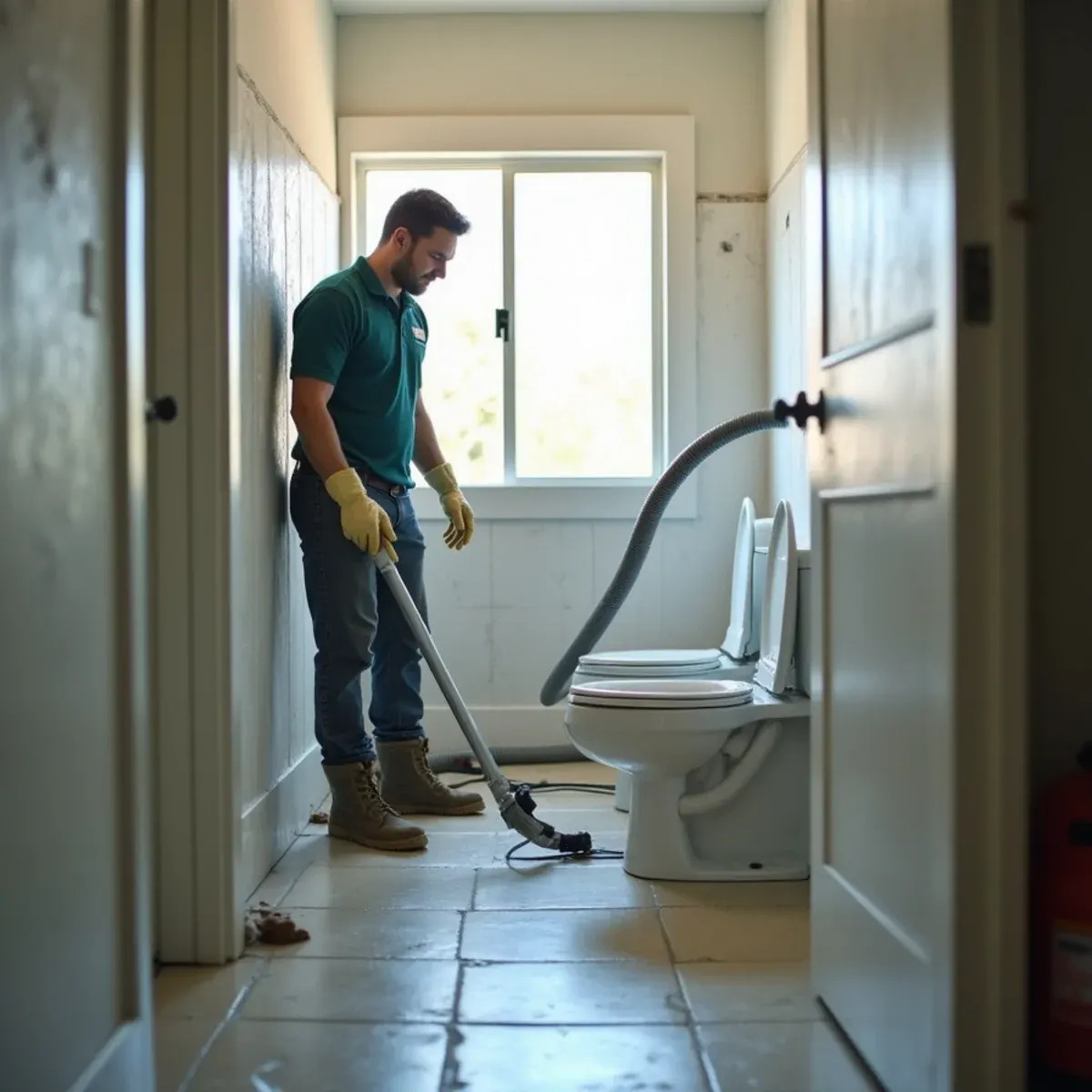
Here's advice most people don't expect: if your toilet is overflowing in an original Norwalk house, don't crank the angle stop behind it with everything you have. A lot of these homes still run original galvanized, and decades of internal scaling leave that stub brittle. We've watched a two-gallon overflow turn into a supply break because the valve snapped at the wall. Shut the house valve at the meter instead, then deal with the bowl. It costs you a minute and it saves the floor.
Norwalk went from farmland to a built-out city in about fifteen years, and it shows in the plumbing. Small lots, modest single-story houses, drain lines laid fast and economically. There's almost no permeable ground between the street and the front door, and the San Gabriel River channel carries the regional runoff along the western edge. What that means on this job is that when a main-line backup pushes waste up through a Norwalk toilet, the house has one bathroom, one hall, and nowhere for the family to go while we work.
What Norwalk Changes About Toilet Overflow
1Angle stops that fail when you close them
Galvanized supply that has been scaling since the Eisenhower years doesn't tolerate a hard turn. If the stop behind your toilet has never been exercised, assume it will weep or break. We plan for that on arrival, and if a stop fails while we're working we isolate at the meter and note it in the file so it doesn't get confused with the original loss.
2Backups show at the lowest fixture first
These houses are single-story with the tub and toilet on one short branch. A true main-line backup rarely announces itself at the bowl — it comes up in the tub or the shower pan while the toilet gurgles. If both are happening at once, stop flushing. That's Category 3 water from the whole system, and everything porous it touched is a removal item, not a drying item.
3No permeable ground, more storm-season calls
Norwalk is paved close to the foundation on most lots, and the western edge drains toward the San Gabriel River channel. Sustained storms load the older laterals with infiltration, and that's when we get clustered backup calls on the same street. A toilet that has been slow all summer tends to fail during the first long wet stretch, not before it.
How the Work Runs
The method is the same one we use on every toilet overflow job, documented to the IICRC S500:2025 standard. Here it is in short — the full toilet overflow cleanup process explains each stage in detail.
- Stop the water, stabilize the room
- Determine the category before scoping
- Extract, then remove only what must go
- Pull the toilet, inspect the flange
- Dry the subfloor and the ceiling below
- Disinfect to category, verify, reset
The Norwalk Background Worth Knowing
The homes built in Norwalk during the postwar surge were built to be affordable and built fast, which was exactly the right priority at the time. Seventy years later, some of those choices have consequences.
There is more on the housing stock, drainage and plumbing history of this city on our water damage restoration in Norwalk page.
Norwalk at a glance
- Dominant construction era
- 1945–1960
- Foundation type
- slab on grade
- Supply piping found here
- original galvanized steel
- Drain line materials
- cast iron
- Terrain and water table
- flat, moderate water table
- Most common local failure
- original galvanized supply lines failing after decades of internal scaling and erosion at fittings
- Highest-value local prevention
- clearing yard and area drains before the season, since small lots leave little ground between the street and the house
What It Costs in Norwalk
We do not quote a number over the phone before seeing the property — anyone who does is guessing. The variables that actually move the price on a toilet overflow job are the category of the water, how far it traveled from the base, what your floor is built from, and they are broken down in full on the toilet overflow cleanup page. The assessment and the written estimate are free anywhere in Norwalk, day or night, with no obligation.
Toilet Overflow Questions from Norwalk Homeowners
That it isn't the toilet. Two fixtures backing up together in a Norwalk single-story means the blockage is downstream of both, out in the lateral or the main. That's Category 3 — waste from the whole system, not bowl water. Stop using every drain in the house, get a plumber to clear the line, and call us in parallel. Carpet, pad and the bottom of the drywall come out; tile and framing usually dry.
Clear water lowers the health risk, not the drying requirement. Clean water still soaks into carpet pad, particle board, and the cut edge of subfloor around the flange, and it still causes swelling and mold growth if it stays. What clean water does change is the scope: no containment, no PPE, usually no demolition. If it stayed on sealed tile and you got it up quickly, you may genuinely be fine. If it reached anything porous, it needs real drying.
Three checks. Did the water rise in the bowl without anyone flushing it? Does another fixture gurgle, drain slowly, or fill up when you run water elsewhere in the house? Is there visible soil or a sewer odor in what came out? Any one of those points at the main line. A stuck fill valve, by contrast, gives you clear water, a bowl that overflows steadily, and a tank you can hear running continuously.
If it is original galvanized from the postwar build-out, it has exceeded any reasonable service life. If you have had one failure, a second is a matter of when. The cheapest moment to repipe is while walls are already open for a repair — the demolition and patching are already in the scope.