
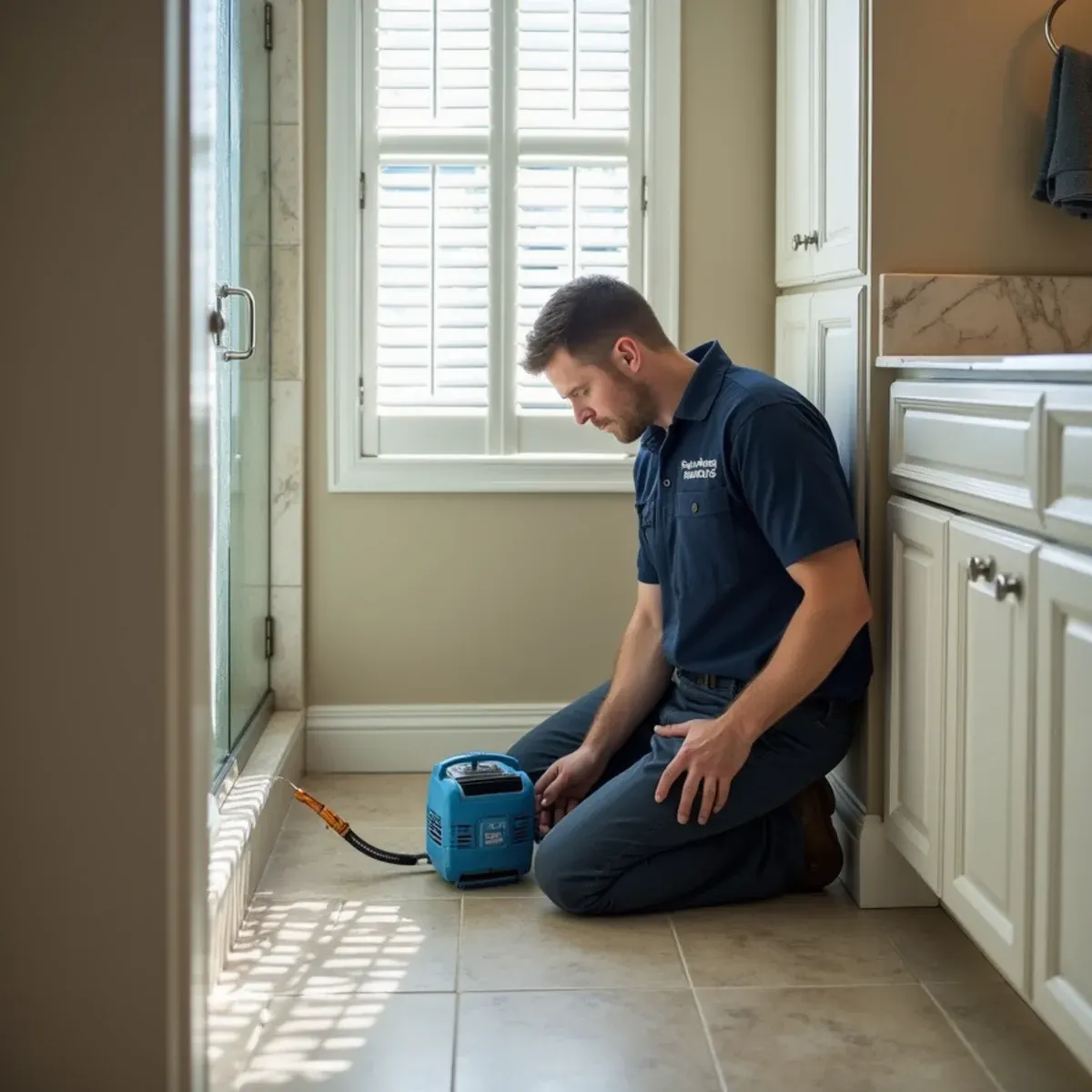
Here is the call we take most often in Norwalk. Homeowner sees a rust-colored stain at the base of the shower wall, assumes the pan has gone, and starts pricing tile. Half the time the pan is fine and the culprit is the original galvanized supply riser behind it, scaled shut and weeping at a threaded joint. Norwalk built out from farmland to a full city between about 1945 and 1960, fast and economically, and a lot of those houses still carry their first-generation galvanized. Rusty water and a wet wall base look the same from the hallway. They are not the same repair.
The housing stock makes it tighter work than elsewhere. Small lots, modest single-story plans, one bathroom crammed against the kitchen wall so the two share a plumbing wall. That shared wall is where a shower pan leak and a galvanized pinhole both end up, and it is why a wet spot can appear under the kitchen sink cabinet with nothing wrong under that sink. With the San Gabriel River channel taking regional runoff along the west edge and very little permeable ground between street and house, exterior water gets blamed for interior failures constantly. Testing settles it.
What Norwalk Changes About Shower Pan Leaks
1Galvanized rust masquerading as a pan leak
Original galvanized fails from the inside out after decades of scaling, and it stains the same brown a failing hot-mopped liner does. We isolate supply from the pan before we quote anything: flood-test the pan with the water off, then pressure-check separately. On a Norwalk house of this vintage, finding out you need repiping instead of a tile job changes the whole scope, and you want to know that on day one.
2Shared kitchen-bathroom plumbing walls
These homes were laid out to keep pipe runs cheap, so the bath and kitchen almost always back onto one wet wall. Water from a failed pan or curb travels along that bottom plate and shows up in the kitchen toe-kick or in cabinet bases. We moisture-map both rooms before opening either, because the wettest drywall is regularly on the kitchen side.
3Small lots, no permeable ground
With house, driveway and slab covering most of the lot, Norwalk homeowners see standing water near the foundation during storms and reasonably suspect it as the source. It rarely is, for a bathroom leak. Water arriving from outside wets the perimeter; a pan failure wets a wall base in the middle of the house. Knowing which pattern you have keeps you from re-grading a yard that was never the problem.
How the Work Runs
The method is the same one we use on every shower pan leaks job, documented to the IICRC S500:2025 standard. Here it is in short — the full shower pan & bathroom leak repair process explains each stage in detail.
- Map the moisture first
- Flood test the pan
- Isolate the actual failure
- Open only what has to open
- Dry the structure to standard
- Rebuild the waterproofing correctly
The Norwalk Background Worth Knowing
The homes built in Norwalk during the postwar surge were built to be affordable and built fast, which was exactly the right priority at the time. Seventy years later, some of those choices have consequences.
There is more on the housing stock, drainage and plumbing history of this city on our water damage restoration in Norwalk page.
Norwalk at a glance
- Dominant construction era
- 1945–1960
- Foundation type
- slab on grade
- Supply piping found here
- original galvanized steel
- Drain line materials
- cast iron
- Terrain and water table
- flat, moderate water table
- Most common local failure
- original galvanized supply lines failing after decades of internal scaling and erosion at fittings
- Highest-value local prevention
- clearing yard and area drains before the season, since small lots leave little ground between the street and the house
What It Costs in Norwalk
We do not quote a number over the phone before seeing the property — anyone who does is guessing. The variables that actually move the price on a shower pan leaks job are how long the shower kept running, what sits under the shower floor, whether the framing is compromised, and they are broken down in full on the shower pan & bathroom leak repair page. The assessment and the written estimate are free anywhere in Norwalk, day or night, with no obligation.
Shower Pan Leaks Questions from Norwalk Homeowners
If we have the wall open and the galvanized in it is original, yes, it is worth serious thought. Those lines are scaled and thin, and reopening finished tile later costs more than doing it once. We will not push it if the pipe we expose still tests sound. What we will do is show you what came out of that wall, tell you honestly what it looks like, and give you an itemized scope so the plumbing and the restoration are separate decisions.
Timing is the cleanest clue. A pan leak only produces water when the shower is running, so the symptom appears within hours of use and dries out between uses. A pressurized supply line leaks around the clock, and the damage grows steadily whether anyone is home or not. Shut off every fixture and watch the water meter's low-flow indicator. If it still moves, you have a supply leak, not a pan. We confirm it with a flood test either way.
Sometimes, and we will tell you honestly which case you are in. A leak at the drain clamping ring, or a failed seal where the surround meets the pan, can occasionally be handled with a limited opening. A split or perforated liner cannot. Liquid-applied products sold as pan sealers can buy a few months on a pinhole, but they will not repair a membrane that has failed at a fold or a corner, and we are not going to sell you that as a fix.
If it is original galvanized from the postwar build-out, it has exceeded any reasonable service life. If you have had one failure, a second is a matter of when. The cheapest moment to repipe is while walls are already open for a repair — the demolition and patching are already in the scope.