
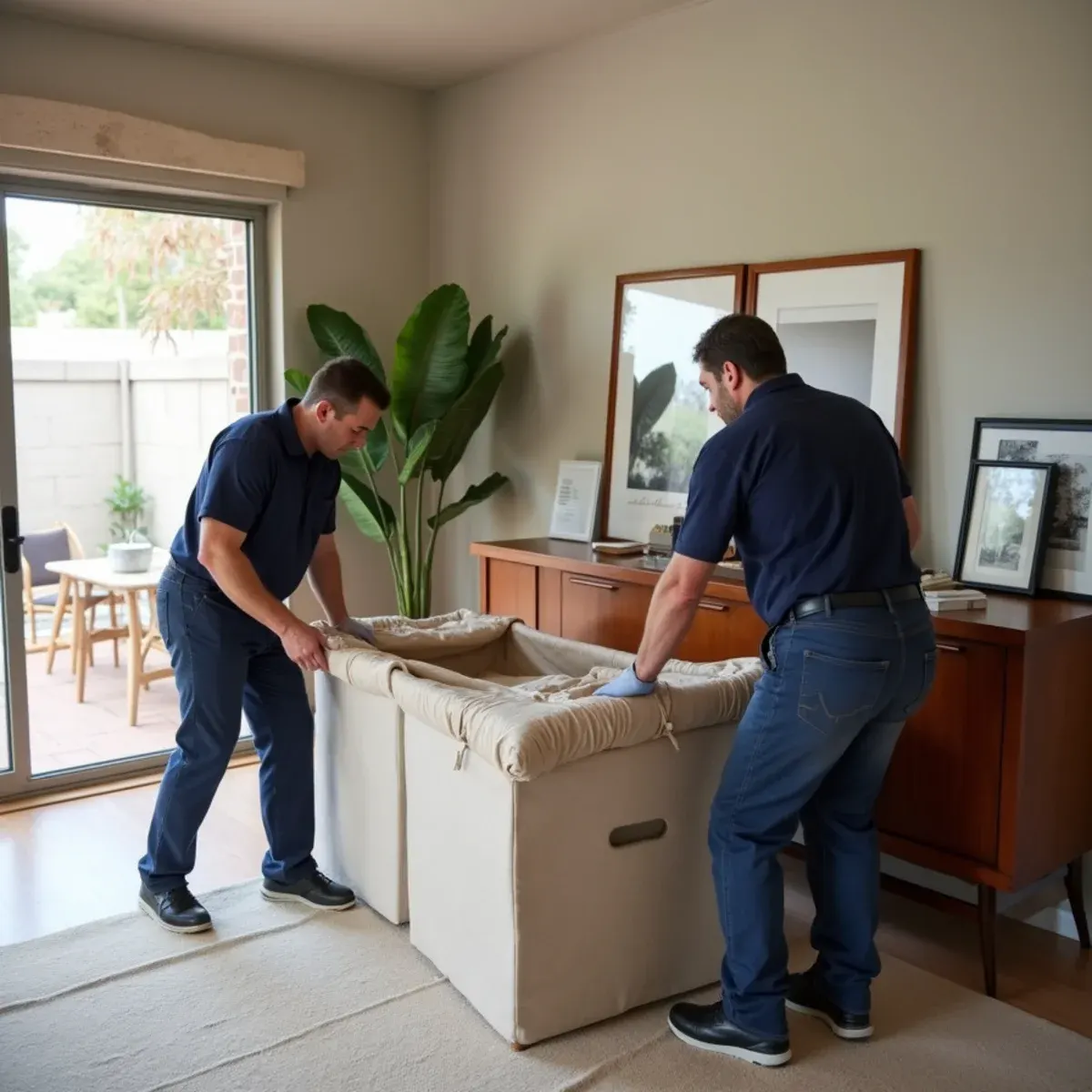
Norwalk lots are small, and that shapes the day more than people expect. Postwar houses built fast and economically between 1945 and 1960, sitting close to the street with narrow side yards and barely any driveway. There is rarely room to park a box truck with the lift gate down without blocking somebody, and no side yard to stage cartons under cover. So we shuttle, we work in a tighter sequence, and we ask about the neighbor's parking before the crew arrives rather than after they are already double-parked.
Inside, the houses are modest and the storage has nowhere to go but the garage — which is also the part of the property that fills first when the San Gabriel River channel along the western edge pushes regional runoff into the surrounding streets. Small lots leave almost no absorbing ground between curb and wall. Add original galvanized supply lines seventy years into their life, failing at scaled fittings inside the walls, and the contents at risk in Norwalk are usually low, boxed and irreplaceable.
What Norwalk Changes About Contents & Pack-Out
1Tight lots limit truck access
With little driveway and narrow side yards, a full-size truck often cannot stage where we would like it. We use smaller vehicles for the shuttle, protect the walk and the entry, and box on a covered table rather than on the lawn. Telling us in advance about a shared drive or a tight alley genuinely shortens the day.
2Garage storage sits in the flood path
In a small postwar house the garage holds the overflow — paperwork, photographs, tools, seasonal boxes, most of it straight on the slab. That is also the lowest, most exposed part of the property when street water rises near the channel. Wet paper and photographs go into the freezer within hours, which stops mold and keeps photo emulsions from fusing together.
3Galvanized failures soak cabinets, not floors
When seventy-year-old galvanized lets go at a fitting inside a wall, water often runs into the base cabinets and the closet behind before it ever appears on the floor. Contents in those enclosed spaces are the wettest and the last to be noticed. We open and meter every cabinet and closet along the affected wall, not just the visible room.
How the Work Runs
The method is the same one we use on every contents & pack-out job, documented to the IICRC S500:2025 standard. Here it is in short — the full contents restoration & pack-out process explains each stage in detail.
- Room-by-room photographic inventory
- Triage into three categories
- Careful packing and transport
- Cleaning and restoration by material type
- Climate-controlled storage
- Delivery and placement back
The Norwalk Background Worth Knowing
The homes built in Norwalk during the postwar surge were built to be affordable and built fast, which was exactly the right priority at the time. Seventy years later, some of those choices have consequences.
There is more on the housing stock, drainage and plumbing history of this city on our water damage restoration in Norwalk page.
Norwalk at a glance
- Dominant construction era
- 1945–1960
- Foundation type
- slab on grade
- Supply piping found here
- original galvanized steel
- Drain line materials
- cast iron
- Terrain and water table
- flat, moderate water table
- Most common local failure
- original galvanized supply lines failing after decades of internal scaling and erosion at fittings
- Highest-value local prevention
- clearing yard and area drains before the season, since small lots leave little ground between the street and the house
What It Costs in Norwalk
We do not quote a number over the phone before seeing the property — anyone who does is guessing. The variables that actually move the price on a contents & pack-out job are volume of contents, proportion of specialty items, storage duration, and they are broken down in full on the contents restoration & pack-out page. The assessment and the written estimate are free anywhere in Norwalk, day or night, with no obligation.
Contents & Pack-Out Questions from Norwalk Homeowners
No, and that is the easiest change you can make. Garage slabs in Norwalk are the lowest storage in the house and the first place street water reaches on a small lot. Move photographs, documents and anything sentimental into an interior closet, up off the floor, in sealed plastic bins rather than cardboard. If they do get wet, call before you try to separate anything and get them into a freezer immediately.
It depends on the scope. For a contained single-room loss we often move contents to an unaffected part of the home and block furniture in place. When the drying chamber covers most of the living area or reconstruction is extensive, off-site pack-out is usually both safer and faster.
Every item is photographed and barcoded at your home and tracked through cleaning, storage, and delivery. You receive the inventory, and at delivery we reconcile it with you item by item before we leave.
If it is original galvanized from the postwar build-out, it has exceeded any reasonable service life. If you have had one failure, a second is a matter of when. The cheapest moment to repipe is while walls are already open for a repair — the demolition and patching are already in the scope.