
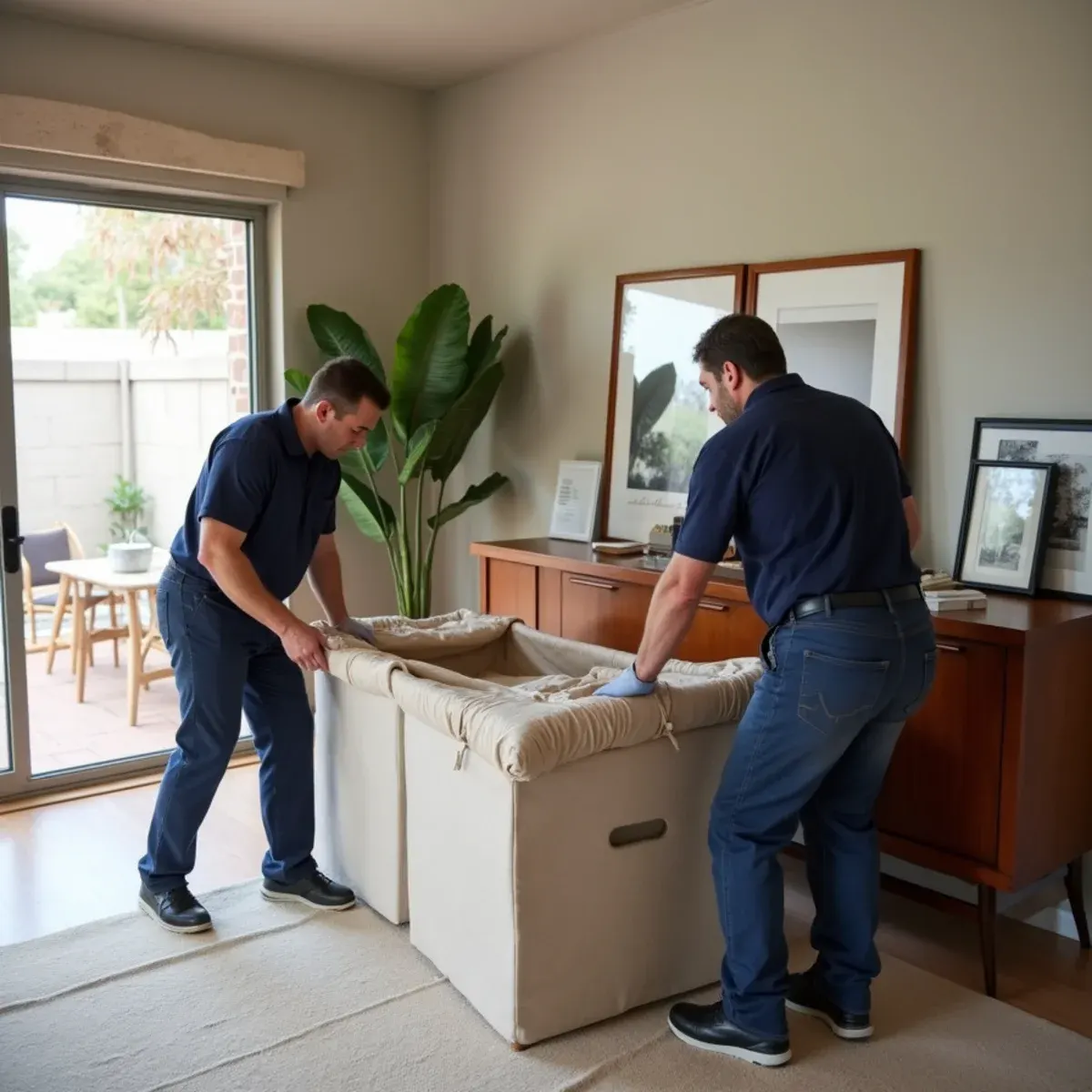
It rains hard for two hours and water comes in under the slider on the low side of the house. Nobody's pipe failed. La Mirada sits on gently rolling ground rather than the dead-flat plain of the coastal cities, and storm water moves across properties here instead of ponding — an advantage right up until fifty years of added patios, raised planters and settled hardscape have quietly redirected it back toward the building. The entry is shallow and wide, and it arrives with soil in it.
That changes the contents job. Exterior storm water is not clean water: it carries soil, fertilizer, whatever was sitting on the driveway and sometimes whatever washed off the landscaping upslope. Anything porous it touched at floor level — rugs, the bottom of upholstered furniture, boxes on the garage slab, particleboard bookcases — gets triaged with contamination in mind, not just moisture. The homes are 1953 to 1965 planned-community tract, well kept, and the water almost always finds the same low corner of the same plan.
What La Mirada Changes About Contents & Pack-Out
1Storm water arrives with soil in it
Water that has crossed a yard, a planter and a driveway is not clean water — IICRC S500:2025 treats ground surface water as Category 3. Silt loads into carpet backing and upholstery and stays there after the item dries, which is what people are actually smelling months later. Porous contents get cleaned accordingly or condemned with documentation rather than optimism.
2Low-side rooms take it first
On rolling ground the same rooms flood every time — whichever side of the house sits downslope, usually a garage, a den or a converted room with a slider. We ask what happened in previous storms, because the answer tells us which contents are already compromised and where to start metering before we have walked the whole house.
3Student rentals near Biola report late
Rental houses around Biola University often sit empty over breaks and get reported days after a storm. Contents in a closed-up house that has been damp for a week are an odor and growth problem rather than a wet-item problem, and individual tenants' belongings need separate inventories. We tag by occupant so each renter's claim stands on its own.
How the Work Runs
The method is the same one we use on every contents & pack-out job, documented to the IICRC S500:2025 standard. Here it is in short — the full contents restoration & pack-out process explains each stage in detail.
- Room-by-room photographic inventory
- Triage into three categories
- Careful packing and transport
- Cleaning and restoration by material type
- Climate-controlled storage
- Delivery and placement back
The La Mirada Background Worth Knowing
La Mirada's gentle slopes mean storm water moves across properties instead of sitting on them, which is generally an advantage — except where fifty years of added patios, raised planters, retaining walls, and settled hardscape have redirected it.
There is more on the housing stock, drainage and plumbing history of this city on our water damage restoration in La Mirada page.
La Mirada at a glance
- Dominant construction era
- 1953–1965
- Foundation type
- slab on grade
- Supply piping found here
- under-slab copper, galvanized steel
- Drain line materials
- cast iron
- Terrain and water table
- rolling, moderate water table
- Most common local failure
- exterior water entering where fifty years of added patios, planters and retaining walls redirected the original drainage back toward the house
- Highest-value local prevention
- walking the property during the first real rain and watching where water actually goes
What It Costs in La Mirada
We do not quote a number over the phone before seeing the property — anyone who does is guessing. The variables that actually move the price on a contents & pack-out job are volume of contents, proportion of specialty items, storage duration, and they are broken down in full on the contents restoration & pack-out page. The assessment and the written estimate are free anywhere in La Mirada, day or night, with no obligation.
Contents & Pack-Out Questions from La Mirada Homeowners
Hard goods and furniture frames generally are. Rugs and upholstery are the real question, because storm water carries soil and the fine material stays in the backing long after the surface dries. If it has happened before, the same pieces have likely been through it more than once, which lowers the odds. We meter and inspect the backing rather than the face, and tell you plainly which pieces justify the cleaning cost.
It depends on the scope. For a contained single-room loss we often move contents to an unaffected part of the home and block furniture in place. When the drying chamber covers most of the living area or reconstruction is extensive, off-site pack-out is usually both safer and faster.
Every item is photographed and barcoded at your home and tracked through cleaning, storage, and delivery. You receive the inventory, and at delivery we reconcile it with you item by item before we leave.
Almost always exterior drainage rather than a plumbing leak — a plugged area drain, a patio that has settled toward the house, or a planter holding moisture against the wall. We identify the actual path rather than just drying the wall, because drying without fixing the cause means doing it again next storm.