
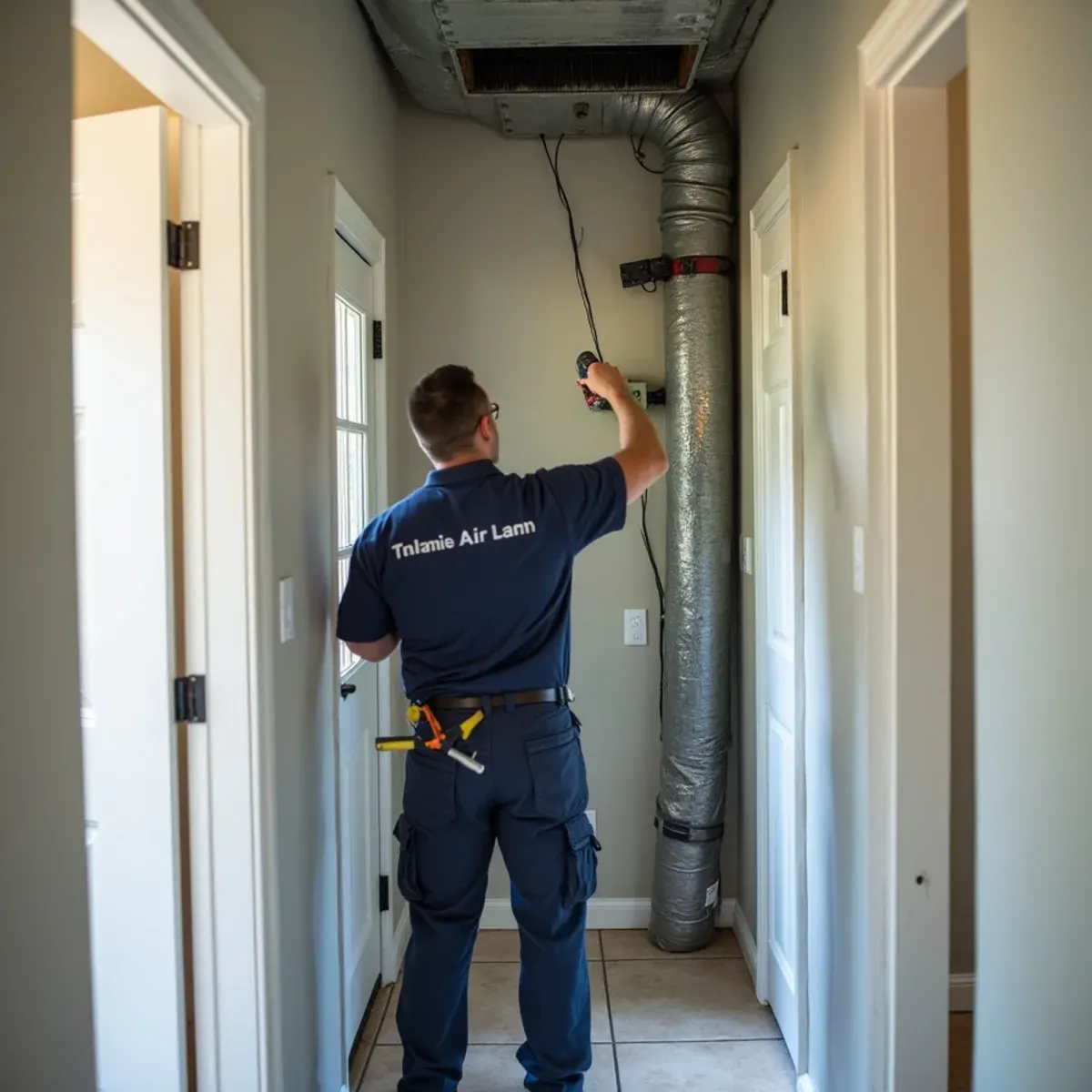
It starts as a stain on a hallway wall. The original galvanized supply has been scaling shut for sixty years, a pinhole finally lets go inside the cavity, and by the time anyone notices, the framing has been damp for a week. Norwalk went from farmland to a full city in about fifteen years, and the houses that came out of that rush are small, close together and plumbed with the same steel. What turns a plumbing failure into an air quality problem is what got added decades later.
Central air came to most of these houses long after they were built, and it often came cheap. Ducting was stuffed into a shallow attic with four feet of ridge height, and returns were frequently panned — a wall or floor cavity used as the return path instead of a sealed duct. When galvanized fails inside that same framing, the return is literally drawing air through wet wood. Small lots and almost no permeable ground between street and house mean the San Gabriel River channel's regional runoff shows up indoors too.
What Norwalk Changes About Air Ducts & HVAC
1Panned wall-cavity returns pull through framing
A framing cavity used as a return can't be brushed clean the way a metal duct can, and it sits inside the same walls the original galvanized runs through. We identify them first, because a cavity return next to a failed pipe explains an odor that survives new drywall. Sealing it properly or converting to a ducted return is often the only fix that holds.
2Low attics over small postwar footprints
Norwalk houses are modest, which cuts both ways. Access is genuinely tight — shallow pitch, no walk boards, ducting laid straight on the ceiling joists — but total duct footage is small. That makes full replacement of contaminated flex realistic here in a way it isn't on a five-thousand-foot house, and it usually prices closer to a thorough cleaning than owners expect.
3Hard ground sends storm water indoors
Between the street, the drive and a small lot, there's very little ground left to absorb anything, and the San Gabriel River channel on the west edge carries runoff from far upstream. Water enters at floor level, which is where the return grille and, in many houses, the filter cabinet live. Those components get inspected on every storm-related call in this city.
How the Work Runs
The method is the same one we use on every air ducts & hvac job, documented to the IICRC S500:2025 standard. Here it is in short — the full air duct cleaning & hvac restoration process explains each stage in detail.
- Inspect before we quote
- Contain and seal the system
- Clean or replace the ducting
- Clean the air handler and coil
- Replace filters and treat surfaces
- Seal, balance, and verify
The Norwalk Background Worth Knowing
The homes built in Norwalk during the postwar surge were built to be affordable and built fast, which was exactly the right priority at the time. Seventy years later, some of those choices have consequences.
There is more on the housing stock, drainage and plumbing history of this city on our water damage restoration in Norwalk page.
Norwalk at a glance
- Dominant construction era
- 1945–1960
- Foundation type
- slab on grade
- Supply piping found here
- original galvanized steel
- Drain line materials
- cast iron
- Terrain and water table
- flat, moderate water table
- Most common local failure
- original galvanized supply lines failing after decades of internal scaling and erosion at fittings
- Highest-value local prevention
- clearing yard and area drains before the season, since small lots leave little ground between the street and the house
What It Costs in Norwalk
We do not quote a number over the phone before seeing the property — anyone who does is guessing. The variables that actually move the price on a air ducts & hvac job are cleaning versus replacing flex duct, number of supply runs and returns, what kind of contamination it is, and they are broken down in full on the air duct cleaning & hvac restoration page. The assessment and the written estimate are free anywhere in Norwalk, day or night, with no obligation.
Air Ducts & HVAC Questions from Norwalk Homeowners
Not the way a duct is cleaned. A panned cavity return is bare framing and drywall backing, so there's no liner to brush and no way to guarantee what's inside it. We clean and treat what's reachable, verify the cavity is dry with meter readings in the studs, and tell you plainly if the honest fix is converting it to a sealed, ducted return. In older Norwalk houses that conversion is common.
Fair question, and often it is an upsell. The honest answer depends on whether contamination actually reached the system. If the HVAC ran during the loss or the demolition, if water got into the attic where the ducting lives, or if the loss involved sewage or fire, the system is in scope. If none of that happened, it probably is not. We run a camera and show you before you decide anything.
It depends on where the moisture is. If the inner liner got damp and the fiberglass behind it stayed dry, cleaning and drying the run works. If water got through a torn jacket into the insulation, that fiberglass is porous, it holds moisture and growth, and there is no reliable way to clean it or verify it is clean. Those runs get replaced. We show you which is which rather than guessing on your behalf.
If it is original galvanized from the postwar build-out, it has exceeded any reasonable service life. If you have had one failure, a second is a matter of when. The cheapest moment to repipe is while walls are already open for a repair — the demolition and patching are already in the scope.