
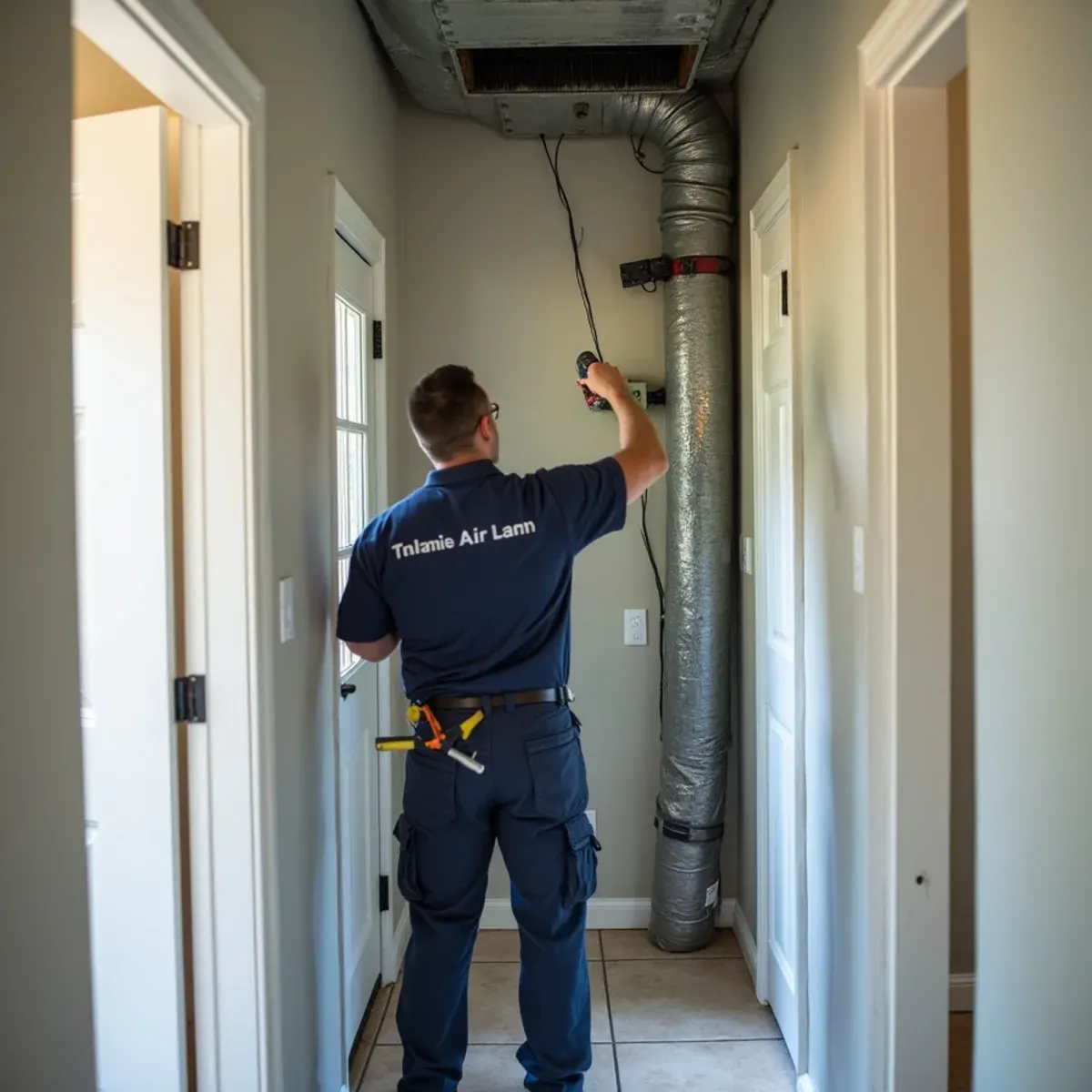
Forget the attic for a minute. A large share of Carson's housing sits in mobile home parks, and manufactured homes don't duct through an attic at all — the supply trunk runs under the floor, down the center of the coach, inside the belly wrap. When a supply line or a drain fails, water goes into that belly, the insulation holds it against the duct, and there is no way to dry it in place while it's sealed under there. The floor tells you first: soft spots near a register, a register grille that smells before anything looks wrong.
The rest of Carson is different work entirely. Postwar tract from 1950 to 1975 on slab, built over former ranch, oil-field and industrial land and incorporated in 1968, with refineries and logistics operations pressed right up against the neighborhoods. Those houses have ordinary attic flex. The shallow water table keeps slabs cool and damp, and the industrial neighbors mean filters and coils carry a heavy load before any loss occurs. We scope manufactured homes and slab houses as two separate services, because treating them as one is how people get billed for work that doesn't apply to their home.
What Carson Changes About Air Ducts & HVAC
1Belly-wrap trunks can't dry in place
The underfloor duct in a manufactured home is wrapped in insulation and a bottom board that holds water against it. Nothing dries through that. The bottom board gets opened, wet insulation comes out, the trunk is inspected for rust-through and crushed sections, and it's replaced or cleaned based on what's actually there. Then it gets re-insulated and resealed, which is the step that most repairs skip.
2Crossover ducts under double-wide homes
Double-wide coaches join two halves with a crossover duct running under the marriage line, and it's the most exposed part of the system — often sagging, sometimes already torn, frequently resting on the ground. After a water event it's usually the first component to fail inspection. We check it on every manufactured-home call here whether or not it's near the reported leak.
3Refinery and port particulate on coils
With refineries and heavy logistics immediately adjacent and the shallow water table keeping humidity up, systems in Carson run dirtier at baseline than inland tracts. Coils foul faster and filters load sooner. That pre-existing condition is documented separately from loss-related contamination, so the carrier sees the difference and you aren't paying to correct years of accumulated fouling as part of a claim.
How the Work Runs
The method is the same one we use on every air ducts & hvac job, documented to the IICRC S500:2025 standard. Here it is in short — the full air duct cleaning & hvac restoration process explains each stage in detail.
- Inspect before we quote
- Contain and seal the system
- Clean or replace the ducting
- Clean the air handler and coil
- Replace filters and treat surfaces
- Seal, balance, and verify
The Carson Background Worth Knowing
Manufactured homes are built with the floor deck, usually particleboard or OSB, sitting on a steel frame, with batt insulation below it and a vapor barrier belly wrap stapled underneath to hold everything in place. Supply lines run through that cavity. When one leaks, the water does not run out onto the ground where you would see it. The belly wrap catches and holds it, the insulation soaks it up, and you now have a sealed reservoir under your floor with no path to evaporate. It can sit there for months before anything shows upstairs.
There is more on the housing stock, drainage and plumbing history of this city on our water damage restoration in Carson page.
Carson at a glance
- Dominant construction era
- 1950–1975
- Foundation type
- slab on grade
- Supply piping found here
- galvanized steel, under-slab copper, manufactured-home supply lines
- Drain line materials
- cast iron
- Terrain and water table
- flat, shallow water table
- Most common local failure
- manufactured-home underfloor leaks trapped in the belly wrap, alongside conventional 1960s slab failures
- Highest-value local prevention
- treating any soft spot in a manufactured-home floor as moisture until a meter proves otherwise
What It Costs in Carson
We do not quote a number over the phone before seeing the property — anyone who does is guessing. The variables that actually move the price on a air ducts & hvac job are cleaning versus replacing flex duct, number of supply runs and returns, what kind of contamination it is, and they are broken down in full on the air duct cleaning & hvac restoration page. The assessment and the written estimate are free anywhere in Carson, day or night, with no obligation.
Air Ducts & HVAC Questions from Carson Homeowners
Usually that water has been sitting in the belly for a while. In a manufactured home the supply trunk runs under the floor inside the insulation and bottom board, so a leak collects right against the subfloor and the duct. Softness at a register is the floor decking giving way from underneath. It needs the bottom board opened to see the trunk and the joists — checking from inside the home won't tell you how far it has traveled.
Fair question, and often it is an upsell. The honest answer depends on whether contamination actually reached the system. If the HVAC ran during the loss or the demolition, if water got into the attic where the ducting lives, or if the loss involved sewage or fire, the system is in scope. If none of that happened, it probably is not. We run a camera and show you before you decide anything.
It depends on where the moisture is. If the inner liner got damp and the fiberglass behind it stayed dry, cleaning and drying the run works. If water got through a torn jacket into the insulation, that fiberglass is porous, it holds moisture and growth, and there is no reliable way to clean it or verify it is clean. Those runs get replaced. We show you which is which rather than guessing on your behalf.
By locating it rather than arguing about it. The dividing line is the connection point where the park's service meets your home. Upstream of that is the park's responsibility, downstream is yours. We open the belly wrap where water is pooling, trace the wet path back to its source, and photograph what we find with the connection in frame. That documentation settles the question. Guessing from where the wet spot showed up inside is unreliable, because water travels along the frame first.