
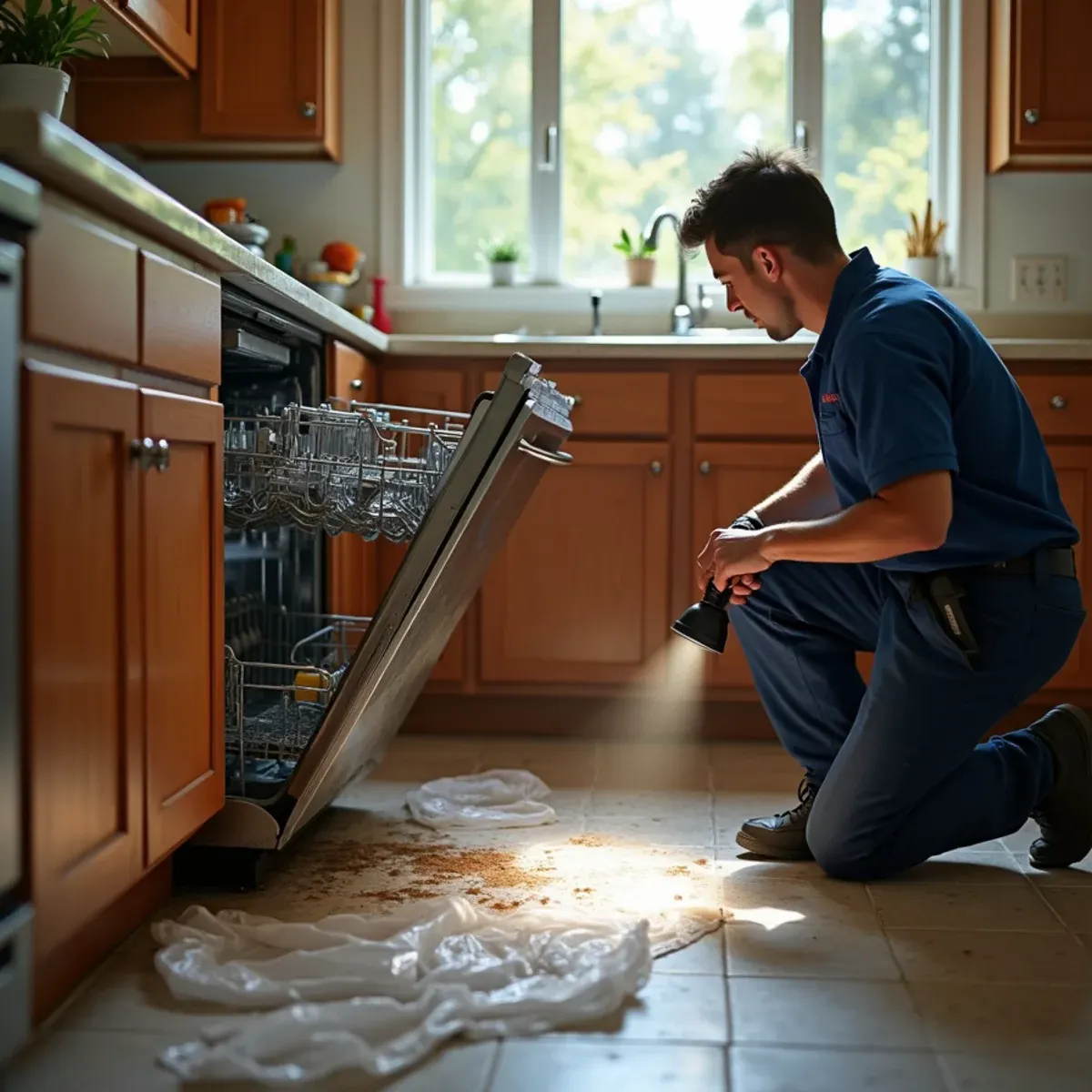
Norwalk went from farmland to a full city in about fifteen years after the war: modest houses on small lots, built fast and built economically, because that was the point. Seventy-odd years later, plenty of them still run original galvanized steel supply. That's the pipe behind your washer, your water heater and your kitchen sink, and it fails from the inside out. Scale narrows the bore, velocity rises, and a corroded fitting gives way. The braided hose usually gets blamed. The fitting upstream is normally the real story.
The lots make the aftermath tighter. There's very little ground between the street and the house to absorb anything, so a water heater dumping in a garage or a side yard has nowhere to soak away and works back toward the foundation instead. Near the San Gabriel River channel along the western edge, those neighborhoods saturate quickly in a wet season. Norwalk's apartment stock brings the other half of our work: shared laundry rooms and hall water heater closets where one failure reaches several units before a manager can be reached.
What Norwalk Changes About Appliance Leaks
1Original galvanized behind the appliances
A large share of Norwalk homes still run their original postwar galvanized supply. It fails from the inside out: scale narrows the bore, velocity rises, and a corroded fitting lets go, usually at the washer connection or the water heater. A new braided hose doesn't solve that. It just puts a tight new joint onto tired metal and moves the weak point along.
2Small lots leave nowhere for water
These postwar lots leave only a few feet between the house and the property line. A water heater failing in a garage or side yard has almost no absorbing ground to run off into, so water pools against the foundation and works back toward the base plate. Near the San Gabriel River channel on the west side, the ground saturates quickly in a wet season.
3Shared laundry rooms in apartment stock
Norwalk carries a substantial apartment stock, much of it with shared laundry rooms and hall water heater closets. One failure reaches several units before a manager can be found after hours. We check the units on either side and below as standard practice, and we document each address separately so the adjusters aren't reading one blended file.
How the Work Runs
The method is the same one we use on every appliance leaks job, documented to the IICRC S500:2025 standard. Here it is in short — the full appliance leak water damage cleanup process explains each stage in detail.
- Isolate the supply
- Pull the appliance and read behind it
- Open cabinet bases where needed
- Extract and remove unsalvageable material
- Targeted drying of the enclosed spaces
- Rebuild and reinstall
The Norwalk Background Worth Knowing
The homes built in Norwalk during the postwar surge were built to be affordable and built fast, which was exactly the right priority at the time. Seventy years later, some of those choices have consequences.
There is more on the housing stock, drainage and plumbing history of this city on our water damage restoration in Norwalk page.
Norwalk at a glance
- Dominant construction era
- 1945–1960
- Foundation type
- slab on grade
- Supply piping found here
- original galvanized steel
- Drain line materials
- cast iron
- Terrain and water table
- flat, moderate water table
- Most common local failure
- original galvanized supply lines failing after decades of internal scaling and erosion at fittings
- Highest-value local prevention
- clearing yard and area drains before the season, since small lots leave little ground between the street and the house
What It Costs in Norwalk
We do not quote a number over the phone before seeing the property — anyone who does is guessing. The variables that actually move the price on a appliance leaks job are slow leak versus sudden failure, how much cabinetry is affected, subfloor condition, and they are broken down in full on the appliance leak water damage cleanup page. The assessment and the written estimate are free anywhere in Norwalk, day or night, with no obligation.
Appliance Leaks Questions from Norwalk Homeowners
Look at the exposed pipe at the water heater or under the kitchen sink. Galvanized is dull gray steel with threaded joints and often a rust-colored crust at the fittings, while copper is unmistakable once you've seen the two side by side. A magnet sticks to galvanized and not to copper. Low pressure at one fixture, rusty water after a vacation, or a stop that won't turn all point the same direction.
Yes. Dishwasher leaks run backward and sideways under the unit into the cabinet bases and subfloor, which is why the visible floor often looks untouched. A free moisture reading takes twenty minutes and will tell you definitively whether anything behind or beneath is wet.
Often only the affected base or toe-kick, not the whole box. Particleboard bottoms that have swollen and delaminated have to be replaced, but the cabinet frame, doors, and countertop can usually stay. We repair at the smallest reasonable scope.
If it is original galvanized from the postwar build-out, it has exceeded any reasonable service life. If you have had one failure, a second is a matter of when. The cheapest moment to repipe is while walls are already open for a repair — the demolition and patching are already in the scope.