
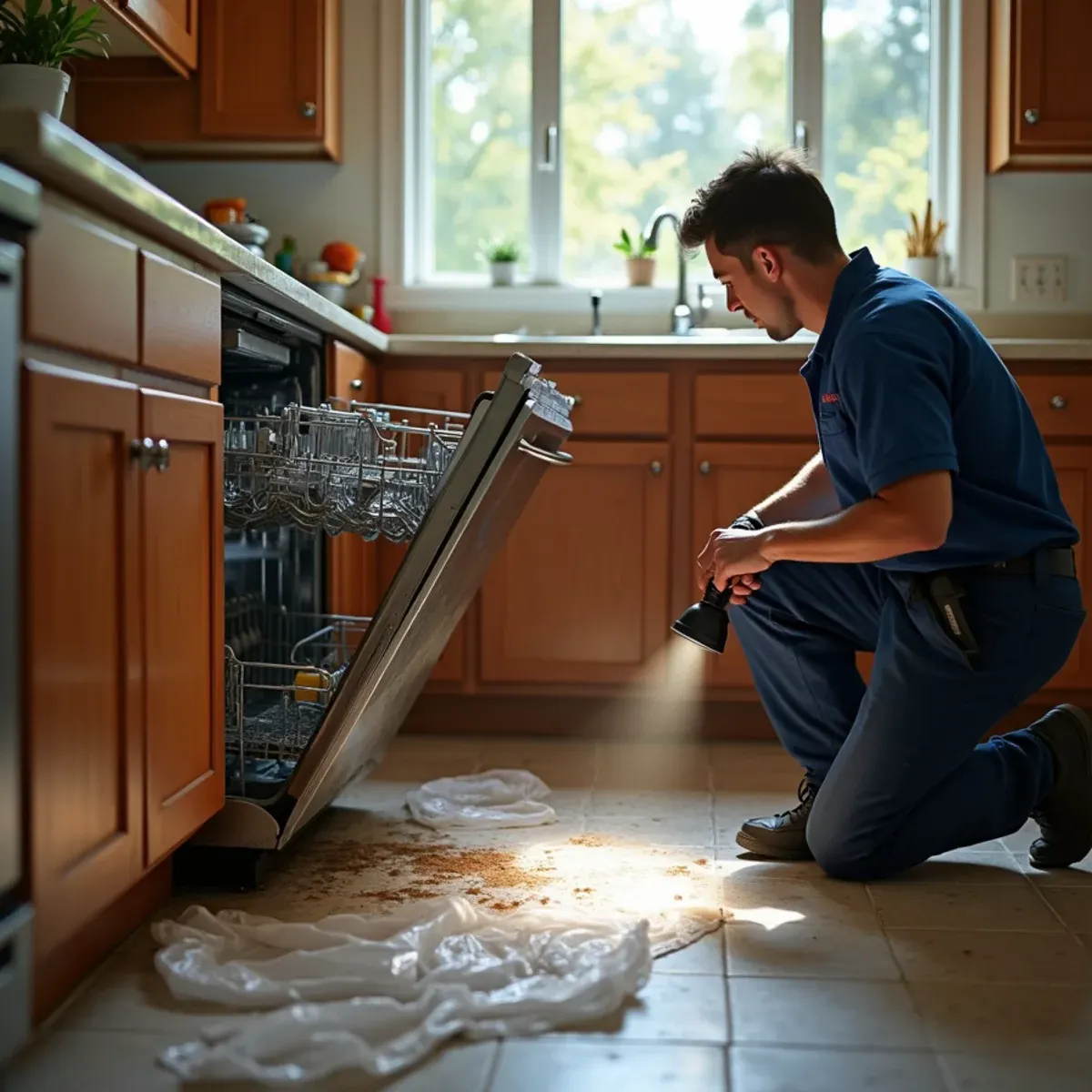
Brea is an oil town that turned into a hillside suburb, and the appliance work splits along that line. Near downtown, the small 1920s houses built for oil-field families have galvanized supply lines, laundry on a back porch and floors that were never meant to get wet. Up toward Carbon Canyon and Olinda Ranch, the 1990s and 2000s tracts have PEX, upstairs laundry rooms and sealed floor cavities. A washing machine hose bursts the same way in both places. What happens in the ten minutes afterward has almost nothing in common.
In the older houses the first problem is often the shutoff itself. Galvanized angle stops behind a washer that has not been moved in forty years will round off or snap before they close, so the water keeps running while somebody hunts for the main in the parkway. In the hillside tracts the valve works fine and the problem is geometry: a leak on the upper floor of a house stepped into a slope ends up two levels down in a garage or a bonus room. We are about eighteen minutes south of you in Cypress.
What Brea Changes About Appliance Leaks
1Seized shutoffs in downtown-era homes
On the small early-century houses around downtown, the laundry and dishwasher stops are frequently original galvanized parts that have not been turned since installation. Know where your main shutoff is at the street before you need it, because that is realistically your only working valve. When we arrive we stop the water first and worry about extraction second, and we will point out which stops need a plumber before you put the room back together.
2Mixed foundations change the drying plan
Brea does not have one foundation type. Older houses near downtown may be raised, on a crawl space, or on an early slab, sometimes within the same block, and a few have additions that combine both. That determines whether an appliance leak drops out of sight or spreads across a floor. We confirm what is under your kitchen before we set a single air mover, because guessing wrong costs a day.
3Upstairs laundry in Olinda Ranch and Blackstone
The newer hillside tracts put washers on the second floor, sometimes directly above a two-story entry. Water follows the framing down interior walls and shows up as a stain far from the source. We trace it with thermal imaging and confirm with a meter rather than opening walls hopefully, and we check the garage ceiling, which on a stepped hillside plan is where this water usually stops.
How the Work Runs
The method is the same one we use on every appliance leaks job, documented to the IICRC S500:2025 standard. Here it is in short — the full appliance leak water damage cleanup process explains each stage in detail.
- Isolate the supply
- Pull the appliance and read behind it
- Open cabinet bases where needed
- Extract and remove unsalvageable material
- Targeted drying of the enclosed spaces
- Rebuild and reinstall
The Brea Background Worth Knowing
Brea's hillside tracts were designed to handle rain. Terrace drains catch runoff partway up a slope, v-ditches carry it around the toe, area drains take the flat yard, and everything ties into a system that moves water past the house rather than through it. The design works. What fails is maintenance. Over a dry summer those inlets fill with eucalyptus leaf litter, decomposed granite, and whatever the wind brought down the canyon, and nobody looks at them because they sit on a slope behind a fence. The first hard storm of the season finds every one that is blocked.
There is more on the housing stock, drainage and plumbing history of this city on our water damage restoration in Brea page.
Brea at a glance
- Dominant construction era
- 1920–2005
- Foundation type
- mixed on grade
- Supply piping found here
- galvanized steel, under-slab copper, PEX in newer hillside tracts
- Drain line materials
- cast iron, clay, ABS
- Terrain and water table
- hillside-mixed, deep water table
- Most common local failure
- canyon and hillside runoff overwhelming slope drainage during concentrated storms
- Highest-value local prevention
- keeping Carbon Canyon-side slope drains, v-ditches and downspout extensions genuinely clear
What It Costs in Brea
We do not quote a number over the phone before seeing the property — anyone who does is guessing. The variables that actually move the price on a appliance leaks job are slow leak versus sudden failure, how much cabinetry is affected, subfloor condition, and they are broken down in full on the appliance leak water damage cleanup page. The assessment and the written estimate are free anywhere in Brea, day or night, with no obligation.
Appliance Leaks Questions from Brea Homeowners
Yes, and it is a small job compared to what we get called for. On a house of that age, ask a licensed plumber to swap the old stops for quarter-turn ball valves in a modern laundry box, and put new braided stainless hoses on at the same time. Then keep to the five-year replacement rule on the hoses. We do restoration rather than plumbing repair, so we will tell you what failed and why, but the valve work is a plumber's.
Yes. Dishwasher leaks run backward and sideways under the unit into the cabinet bases and subfloor, which is why the visible floor often looks untouched. A free moisture reading takes twenty minutes and will tell you definitively whether anything behind or beneath is wet.
Often only the affected base or toe-kick, not the whole box. Particleboard bottoms that have swollen and delaminated have to be replaced, but the cabinet frame, doors, and countertop can usually stay. We repair at the smallest reasonable scope.
Usually not under a standard homeowners policy. Water that runs across the ground and enters a building is surface water, and that is an excluded cause on nearly every form, whether it came off a Carbon Canyon slope or out of the street. Separate flood coverage handles it. Damage from a covered failure is a different story, so let us document the entry point and cause before anything gets cleaned up.