
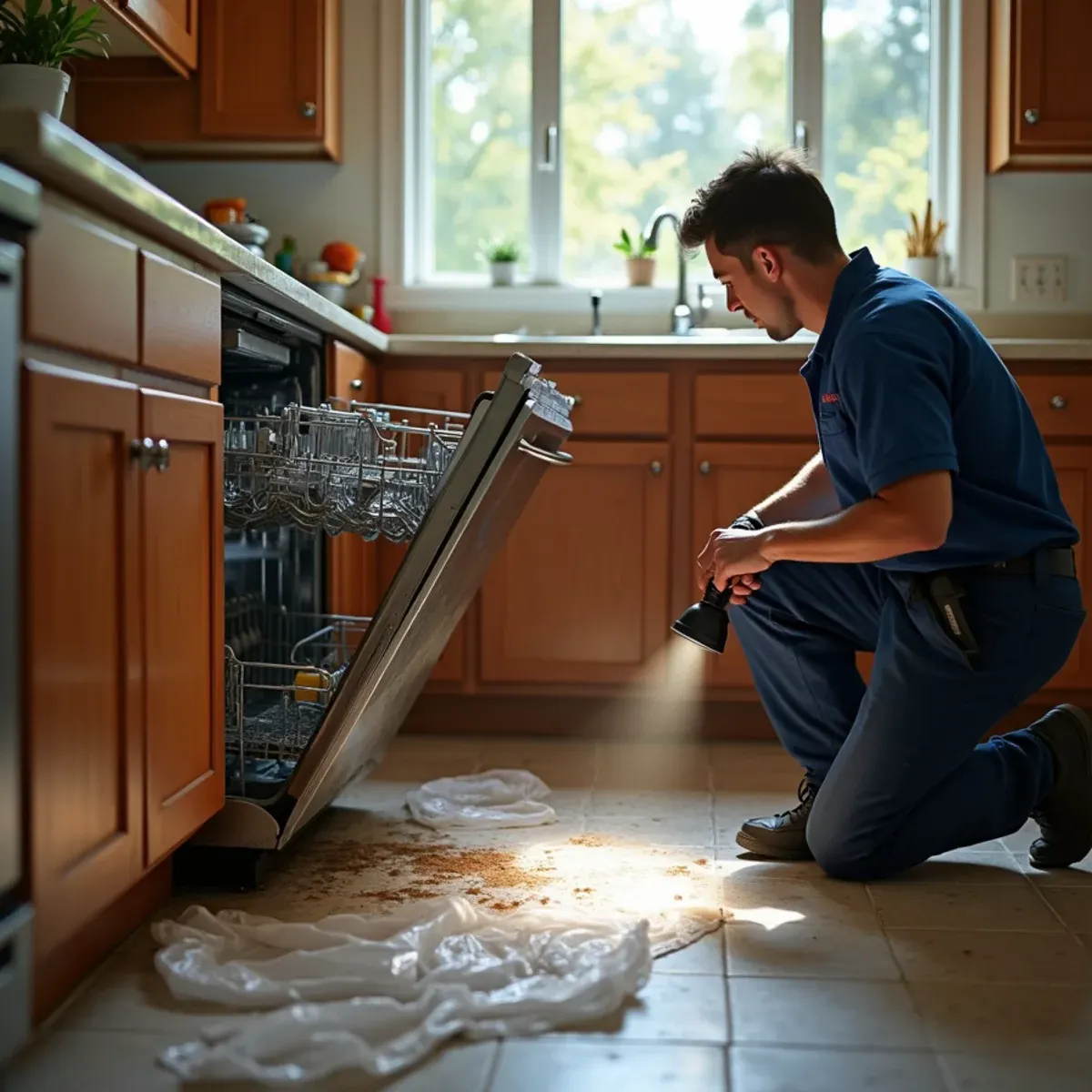
The call usually starts with a damp spot that makes no sense. A wet patch in a hallway, or a bedroom closet with no plumbing anywhere near it. La Habra is not flat. The city sits on gently rolling ground at the head of the Coyote Creek watershed, and the slab tracts poured between 1950 and 1980 follow that grade. Water from a dishwasher or a water heater does not sit where it lands. It runs along the top of the slab under the flooring until something stops it, and that is usually the far wall of a downhill room.
That grade decides where our equipment goes. Drying a slab loss here means finding the real downhill edge of the wet area with a meter instead of assuming a circle around the appliance. The tract stock is uniform enough that we already know where the laundry wall and the garage water heater usually sit, which speeds up the mapping considerably. The apartments along the Whittier Boulevard corridor add a second problem, where one washer affects three households. Coyote Creek runs from here down past our Cypress shop, about seventeen minutes away.
What La Habra Changes About Appliance Leaks
1Mapping wet slab downhill from the appliance
We start at the appliance and work outward in a grid, but we weight the search toward the low side of the house, because that is where the water went. Baseboards come off at intervals so we can read the bottom plate and the slab edge. Skipping that mapping is how a job ends with a dry kitchen and a mildew smell in a bedroom four weeks later.
2Garage water heaters in 1960s tract plans
La Habra's postwar plans put the tank in the garage, often at the uphill corner, which is the worst possible spot. When it fails, gravity carries the water through the house rather than out the garage door. If your garage floor slopes inward, a pan piped to daylight and a drip tray alarm are worth the small cost, and we will show you the path the water took on your own slab.
3Stacked apartments on the corridors
The multi-family stock along Whittier Boulevard and near Idaho Street puts washers above other people's ceilings. These jobs need access to two or three units, a scope for each, and readings taken before anything is removed, because separate policies are usually involved. We coordinate with the property manager and dry the shared assemblies as one system, since drying one unit and leaving the cavity wet solves nothing.
How the Work Runs
The method is the same one we use on every appliance leaks job, documented to the IICRC S500:2025 standard. Here it is in short — the full appliance leak water damage cleanup process explains each stage in detail.
- Isolate the supply
- Pull the appliance and read behind it
- Open cabinet bases where needed
- Extract and remove unsalvageable material
- Targeted drying of the enclosed spaces
- Rebuild and reinstall
The La Habra Background Worth Knowing
Copper is good pipe. What it is not is immortal, and the way it went in during this era shortened its life. Soft copper tubing was laid in the sand under the slab before the pour, sometimes in direct contact with aggregate, often with tight bends that thinned the wall on the outside of the curve. Add fifty to seventy years of water moving through the inside and soil chemistry working on the outside, and it develops pinholes. The hot line almost always goes first, because heat accelerates every part of that process.
There is more on the housing stock, drainage and plumbing history of this city on our water damage restoration in La Habra page.
La Habra at a glance
- Dominant construction era
- 1950–1980
- Foundation type
- slab on grade
- Supply piping found here
- under-slab copper, galvanized steel
- Drain line materials
- cast iron
- Terrain and water table
- rolling, moderate water table
- Most common local failure
- under-slab copper failures in 1960s tract housing, plus drainage that decades of added hardscape has redirected
- Highest-value local prevention
- watching where water actually runs during the first storm, because the ground here is not flat
What It Costs in La Habra
We do not quote a number over the phone before seeing the property — anyone who does is guessing. The variables that actually move the price on a appliance leaks job are slow leak versus sudden failure, how much cabinetry is affected, subfloor condition, and they are broken down in full on the appliance leak water damage cleanup page. The assessment and the written estimate are free anywhere in La Habra, day or night, with no obligation.
Appliance Leaks Questions from La Habra Homeowners
Usually not all of it. Carpet itself often survives; the pad underneath rarely does, and on a sloping slab like yours the wet pad extends further downhill than the visible stain. We lift the carpet along the low wall, remove wet pad, dry the slab with airflow underneath, then reinstall and stretch. If the water sat for days or came from a drain rather than a supply line, the carpet goes too, and we will say so up front.
Yes. Dishwasher leaks run backward and sideways under the unit into the cabinet bases and subfloor, which is why the visible floor often looks untouched. A free moisture reading takes twenty minutes and will tell you definitively whether anything behind or beneath is wet.
Often only the affected base or toe-kick, not the whole box. Particleboard bottoms that have swollen and delaminated have to be replaced, but the cabinet frame, doors, and countertop can usually stay. We repair at the smallest reasonable scope.
Do a meter test. Shut off every fixture and the irrigation, note the leak indicator, and check it again a few hours later with nobody using water. If it moved, something is losing water. In 1960s La Habra tract homes that is most often the hot line under the slab, and the giveaway is a warm patch of floor or the sound of water running behind a closed system.