
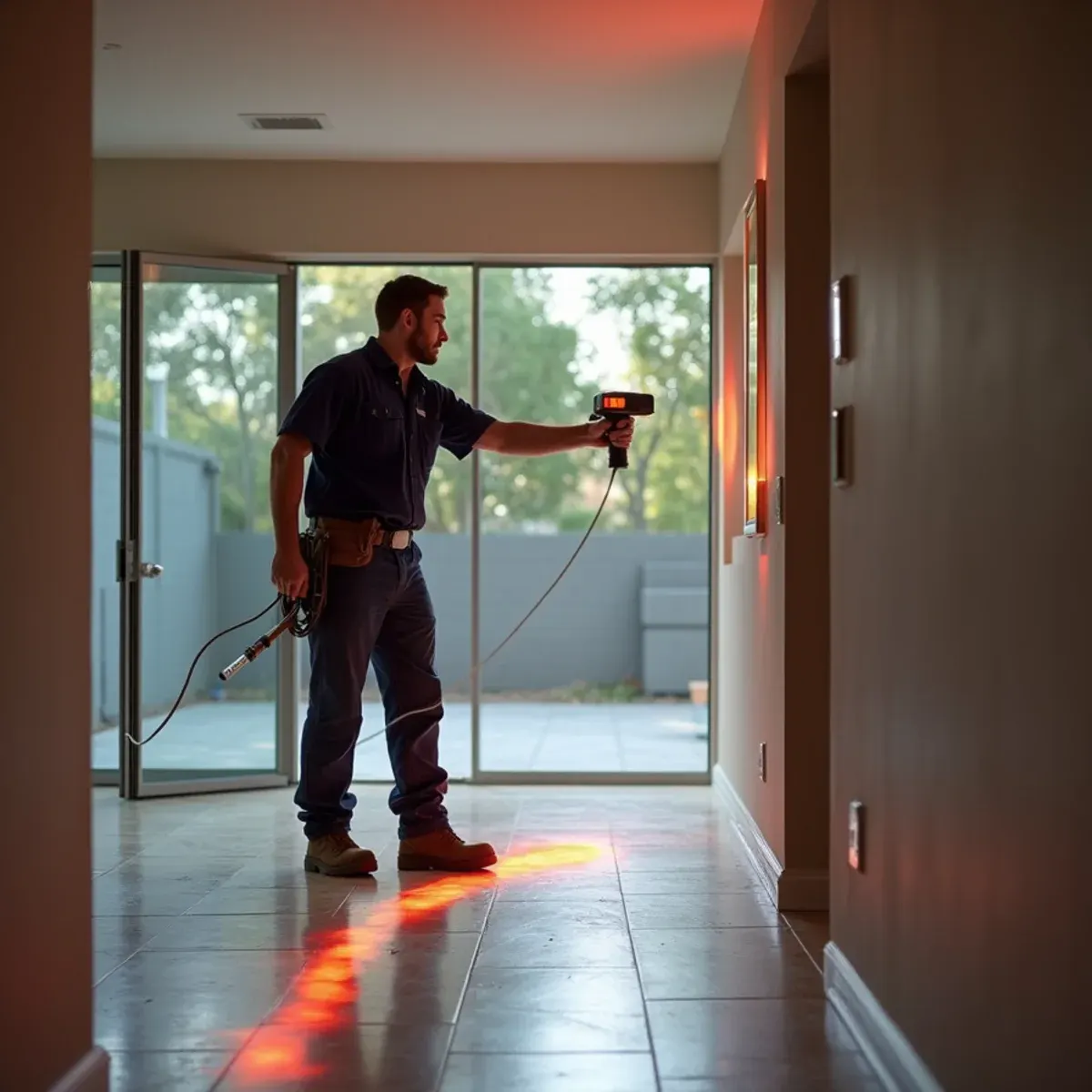
The call usually comes in like this: the carpet in the back bedroom is soaked, nothing above it is wet, and the plumber says the leak is at the other end of the house. That's normal in La Habra. The ground here rolls gently — this is the head of the Coyote Creek watershed, the same creek that runs past our shop in Cypress — and the slabs were poured on that grade. Water leaving a pinhole under the kitchen runs downhill inside the slab and comes up wherever it can.
Nearly all of the residential stock went in between 1950 and 1980 with under-slab copper, some of it preceded by galvanized. Sixty-plus years in, the hot-side returns are the usual failures. The other complication is what's been added since: patios, room additions, driveway extensions and hardscape poured over the original slab edge. A spot repair that would have been easy in 1968 may now sit under six inches of unreinforced concrete somebody poured over a weekend.
What La Habra Changes About Slab Leak Damage
1The wet spot is downhill of the leak
La Habra's rolling grade means water leaving a pinhole travels under the slab before it surfaces. We routinely find the failure fifteen or twenty feet uphill of the wet carpet, usually on a hot-side run. Cutting where the floor is wet gets you an expensive hole and no pipe, which is why we locate acoustically and thermally before anybody picks up a saw.
2Hardscape poured over original slab edges
Sixty years of patios, driveway widenings and room additions have buried much of the perimeter where a spot repair would otherwise be simple. We find lines running under later concrete that nobody permitted or documented. Sometimes that changes the recommendation entirely — a reroute through the attic beats breaking through two layers of slab poured thirty years apart.
3Apartment slabs along the corridors
The multi-family stock along Whittier Boulevard and near downtown shares slabs and shutoffs across units. One leak can wet two or three apartments, and the isolation point may not be inside the affected unit at all. We work with management to find the right valve fast, because minutes of continued flow across a shared slab turns one claim into several.
How the Work Runs
The method is the same one we use on every slab leak damage job, documented to the IICRC S500:2025 standard. Here it is in short — the full slab leak water damage repair process explains each stage in detail.
- Confirm it is actually a slab leak
- Electronic leak location
- Choose the repair approach with you
- Dry the slab and the affected assemblies
- Address the flooring and wall base
- Restore the floor and finish
The La Habra Background Worth Knowing
Copper is good pipe. What it is not is immortal, and the way it went in during this era shortened its life. Soft copper tubing was laid in the sand under the slab before the pour, sometimes in direct contact with aggregate, often with tight bends that thinned the wall on the outside of the curve. Add fifty to seventy years of water moving through the inside and soil chemistry working on the outside, and it develops pinholes. The hot line almost always goes first, because heat accelerates every part of that process.
There is more on the housing stock, drainage and plumbing history of this city on our water damage restoration in La Habra page.
La Habra at a glance
- Dominant construction era
- 1950–1980
- Foundation type
- slab on grade
- Supply piping found here
- under-slab copper, galvanized steel
- Drain line materials
- cast iron
- Terrain and water table
- rolling, moderate water table
- Most common local failure
- under-slab copper failures in 1960s tract housing, plus drainage that decades of added hardscape has redirected
- Highest-value local prevention
- watching where water actually runs during the first storm, because the ground here is not flat
What It Costs in La Habra
We do not quote a number over the phone before seeing the property — anyone who does is guessing. The variables that actually move the price on a slab leak damage job are how long the leak ran undetected, flooring type over the leak, repair method chosen, and they are broken down in full on the slab leak water damage repair page. The assessment and the written estimate are free anywhere in La Habra, day or night, with no obligation.
Slab Leak Damage Questions from La Habra Homeowners
Both can be true. On La Habra's sloping ground, water under a slab runs to the low side of the house before it finds a path up through the concrete or along a crack. The wet bedroom is where it surfaced; the hallway is where it left the pipe. A proper locate confirms the source by sound and thermal signature, not by where the carpet is soaked.
The meter test is the first step: shut off every fixture and watch the low-flow indicator. If it moves and nothing is wet above the floor, suspect the slab. Warm spots on the floor, running-water sounds from below, and flooring that lifts or cups without an obvious cause all point the same direction. We confirm it with thermal imaging and moisture mapping at no charge.
Not always. Depending on where the leak is and the condition of the system, rerouting the line overhead through the attic and walls avoids opening the concrete entirely. When a spot repair is the better option, precise electronic location keeps the opening small — typically a couple of feet, not a trench across the room.
Do a meter test. Shut off every fixture and the irrigation, note the leak indicator, and check it again a few hours later with nobody using water. If it moved, something is losing water. In 1960s La Habra tract homes that is most often the hot line under the slab, and the giveaway is a warm patch of floor or the sound of water running behind a closed system.