
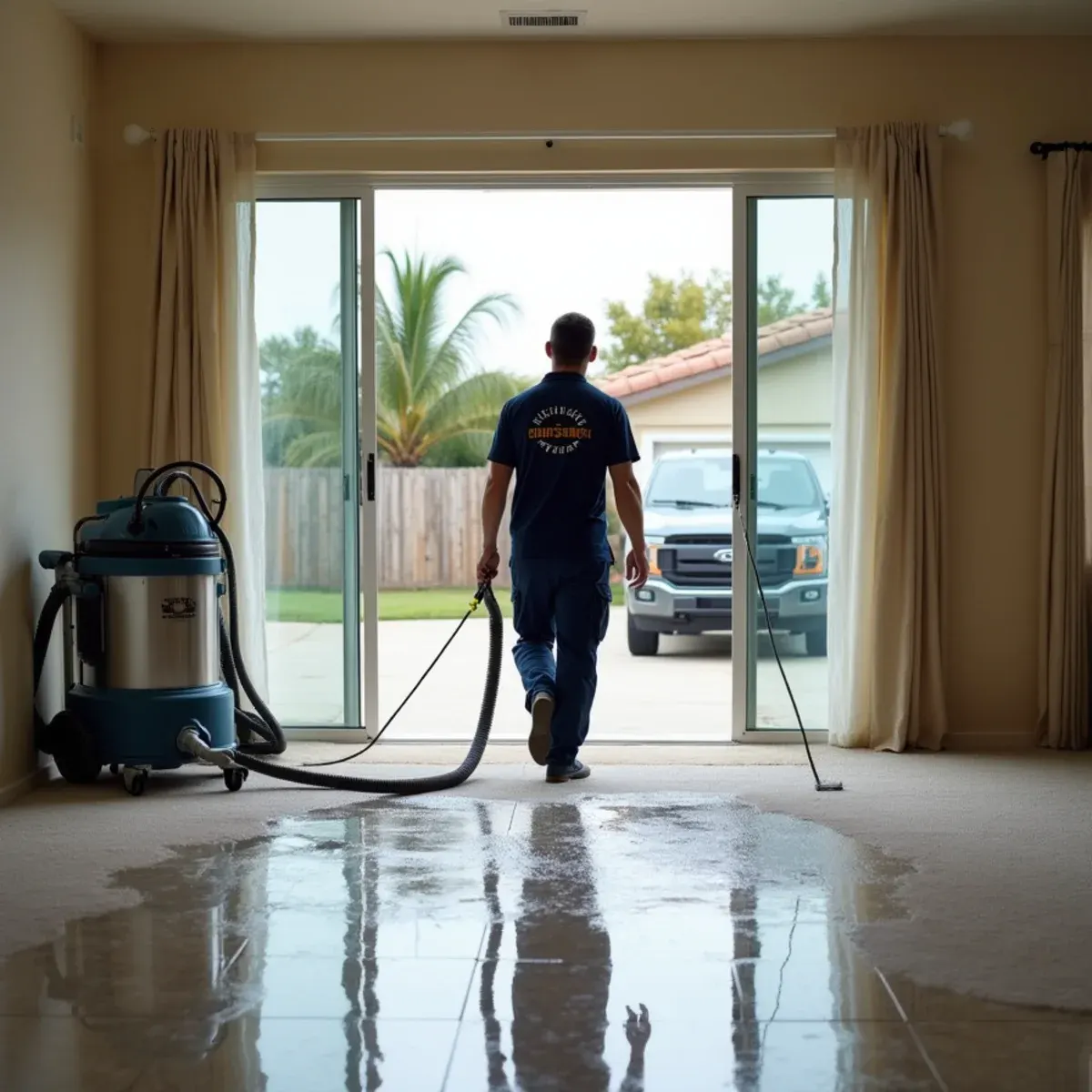
Here's something that surprises people: the ground under La Habra is not flat, and that decides where your water went. Homes across Westridge, Vista Grande and the Idaho Street area sit on gently rolling terrain, and their slabs were poured to follow it. When a supply line fails in a hallway, the water doesn't spread in a neat circle — it runs to the low side of the house and pools against whatever wall is there. We've walked into plenty of La Habra homes where the wettest room was three rooms away from the leak.
So extraction starts at the low end and works back toward the source. That's the opposite of what most people expect, and it matters because pulling water near the leak first just lets the far end keep sitting. The 1950s-to-1980s tract stock here runs under-slab copper and galvanized, and the drain side is cast iron, so we see both pressurized failures and slow drain leaks. La Habra also sits at the head of the Coyote Creek watershed — the same creek that runs past our Cypress base — and decades of added hardscape have redirected surface flow in ways the original grading never anticipated.
What La Habra Changes About Water Extraction
1Find the low corner before extracting
On rolling ground, the visible wet area rarely marks the deepest saturation. We meter a full perimeter and identify where the slab falls before running equipment. Starting extraction at the low wall keeps water from continuing to feed there while we work, and it usually tells us where the wall base and any built-in cabinetry need to be opened.
2Hardscape has rerouted surface water
Patio pours, driveway extensions and raised planters added over sixty years have changed where storm water goes on these lots. That shows up as water entering at a threshold nobody thought was low. After we finish extraction, we walk the exterior with you and note where the ground now slopes toward the house, because that's the difference between a one-time loss and an annual one.
3Cast-iron drain leaks read differently
A failing cast-iron line under a 1960s slab releases water slowly and often intermittently, so the flooring is damp rather than flooded. There's less to extract and more to remove. We're candid about that: when the loss is a drain-line seepage under a slab, extraction is minor and the real scope is flooring removal, cavity drying and getting a plumber to scope the line.
How the Work Runs
The method is the same one we use on every water extraction job, documented to the IICRC S500:2025 standard. Here it is in short — the full water extraction & removal process explains each stage in detail.
- Bulk removal with submersible pumps
- Truck-mounted extraction on carpet and pad
- Hard-surface and specialty extraction
- Cavity and void extraction
- Removing what cannot be saved
- Post-extraction moisture reading
The La Habra Background Worth Knowing
Copper is good pipe. What it is not is immortal, and the way it went in during this era shortened its life. Soft copper tubing was laid in the sand under the slab before the pour, sometimes in direct contact with aggregate, often with tight bends that thinned the wall on the outside of the curve. Add fifty to seventy years of water moving through the inside and soil chemistry working on the outside, and it develops pinholes. The hot line almost always goes first, because heat accelerates every part of that process.
There is more on the housing stock, drainage and plumbing history of this city on our water damage restoration in La Habra page.
La Habra at a glance
- Dominant construction era
- 1950–1980
- Foundation type
- slab on grade
- Supply piping found here
- under-slab copper, galvanized steel
- Drain line materials
- cast iron
- Terrain and water table
- rolling, moderate water table
- Most common local failure
- under-slab copper failures in 1960s tract housing, plus drainage that decades of added hardscape has redirected
- Highest-value local prevention
- watching where water actually runs during the first storm, because the ground here is not flat
What It Costs in La Habra
We do not quote a number over the phone before seeing the property — anyone who does is guessing. The variables that actually move the price on a water extraction job are volume and depth of water, flooring type, contamination level, and they are broken down in full on the water extraction & removal page. The assessment and the written estimate are free anywhere in La Habra, day or night, with no obligation.
Water Extraction Questions from La Habra Homeowners
That's the normal pattern in La Habra. Your slab follows the rolling ground it was poured on, and water under carpet takes the fall line until a wall stops it. The kitchen may show almost nothing while a bedroom two rooms downhill is saturated to the pad. We meter the whole floor plan rather than the room you noticed, extract from the low end back, and check the bottom plates on every wall the water crossed.
For a typical single-room residential loss, extraction runs one to three hours. Multi-room losses or Category 3 water can take most of a day because of containment setup and material removal. We will give you a realistic timeframe after the walkthrough, before we start.
Often we can save the carpet and only replace the pad, which is the cheaper and less disruptive path. The deciding factors are water category, how long it sat, and whether the pad is a moisture barrier type. Clean water caught quickly usually means the carpet stays.
Do a meter test. Shut off every fixture and the irrigation, note the leak indicator, and check it again a few hours later with nobody using water. If it moved, something is losing water. In 1960s La Habra tract homes that is most often the hot line under the slab, and the giveaway is a warm patch of floor or the sound of water running behind a closed system.