
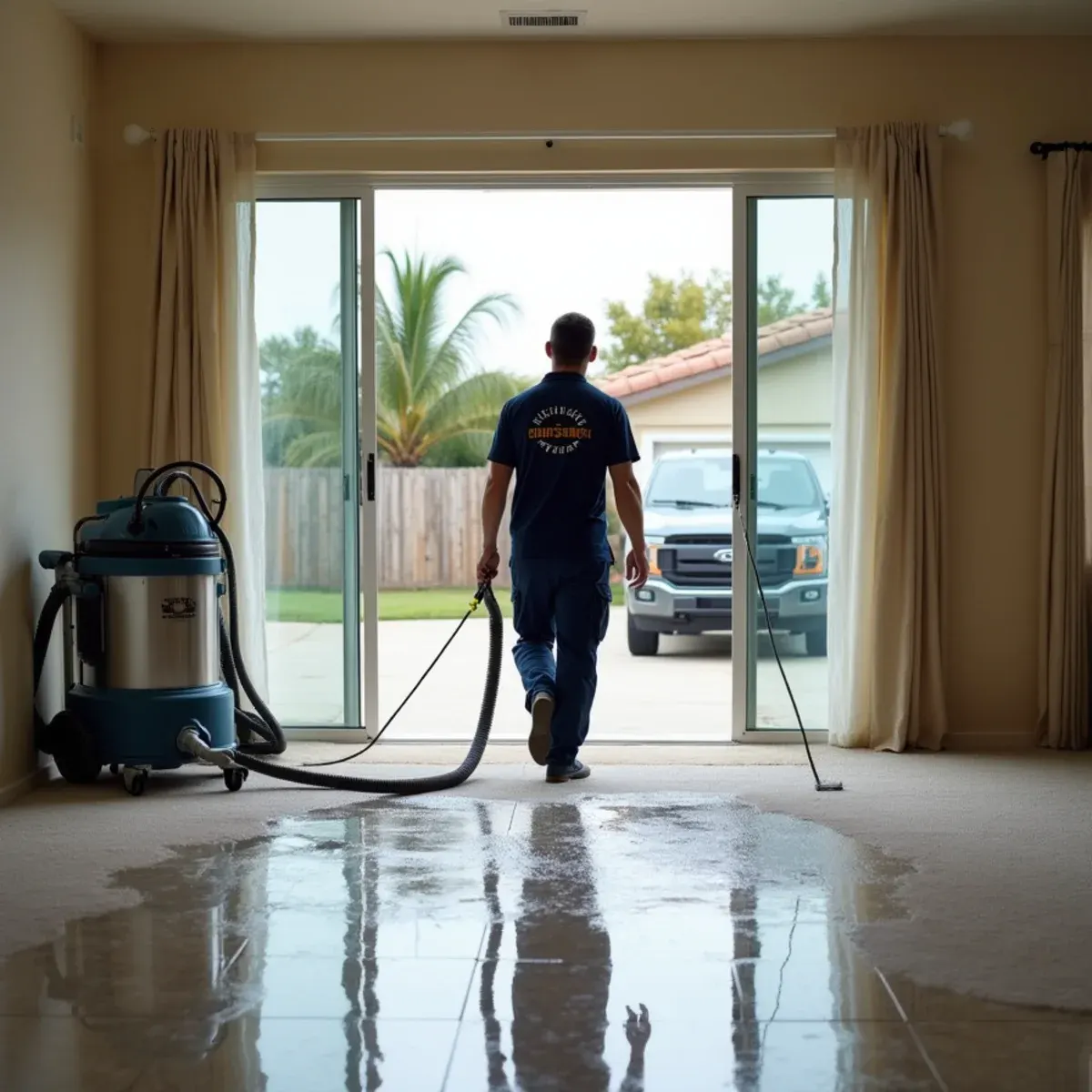
Whittier makes extraction a question of elevation. In College Hills, subdivided in 1923 as the city's first planned hillside development, driveways climb and the front door can sit twenty feet above the street. Vacuum lift works against you on every foot of that rise, so a truck-mounted unit parked at the curb is doing meaningfully less work by the time the wand reaches the house. We stage portable extractors at the level of the loss and shuttle to the truck rather than pretending the numbers don't matter.
Uptown is the other half of the city and the other half of the problem. The late-Victorian, Craftsman and 1920s Spanish Revival homes around Greenleaf Avenue and Philadelphia Street sit on raised foundations, so water leaves the finish floor and collects in the crawl space where nobody sees it. That's pump-and-remove work: free water out of the low corner, saturated insulation cut down and bagged, subfloor and joists metered. East Whittier, by contrast, is conventional postwar slab tract, and the extraction there looks like it does anywhere else in the flatlands.
What Whittier Changes About Water Extraction
1Uphill hose runs cut extraction power
Vertical lift is expensive for a vacuum system. On the steep grades in College Hills and Friendly Hills, hauling water up to a street-parked truck reduces what the wand can actually pull out of pad. We bring portables that sit at the loss, use the truck as the collection point, and where the driveway allows it, reposition the truck up the grade instead of accepting weak extraction throughout.
2Crawl-space pumping under Uptown homes
A leak inside a raised-foundation Uptown house drips through the floor system into the crawl. By the time it's noticed, there's standing water in the low areas and fiberglass batting holding weight between the joists. The extraction is a submersible pump plus physical removal of insulation, not a wand pass upstairs. We open the access on every raised-foundation call, even when the visible damage looks minor.
3Turnbull Canyon runoff during storms
Homes below the canyon and along the Whittier Hills take exterior water that has crossed soil and slope, which puts it in a higher category than a clean supply break. Pad, wet drywall base and particleboard cabinet bottoms come out rather than get dried. We also look at where slope drains discharged, since a plugged one turns a graded hillside into a channel aimed at your side yard.
How the Work Runs
The method is the same one we use on every water extraction job, documented to the IICRC S500:2025 standard. Here it is in short — the full water extraction & removal process explains each stage in detail.
- Bulk removal with submersible pumps
- Truck-mounted extraction on carpet and pad
- Hard-surface and specialty extraction
- Cavity and void extraction
- Removing what cannot be saved
- Post-extraction moisture reading
The Whittier Background Worth Knowing
A leak under a raised foundation does not announce itself the way a slab leak does. There is no puddle on the floor and no warm spot underfoot, because the water drips down into the soil and stays there. What you get instead is a smell that is stronger in the morning, a board that feels slightly soft, and eventually a floor that has been quietly feeding fungal growth for months. By the time an Uptown homeowner calls us about a crawl space leak, the question is rarely how to dry it. It is how much of the joist and subfloor is still doing its job.
There is more on the housing stock, drainage and plumbing history of this city on our water damage restoration in Whittier page.
Whittier at a glance
- Dominant construction era
- 1890–1980
- Foundation type
- mixed on grade
- Supply piping found here
- original turn-of-century piping, galvanized steel, under-slab copper
- Drain line materials
- cast iron, clay
- Terrain and water table
- hillside-mixed, moderate water table
- Most common local failure
- raised-foundation crawl-space leaks in Uptown, and slope drainage failures in the hillside tracts
- Highest-value local prevention
- an annual crawl-space or slope-drain check, depending which Whittier you live in
What It Costs in Whittier
We do not quote a number over the phone before seeing the property — anyone who does is guessing. The variables that actually move the price on a water extraction job are volume and depth of water, flooring type, contamination level, and they are broken down in full on the water extraction & removal page. The assessment and the written estimate are free anywhere in Whittier, day or night, with no obligation.
Water Extraction Questions from Whittier Homeowners
No, and leaving it is the greater risk. Removing standing water from a crawl space relieves load on the soil and stops the moisture supply feeding your floor framing. What we're careful about is not disturbing footings or old brick piers with equipment placement, and not drying so aggressively that century-old joists and subfloor lose moisture too fast. We meter the wood daily and control the rate rather than blasting the space.
For a typical single-room residential loss, extraction runs one to three hours. Multi-room losses or Category 3 water can take most of a day because of containment setup and material removal. We will give you a realistic timeframe after the walkthrough, before we start.
Often we can save the carpet and only replace the pad, which is the cheaper and less disruptive path. The deciding factors are water category, how long it sat, and whether the pad is a moisture barrier type. Clean water caught quickly usually means the carpet stays.
It cuts both ways. A crawl space leak hides longer, because the water drips into soil instead of pooling on your floor, so it often runs for months and reaches the framing before anyone notices. The upside is real though: the plumbing is accessible, so locating and repairing it does not mean breaking concrete. On balance, detection is your weak point in Uptown, which is why an annual look under the house is worth doing.