
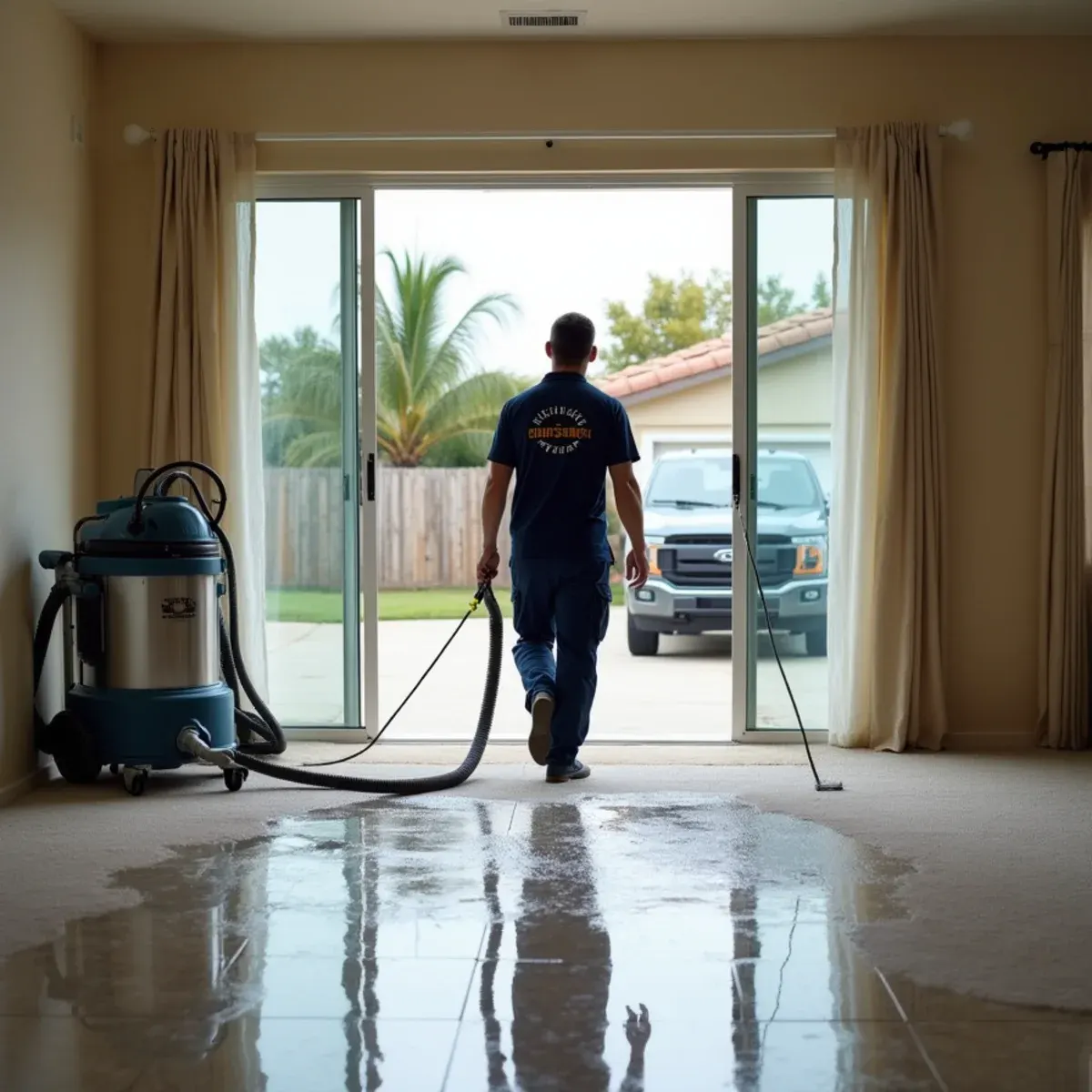
A single fire sprinkler head discharging into a Santa Fe Springs warehouse puts more water on the floor in fifteen minutes than a residential supply break does in an hour. That's the loss we're called for most often here, because this is one of the most industrial cities in this part of Los Angeles County — a warehouse, manufacturing and distribution base along Norwalk Boulevard and the Telegraph Road corridor that dwarfs the residential footprint around Los Nietos. Our work here is loading docks, racking and tenant improvements far more than kitchens.
Open-plan concrete changes the priorities. There are no walls to contain the spread, so water travels the full length of a bay before anything stops it, and it runs under pallet racking where a wand can't reach. Phase one is pumping and squeegeeing volume to collection points. Phase two is getting product off the slab, because cardboard and paper stock wick fast and become the biggest part of the claim. Finish materials — the office build-out, the drywall, the VCT — usually come third, which is the reverse of a residential job.
What Santa Fe Springs Changes About Water Extraction
1Sprinkler water is not clean water
Water sitting in a fire sprinkler system for years picks up scale, corrosion products and biological growth. Under IICRC S500:2025 that's not a Category 1 loss, and it affects what can be saved. Porous materials it contacted — carpet, gypsum board base, saturated packaging — generally come out. We extract, then clean the affected slab rather than simply drying it.
2Racking blocks the extraction path
Water runs under pallet racking and stays there. Extraction under a loaded rack is slow and incomplete, so we work with your team on what can be moved or blocked up and in what order. Product on the bottom shelf of a rack is usually already wicking by the time we arrive, and separating salvageable from unsalvageable early keeps the drying scope from ballooning.
3Access information decides your response time
After-hours failures in industrial buildings stall on logistics: gate codes, alarm contacts, riser room location, main shutoff. We keep that information on file for commercial clients so crews start pumping on arrival. It is the single most useful thing a facility manager here can prepare, and it costs nothing until the night it saves several hours.
How the Work Runs
The method is the same one we use on every water extraction job, documented to the IICRC S500:2025 standard. Here it is in short — the full water extraction & removal process explains each stage in detail.
- Bulk removal with submersible pumps
- Truck-mounted extraction on carpet and pad
- Hard-surface and specialty extraction
- Cavity and void extraction
- Removing what cannot be saved
- Post-extraction moisture reading
The Santa Fe Springs Background Worth Knowing
The water sitting in a wet-pipe sprinkler system has been there for years. It is stagnant, it has been in contact with black steel and scale that whole time, and some systems carry corrosion inhibitors or antifreeze as well. When a head discharges, that is what lands on your floor and soaks into your product. Under IICRC S500:2025 water gets categorized on the evidence in front of us, and sprinkler discharge that has run across a warehouse floor almost never stays in Category 1. That decision drives what we dry in place, what comes out, and how the crew works.
There is more on the housing stock, drainage and plumbing history of this city on our water damage restoration in Santa Fe Springs page.
Santa Fe Springs at a glance
- Dominant construction era
- 1950–1975
- Foundation type
- slab on grade
- Supply piping found here
- galvanized steel, copper, commercial-grade systems
- Drain line materials
- cast iron, commercial waste lines
- Terrain and water table
- flat, moderate water table
- Most common local failure
- fire-sprinkler discharge and commercial supply failures across large open-plan warehouse and manufacturing floors
- Highest-value local prevention
- keeping current building access and shutoff information on file before an after-hours failure
What It Costs in Santa Fe Springs
We do not quote a number over the phone before seeing the property — anyone who does is guessing. The variables that actually move the price on a water extraction job are volume and depth of water, flooring type, contamination level, and they are broken down in full on the water extraction & removal page. The assessment and the written estimate are free anywhere in Santa Fe Springs, day or night, with no obligation.
Water Extraction Questions from Santa Fe Springs Homeowners
Yes. Floor drains handle depth, not saturation. Once the standing water is gone you still have a wet slab, wet racking bases, wet packaging and water that ran under equipment pads and into wall bases. Sprinkler water also carries pipe scale and biological material, so the slab needs cleaning rather than just drying. We extract residual water, remove unsalvageable porous materials, and document readings for your carrier and any business-interruption claim.
For a typical single-room residential loss, extraction runs one to three hours. Multi-room losses or Category 3 water can take most of a day because of containment setup and material removal. We will give you a realistic timeframe after the walkthrough, before we start.
Often we can save the carpet and only replace the pad, which is the cheaper and less disruptive path. The deciding factors are water category, how long it sat, and whether the pad is a moisture barrier type. Clean water caught quickly usually means the carpet stays.
No. Water that has sat in a wet-pipe system for years picks up scale, rust and whatever inhibitors are in the system, and once it runs across a warehouse floor it collects everything on that floor too. We categorize on the evidence per IICRC S500:2025, and sprinkler discharge almost always lands past Category 1. That affects what gets dried in place, what gets removed, and what protective equipment the crew works in.