
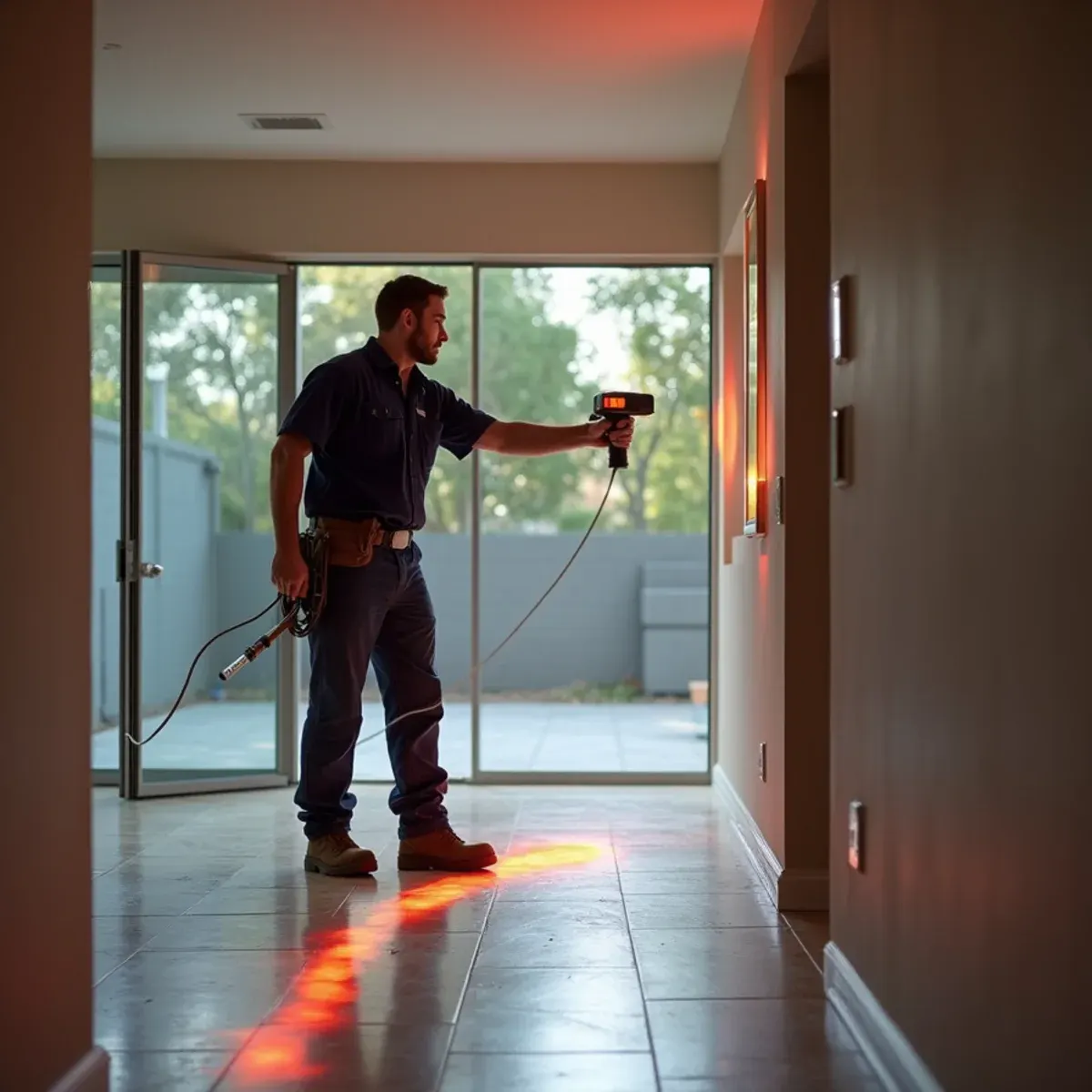
The person who calls us in Santa Fe Springs is usually a facility manager, not a homeowner. This is warehouse, manufacturing and distribution ground with a residential footprint that's small by comparison, so most under-slab supply failures here are beneath sealed, densified concrete floors carrying racking, forklifts and product. Those floors are thicker than residential slabs, often six to eight inches, and the surface treatments that make them durable also make thermal imaging and acoustic listening harder.
Locating is the same physics, executed around your operation. We isolate at the main, watch the meter, and work the floor in sections you can give us, which usually means nights or a weekend rather than a shutdown. Cutting under a loaded rack isn't an option, so the plan has to account for what can be moved and what can't. The residential pockets in Los Nietos are ordinary 1950s to 1970s slab tract, and those we handle the way we'd handle a house anywhere.
What Santa Fe Springs Changes About Slab Leak Damage
1Sealed warehouse floors resist standard locating
Densified, sealed concrete six to eight inches thick behaves differently from a four-inch residential slab. Thermal signatures are muted and acoustic transmission is poor. We compensate with pressure isolation by zone, tracer methods where appropriate, and longer static tests at the meter — and we tell facility managers up front that locating in these buildings takes more time.
2Racking and product set the schedule
We can't cut under a loaded rack, and you can't empty a distribution floor on our timeline. So the sequence gets negotiated: which aisles can be cleared, when, and for how long. Most of our slab work in the Norwalk Boulevard and Telegraph Road industrial parks happens on nights and weekends, in the sections you're able to release.
3Business interruption drives the drying plan
A warehouse floor doesn't need to look finished, but it does need to be dry enough for racking, coatings and forklift traffic. We document with in-situ probes and hand you readings a coatings contractor can act on. IICRC S500:2025 documentation carries more weight on commercial claims, where the carrier will look hard at the drying record.
How the Work Runs
The method is the same one we use on every slab leak damage job, documented to the IICRC S500:2025 standard. Here it is in short — the full slab leak water damage repair process explains each stage in detail.
- Confirm it is actually a slab leak
- Electronic leak location
- Choose the repair approach with you
- Dry the slab and the affected assemblies
- Address the flooring and wall base
- Restore the floor and finish
The Santa Fe Springs Background Worth Knowing
The water sitting in a wet-pipe sprinkler system has been there for years. It is stagnant, it has been in contact with black steel and scale that whole time, and some systems carry corrosion inhibitors or antifreeze as well. When a head discharges, that is what lands on your floor and soaks into your product. Under IICRC S500:2025 water gets categorized on the evidence in front of us, and sprinkler discharge that has run across a warehouse floor almost never stays in Category 1. That decision drives what we dry in place, what comes out, and how the crew works.
There is more on the housing stock, drainage and plumbing history of this city on our water damage restoration in Santa Fe Springs page.
Santa Fe Springs at a glance
- Dominant construction era
- 1950–1975
- Foundation type
- slab on grade
- Supply piping found here
- galvanized steel, copper, commercial-grade systems
- Drain line materials
- cast iron, commercial waste lines
- Terrain and water table
- flat, moderate water table
- Most common local failure
- fire-sprinkler discharge and commercial supply failures across large open-plan warehouse and manufacturing floors
- Highest-value local prevention
- keeping current building access and shutoff information on file before an after-hours failure
What It Costs in Santa Fe Springs
We do not quote a number over the phone before seeing the property — anyone who does is guessing. The variables that actually move the price on a slab leak damage job are how long the leak ran undetected, flooring type over the leak, repair method chosen, and they are broken down in full on the slab leak water damage repair page. The assessment and the written estimate are free anywhere in Santa Fe Springs, day or night, with no obligation.
Slab Leak Damage Questions from Santa Fe Springs Homeowners
Usually yes, with planning. We start with a static meter test after hours and isolate zones so we can narrow the search without opening the whole floor. The cut is then scheduled around what you can clear, aisle by aisle. Full shutdowns are rare. What we do need is honest access information, current shutoff locations, and somebody with authority to approve a cut at night.
The meter test is the first step: shut off every fixture and watch the low-flow indicator. If it moves and nothing is wet above the floor, suspect the slab. Warm spots on the floor, running-water sounds from below, and flooring that lifts or cups without an obvious cause all point the same direction. We confirm it with thermal imaging and moisture mapping at no charge.
Not always. Depending on where the leak is and the condition of the system, rerouting the line overhead through the attic and walls avoids opening the concrete entirely. When a spot repair is the better option, precise electronic location keeps the opening small — typically a couple of feet, not a trench across the room.
No. Water that has sat in a wet-pipe system for years picks up scale, rust and whatever inhibitors are in the system, and once it runs across a warehouse floor it collects everything on that floor too. We categorize on the evidence per IICRC S500:2025, and sprinkler discharge almost always lands past Category 1. That affects what gets dried in place, what gets removed, and what protective equipment the crew works in.